
Reduce Retail Shrink With Security Guards: A Step-by-Step Plan
Cut retail shrink with a security guard plan covering deployment, training, and measurable outcomes. See the step-by-step method to protect your profit.
Last Updated: November 1, 2026
Quick Summary
Reduce retail shrink with security guards by deploying trained officers to deter theft, observe high-risk zones, and document incidents under written post orders. Match guard coverage to your highest-risk zones and peak hours, then review incident data weekly to shift hours where they cut loss most.
- Shrink comes from external theft, internal theft, process errors, and vendor fraud; guards address the first two directly.
- Written post orders should define patrol routes, access control, observation priorities, escalation steps, and prohibited actions.
- Score each store zone for risk, then set coverage hours around peak traffic and shift-change windows.
- Track shrink rate, incident reports, apprehensions, inventory accuracy, and response time monthly to judge guard effectiveness.
- Measure officers on deterrence and documentation, not arrests, to avoid pushing them toward risky interventions.
Table of Contents
- Why Security Guards Belong in Your Retail Shrink Strategy
- Retail Loss Prevention Strategies That Guards Reinforce
- Retail Security Guard Duties: What Officers Should Actually Do
- Step-by-Step: Deploying Guards by Store Zone, Shift, and Risk Level
- Self-Checkout Loss Prevention and Front-End Coverage
- Measuring Retail Shrink and Guard Effectiveness
- Common Mistakes That Undermine Guard-Led Shrink Reduction
- Building Your Guard-Led Shrink Reduction Plan With Ranger Operation Services
- Frequently Asked Questions
Why Security Guards Belong in Your Retail Shrink Strategy
Retail shrink is the value of inventory lost between the moment a store buys goods and the moment it sells them. Shrink eats into profit on every sale, and guards are one of the few controls that work on theft, deterrence, and documentation at the same time.
Here is the part most guides get wrong: guards are not a replacement for inventory controls. They are the human layer that makes every other control work harder.
The Four Sources of Retail Shrink
Shrink comes from four main sources, and each one needs a different fix:
- External theft: shoplifting and organized retail crime
- Internal theft: employee theft and sweetheart deals at the register
- Process errors: bad receiving, pricing mistakes, and paperwork gaps
Guards address the first two directly. They support the last two by watching the receiving process and logging what they see.
Retail Loss Prevention Strategies That Guards Reinforce
Most retail loss prevention strategies work better with a visible officer on the floor. A guard makes deterrence real, and deterrence is cheaper than recovery.
The National Retail Federation's retail security research consistently finds that theft and inventory loss remain top concerns for retailers. Guards support these strategies:
- Visible deterrence: a uniformed presence at entrances and high-value aisles
- Access control: checking employee badges and controlling backroom doors
- Patrols: scheduled and random walks through the sales floor
- Incident reporting: written records that support prosecution and insurance claims
For a deeper look at the full set of tactics, see our guide to retail loss prevention strategies.
Retail Security Guard Duties: What Officers Should Actually Do
Retail security guard duties are often listed in vague terms, which is why so many guard programs underperform. A good officer does three things: deter, observe, and intervene safely. But the difference between a guard who reduces shrink and one who just occupies a chair comes down to written post orders, legal boundaries, and documentation discipline.
Deterrence, Observation, and Safe Intervention
Deterrence means being seen in the right places at the right times.
Observation means watching patterns, not just people. Officers should track high-value merchandise, self-checkout lanes, the backroom door, and the receiving dock.
Safe intervention means knowing the legal limits and the store's written policy. In most states, a private security officer's authority to detain a suspected shoplifter is narrow and varies by jurisdiction.
Written Post Orders: The Document That Makes Duties Real
An officer without a post order is just a person in a uniform. Post orders should be specific to each post and shift, and they should cover:
- Post location and patrol route, where the officer stands, walks, and how often
- Access control rules, which doors are locked, who gets badge checks, how deliveries are logged
- Observation priorities, top-loss SKUs, self-checkout, fitting rooms, backroom, dock
- Escalation ladder, who the officer calls, in what order, and at what threshold
Post orders should be reviewed with store management and updated after every significant incident or audit cycle.
Documentation and Evidence Handling
Incident reports are the guard program's memory. A useful report captures date, time, location, observed behavior, description, witnesses, camera coverage, actions taken, and outcome, without speculation or conclusory language. Reports support prosecution, insurance claims, trespass notices, and civil recovery. Officers should also know how to preserve video evidence: note the camera number and time stamp, and notify the manager or CCTV operator immediately so footage is not overwritten.
Coordination With Store Teams and Systems
Guards who work in isolation miss what cashiers, stockers, and CCTV operators see. A simple protocol works: the officer checks in with the front-end manager at shift start, carries a radio or phone on the store's channel, and receives alerts from the CCTV operator when a camera catches suspicious behavior. Integrating these human elements effectively requires a robust modern security system installation that ensures seamless communication across every corner of the retail floor.
For a direct answer on how officers cut shrink, read how retail loss prevention officers reduce shrink.
Step-by-Step: Deploying Guards by Store Zone, Shift, and Risk Level
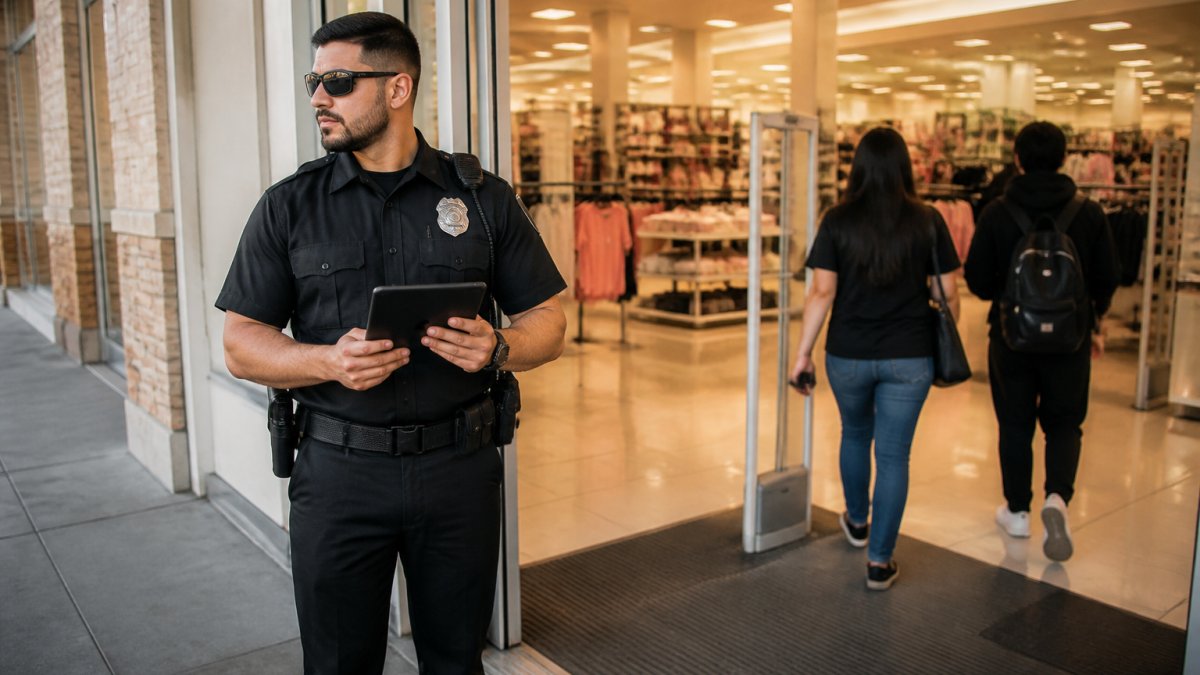
Deploying guards well means matching coverage to risk, not just posting an officer at the door. This section explains how to place, schedule, and escalate guard coverage.
The Six-Step Deployment Process
- Map your store into zones. Entrance, exits, sales floor, high-value aisles, self-checkout, fitting rooms, backroom, and receiving dock. Walk the store with a floor plan and mark every zone.
- Score each zone for risk. Use recent incident reports, inventory audits, cycle counts, and known top-loss SKUs. A simple 1-5 score for theft frequency, value at risk, and visibility gaps is enough to rank zones.
- Set coverage hours by shift. Match shifts to your busiest and highest-risk hours, not just store hours. Most shrink occurs during peak traffic and shift-change windows, so coverage should overlap opening, lunch rush, after-school hours, and closing.
- Assign roles by zone. Entrance officers handle access control and greeting. Floor officers handle patrols and observation. A dock officer handles receiving windows and vendor access.
- Define escalation steps. Write down exactly what an officer does when they see suspicious activity, observe, document, notify the manager, and only then decide whether policy allows intervention.
- Review weekly. Adjust coverage based on incident reports, shrink data, and recovery rates. Move hours from low-yield posts to high-risk zones.
Coverage Matrix by Zone, Risk, and Shift
| Zone | Main Risk | Guard Role | Coverage Window |
|---|---|---|---|
| Entrance | Shoplifting, trespassing, ORC groups | Greet, observe, control access, watch for banned individuals | Peak hours and closing |
| Exits | Push-out theft, receipt fraud | Visible presence, receipt checks where policy allows | Peak hours |
| High-value aisles | Organized retail crime, concealment | Patrol, visible presence, customer engagement | All open hours |
| Self-checkout | Scan avoidance, ticket switching | Monitor, assist, report | Peak hours |
| Fitting rooms | Concealment, tag removal | Attend entry, limit item counts, observe patterns | Peak hours |
| Backroom and dock | Employee theft, vendor fraud | Access control, log deliveries, watch receiving | Receiving windows |
Shift and Peak-Risk Logic
Coverage should follow the shrink clock, not the store clock. A common pattern is heavy loss during the first hour after opening, the lunch and after-school rush, and the last hour before closing, when staffing thins and fitting rooms and exits are less watched. Schedule officer overlap at those windows. If your data shows a specific zone, self-checkout, for example, spiking during certain hours, shift a floor officer there rather than adding a new post.
Escalation Thresholds
Write the escalation ladder into the post orders so every officer responds the same way:
- Low concern: unusual behavior, no clear theft, observe and document.
- Moderate concern: concealment or bypass of checkout, notify the manager, preserve camera coverage, approach only within policy.
- High concern: threat to safety, weapons, or violence, do not intervene physically; call 911 and follow the store's emergency plan.
If you are weighing coverage hours, our article on the benefits of 24/7 security for retail businesses lays out the case for full-time versus limited-shift coverage.
Self-Checkout Loss Prevention and Front-End Coverage
Self-checkout loss prevention depends on attention, and attention is exactly what a guard provides. Self-checkout lanes are a known shrink hotspot because customers can scan wrong, skip items, or switch tags with little friction.
Front-end coverage should include:
- A visible officer near self-checkout during peak hours
- Clear sightlines to every lane
- A written policy for when to intervene versus when to observe and report
- Coordination with cashiers and front-end managers
Surveillance tech and guards work best as a pair. Our guide to integrating surveillance tech with security guards explains how cameras and officers support each other at the front end.
Measuring Retail Shrink and Guard Effectiveness
Measuring retail shrink is the only way to know if your guard program is working. Without numbers, you are guessing.
Track these metrics monthly:
- Shrink rate: inventory loss as a share of sales
- Incident reports: count and type per zone
- Apprehensions and trespass notices: with proper documentation
- Inventory accuracy: from audits and cycle counts
Compare results before and after guard deployment by zone. If one zone improves and another does not, move coverage. That is how a guard-led plan gets sharper over time.
Common Mistakes That Undermine Guard-Led Shrink Reduction
The biggest mistake is hiring guards and giving them no clear instructions. An officer without a post order is just a person in a uniform.
Other common errors we see:
- No written post orders. Officers need clear duties by zone and shift.
- Skipping training on legal limits. Poor apprehension policy creates lawsuits.
- Weak incident reporting. Bad reports cannot support prosecution.
- No integration with store teams. Guards who work alone miss what cashiers see.
Watch out: if you measure officers only by apprehensions, you push them toward risky interventions. Measure deterrence and documentation instead.
Building Your Guard-Led Shrink Reduction Plan With Ranger Operation Services
A guard-led shrink plan works when coverage, training, and reporting line up. Ranger Operation Services provides state-certified Class D and G officers with Level IV training, and deploys within a four-hour window.
Ranger Operation Services has 500+ licensed officers and employees, 24/7 dispatch support, and $5M General Liability insurance. If you are ready to contract, our guide to contracting professional security guard services walks through the process.
Frequently Asked Questions
How can security guards help reduce retail shrink?
Guards reduce retail shrink through visible deterrence, access control, and incident reporting. A uniformed presence at entrances and high-value aisles discourages shoplifting and organized retail crime, while documented patrols and reporting give managers data to tighten inventory control. Guards also support employee theft prevention by enforcing bag checks, staff permissions, and restricted backroom access, and they coordinate with store teams during suspicious activity so incidents are handled safely and legally.
Where should security guards be positioned in a retail store?
Start with the highest-risk zones: entrances and exits, self-checkout lanes, high-value merchandise aisles, and receiving or backroom doors. Position one guard at the front for visible deterrence and access control, and rotate a second through the sales floor on unpredictable patrols. Backroom and receiving areas need coverage during deliveries, when inventory loss is most likely. Adjust postings by shift and shrink data rather than keeping a fixed post all day.
How can stores measure whether security guards are reducing shrink?
Track shrink rate before and after deployment using inventory audits and cycle counts, then compare incident reports, apprehensions, and trespassing records over the same period. Pair those numbers with guard activity logs and video analytics to see whether patrols match theft hotspots. Review results monthly with your security provider and adjust deployment zones, shift coverage, and retail loss prevention strategies based on what the data shows.
What should retail security guards do when they suspect shoplifting?
Guards should observe, document, and deter rather than confront. Customer service-led deterrence, such as offering help or announcing a greeting, often stops theft without escalation. If a guard witnesses a clear incident, they follow the store's written policy and state law on detention, contact a manager, and complete an incident report. Physical intervention is limited to lawful defense of people, and every action is documented to protect the store from liability.
Shrink does not fix itself, and cameras alone will not stop a determined thief. Ranger Operation Services combines trained officers, rapid deployment, and real-time assignment tracking to give your store a defense that actually shows up. Get started with Ranger Operation Services and build a guard-led plan that protects your inventory and your margins.
