
Benefits of 24/7 Security for Retail Businesses
Discover the benefits of 24/7 security for retail businesses, from shrinkage reduction to faster incident response. Learn deployment timeframes and ROI.
Table of Contents
- The Hidden Costs of Retail Theft and Shrinkage
- How 24/7 Security Reduces Shrinkage and Deters Crime
- Retail Loss Prevention Strategies That Work With 24/7 Security
- Remote Guarding vs On-Site Security: Which Fits Your Retail Operation?
- Security Guard Deployment Timeframes: Why Speed Matters
- The ROI of 24/7 Security: Insurance, Liability, and Operational Continuity
- Conclusion
- Frequently Asked Questions
Last Updated: September 28, 2026
The Hidden Costs of Retail Theft and Shrinkage
Retail shrinkage is the loss of inventory from theft, fraud, administrative error, and vendor mistakes, and it quietly erodes margin long before it shows up on a quarterly report. This guide from Ranger Operation Services breaks down the benefits of 24/7 security for retail businesses, from deterrence to insurance savings. Most operators underestimate what shrinkage actually costs because the damage is spread across dozens of small incidents rather than one dramatic heist. A single organized retail crime crew can clear a high-value aisle in under two minutes, and the labor cost of restocking, re-securing, and filing reports often exceeds the stolen merchandise itself.
The hidden costs go well beyond the missing product:
- Lost margin on items that were already discounted
- Overtime pay for staff who stay late to file incident reports
- Higher insurance premiums after repeated claims
- Employee turnover when workers feel unsafe
- Reputation damage when shoppers notice empty shelves or visible theft
Understanding these layers matters because security spending is judged against total loss, not just the sticker price of stolen goods.
How 24/7 Security Reduces Shrinkage and Deters Crime
24/7 security is continuous protection through a combination of on-site personnel, remote monitoring, and surveillance systems that operate around the clock rather than during posted hours alone. The core mechanism is deterrence: visible security presence and real-time monitoring make a store a harder target, which pushes would-be offenders toward easier opportunities. When a uniformed officer is walking the floor and cameras are actively monitored, most casual thieves move on.
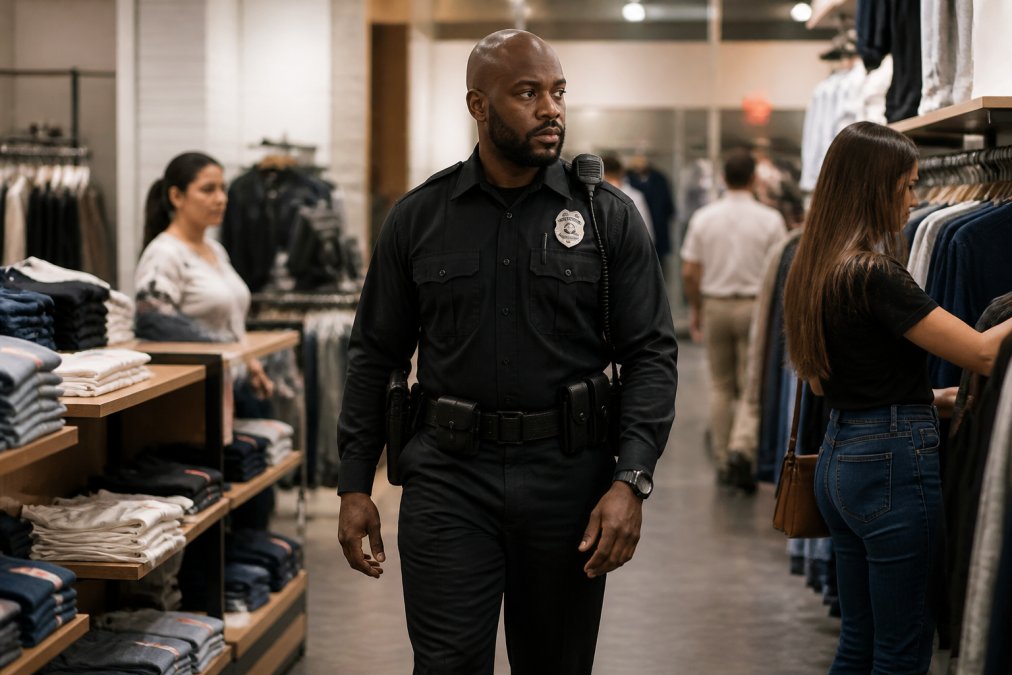
Visible Deterrence and Real-Time Monitoring
Visible deterrence works because offenders assess risk before they act. A camera that records passively is far less effective than a monitored system where a remote operator can speak over an intercom, flag suspicious behavior, or dispatch a mobile patrol within minutes. Real-time monitoring closes the gap between "something happened" and "someone responded." Many loss prevention managers find that the biggest drop in incidents comes not from catching thieves but from making the store look actively watched.
Retail Loss Prevention Strategies That Work With 24/7 Security
Effective retail loss prevention strategies combine people, technology, and process rather than relying on any single measure. The strongest programs layer 24/7 security on top of everyday operational discipline. A common mistake is treating security as a standalone cost center instead of part of how the store runs.
- Access control on stockrooms, receiving docks, and cash offices so only authorized staff enter. Card readers, keypad locks, and door contacts tied to the alarm panel create an auditable trail. When a vendor or employee badge is used after hours, the system logs it, and that log becomes evidence if inventory goes missing.
- Video analytics that flag loitering, shelf sweeps, and after-hours movement. Modern cameras don't just record; they classify behavior. A person standing in the same aisle for more than a set threshold, or a rapid sweep of a high-value shelf, triggers an alert to a monitoring center rather than sitting in storage until someone reviews it.
- Mobile patrolling of parking lots and perimeter areas where theft often starts. Many organized retail crime crews stage vehicles in the lot, move product to a waiting car, and never set off an in-store alarm. A patrol vehicle circling the lot every 30 to 45 minutes disrupts that staging pattern.
- Incident response protocols that every employee knows and can execute. The protocol should specify who calls 911, who locks the doors, who preserves camera footage, and who speaks to responding officers. Without a written protocol, employees improvise, and improvised responses create liability.
- Regular security audits to find blind spots before offenders do. A quarterly walk-through that maps camera coverage against actual floor layout catches gaps that were created when shelving moved or a new display was added.
- Onboarding security training for every new hire, not just loss prevention staff, covering how to report incidents, how to use the panic button, and what to do during a robbery.
- Quarterly refreshers that walk through recent incidents and what worked or failed.
- A no-confrontation policy that tells employees to observe and report rather than physically intervene, which reduces injury risk and liability exposure.
- Recognition for reporting so employees don't feel like they're snitching on coworkers or customers.
Remote Guarding vs On-Site Security: Which Fits Your Retail Operation?
Remote guarding vs on-site security comes down to coverage model, cost structure, and how fast you need a physical response. Remote guarding uses off-site operators monitoring cameras and sensors, while on-site security places licensed officers physically in the store. Each has clear strengths.
| Factor | Remote Guarding | On-Site Security |
|---|---|---|
| Coverage | Multiple sites from one hub | One location at a time |
| Cost structure | Lower per-site cost | Higher labor cost |
| Physical response | Requires dispatch to site | Immediate, on the floor |
| Best for | Low-to-moderate risk, after hours | High-risk, high-traffic stores |
| Deterrence level | Moderate (visible cameras, audio) | High (uniformed presence) |
Security Guard Deployment Timeframes: Why Speed Matters
Security guard deployment timeframes determine whether a security contract actually protects your store or just satisfies a checklist. When an incident is unfolding, the difference between a guard arriving in one hour versus four hours is often the difference between a contained event and a major loss. Speed matters most during three scenarios: active theft in progress, after-hours break-ins, and crowd or conflict situations that can escalate quickly.
The ROI of 24/7 Security: Insurance, Liability, and Operational Continuity
The return on 24/7 security shows up in three places: lower insurance costs, reduced liability, and uninterrupted operations. Shrinkage reduction is the obvious win, but the financial case is stronger when you factor in the costs that don't appear on a theft report.
Insurance Premium Reduction and Liability Limits
Insurance carriers price retail risk based on claims history and the controls a business has in place. Documented security infrastructure, including monitored surveillance, access control, and licensed personnel, can support lower premiums and higher liability limits over time. The key word is documented: insurers want evidence of security protocols, incident logs, and KPI tracking, not just the presence of cameras.
- Alarm verification, a system that confirms a real event before dispatch, which reduces false alarm fees and demonstrates responsible monitoring.
- Camera coverage maps, a floor plan showing camera placement, fields of view, and recording retention periods.
- Access control logs, records showing who entered restricted areas and when.
- Incident reports, a consistent format with dates, times, descriptions, and outcomes.
- Training records, proof that employees have been trained on security protocols.
Business Continuity During Emergencies
Operational continuity during emergencies is the benefit retailers overlook until they need it. A fire alarm, a violent incident, or a power outage can shut a store for a full day, and the lost revenue often dwarfs the original event. Trained security personnel manage evacuations, control access during investigations, and coordinate with emergency response so the store reopens faster. That continuity is part of the ROI, even though it never appears in a shrinkage report.
The Combined Financial Story
When you add shrinkage reduction, insurance savings, liability protection, and continuity together, the ROI case becomes a single narrative rather than four separate line items. Most retailers find that the security spend is justified by any one of these benefits, and the combination makes the decision straightforward. The mistake is evaluating security only against the cost of stolen goods, which understates the value by ignoring the downstream savings.
Conclusion
Retail theft and shrinkage will keep testing every operator's margins, and the stores that respond with layered, always-on protection will hold their ground while others absorb the losses. Ranger Operation Services builds security programs around the realities of retail, with a four-hour statewide deployment guarantee, 24/7 dispatch support, and a team of over 500 licensed officers and employees. A named regional supervisor oversees every account, and the proprietary mobile app gives you real-time assignment tracking from dispatch to completion.
Frequently Asked Questions
How does 24/7 security reduce retail shrinkage?
24/7 security reduces shrinkage by maintaining a constant visible presence that deters both opportunistic and organized theft. Guards can monitor high-risk areas, verify alarms, and respond immediately to incidents. Real-time surveillance and access control prevent unauthorized entry after hours. According to industry data, retailers with continuous security coverage report lower inventory losses because potential thieves avoid stores with active monitoring and personnel.
What is the difference between remote guarding vs on-site security?
Remote guarding uses cameras, sensors, and off-site monitoring to detect and respond to threats, often with two-way audio to warn intruders. On-site security places trained guards physically at your location to deter crime, assist customers, and handle emergencies directly. Remote guarding costs less and covers multiple sites, while on-site guards provide immediate physical intervention and customer service. Many retailers combine both for layered protection.
Is 24/7 security cost-effective for small retail businesses?
Yes, 24/7 security can be cost-effective for small retailers when you factor in avoided losses. Shrinkage, vandalism, and liability incidents carry direct costs that often exceed security expenses. Remote guarding and mobile patrol options offer lower-cost coverage than full-time on-site guards. Additionally, some insurers offer premium discounts for verified security measures, further improving ROI. Start with a risk assessment to identify the most vulnerable hours and allocate coverage accordingly.
What are typical security guard deployment timeframes for retail emergencies?
Deployment timeframes vary by provider and location. Some companies guarantee response within four hours for emergency requests, including nights and weekends. For scheduled coverage, deployment may occur within 24 to 48 hours. When evaluating providers, ask about their 24/7 dispatch capabilities and whether they maintain a standby force. Rapid deployment reduces the window of vulnerability after an incident or during peak risk periods.