
Retail Loss Prevention Strategies 2026: The Complete Guide
Retail loss prevention strategies for 2026: AI tools, guard deployment, organized crime prevention, and operational controls to cut shrink and protect.
Table of Contents
- Retail Loss Prevention Strategies That Actually Work in 2026
- AI-Powered Loss Prevention Tools: Real-Time Monitoring and Fraud Detection
- Retail Security Guard Deployment: Deterrence, Access Control, and Non-Confrontational Apprehension
- Organized Retail Crime Prevention: Strategies for High-Risk Merchandise
- Operational Controls and Process Audits: Inventory Accuracy and Cycle Counting
- Employee Training and Awareness: Building a Loss Prevention Culture
- Psychological Deterrents, Post-Incident Recovery, and Supply Chain Loss
- Conclusion: Your 2026 Loss Prevention Action Plan
- Frequently Asked Questions
Last Updated: September 13, 2026
Retail Loss Prevention Strategies That Actually Work in 2026
Retail loss prevention is the set of operational, technological, and personnel practices a store uses to reduce shrink, protect margins, and keep staff and customers safe. In 2026, theft is more organized, internal fraud is harder to spot, and margins are thinner. This guide from Ranger Operation Services breaks down the retail loss prevention strategies that hold up under real operating conditions.
Most stores lose money not because they lack cameras, but because their loss prevention program is a stack of disconnected tactics with no framework (nrf.com). Fix the framework and the tactics start working.
The 2026 Threat Landscape: Organized Crime and Internal Fraud
Two forces dominate loss in 2026: organized retail crime and internal fraud. Organized crews work in teams, hit multiple locations in a day, and resell online within hours (nrf.com). Internal fraud is quieter and often costlier per incident.
They require different responses: organized crime is a deterrence and response problem; internal fraud is a controls and audit problem. Treating them the same wastes money on both.
A common mistake is assuming cameras solve both. Cameras document theft after the fact, rarely prevent a determined crew, and do almost nothing against a cashier who knows the blind spots.
Separate your budget: deterrence spending goes to visible controls and staffing; fraud prevention goes to transaction monitoring, access control, and cycle counting.
How to Build Your Loss Prevention Framework
A loss prevention framework is a written system connecting risk assessment, controls, monitoring, and response into one repeatable cycle. Without it, every incident becomes a one-off scramble.
Build it in five steps:
- Assess risk by category. Rank merchandise by theft rate, resale value, and margin impact.
- Map your controls. For each risk, name the control that addresses it: physical, procedural, or technological.
- Assign ownership. Every control needs a named person accountable for it.
- Set measurement. Track loss prevention KPIs like shrink rate, inventory accuracy, and incident frequency.
- Review quarterly. Threats shift. A framework that never updates is already obsolete.
The National Retail Federation's [retail security(/services/unarmed-security-guards) resources | nrf.com] are a reasonable starting reference for structuring this cycle, though your own incident data should drive the specifics.
AI-Powered Loss Prevention Tools: Real-Time Monitoring and Fraud Detection
AI-powered loss prevention tools use computer vision and transaction analytics to flag suspicious behavior as it happens, not days later, the biggest change in retail asset protection this decade.
Point-of-Sale Monitoring and Video Management Software
Point-of-sale monitoring watches transaction patterns for fraud signals: excessive voids, repeated no-sales, refunds without a matching return, and discount abuse. Video management software ties each flagged transaction to footage at that register and timestamp.
Together they close the biggest gap in internal theft investigations: instead of pulling hours of footage and hoping, an investigator opens a flagged exception and sees the exact transaction and moment.
Where this falls short: exception reports generate false positives, especially with high legitimate refund volume. Someone must own the review, or the software becomes expensive decoration.
AI-Powered Analytics for Shrinkage Reduction
AI-powered analytics for shrinkage reduction look for patterns across time, staff, shifts, and locations, shrink spiking on a specific shift, or a category disappearing faster than sales data explains.
The honest limitation: these systems need clean input data. If inventory counts are inaccurate, the analytics will confidently point you at the wrong problem. Fix inventory accuracy first, then layer analytics on top.
Retail Security Guard Deployment: Deterrence, Access Control, and Non-Confrontational Apprehension
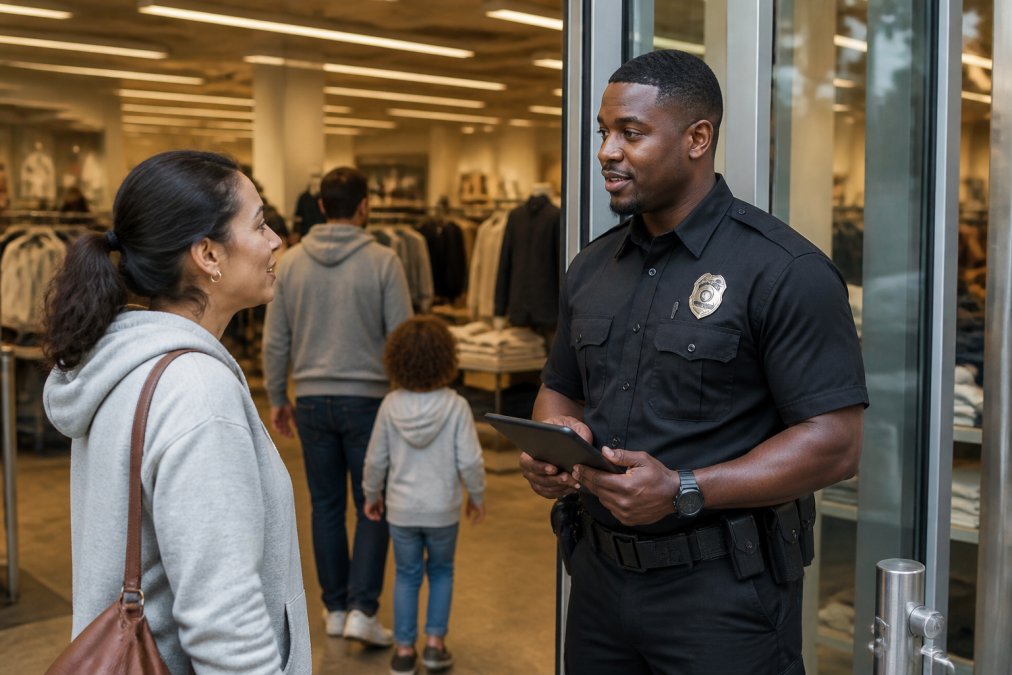
Retail security guard deployment works best when the guard's role is defined before the first shift. A guard told to "keep an eye on things" does neither deterrence nor documentation well; one with a defined post, greeting protocol, and incident process changes the store's risk profile on day one.
The three functions that matter most:
- Deterrence. Visible, professional presence at entry and high-risk aisles. Deterrence is psychological before it is physical.
- Access control. Managing back-of-house doors, receiving areas, and employee entrances, where a large share of internal loss actually occurs.
- Non-confrontational apprehension. Observing, documenting, and coordinating with law enforcement rather than physically intervening. This protects the guard, the store, and the case.
Non-confrontational training is not optional. A guard who physically stops a shoplifter creates liability, injury risk, and often a thrown-out case; one who observes, records, and reports creates evidence.
This is where a provider's training standards matter more than headcount. Ranger Operation Services staffs state-certified Class D and G officers with Level IV training, so the guard at your door understands the difference between deterrence and detention. Ranger's four-hour deployment window and 24/7 dispatch matter when an incident escalates on a Saturday night.
Organized Retail Crime Prevention: Strategies for High-Risk Merchandise
Organized retail crime prevention starts with accepting you cannot secure everything equally. Crews target high-resale electronics, branded apparel, health and beauty, and anything easily moved online.
Protect high-risk merchandise with layered controls:
- Move high-theft items behind a counter or into locked cases
- Apply electronic article surveillance tags to items crews actually target
- Limit display quantities and restock from secured storage
- Vary patrol timing so crews cannot predict coverage windows
The mistake most stores make is uniform protection: equal effort across all categories gives the highest-risk items the same weak coverage as the lowest-risk ones. Concentrate controls where the loss actually is.
Operational Controls and Process Audits: Inventory Accuracy and Cycle Counting
Inventory accuracy is the foundation every other loss prevention strategy sits on. If you don't know what you have, you cannot tell theft from paperwork error. Most guides treat cycle counting as a footnote; in practice, it makes every other control measurable.
Cycle Counting Mechanics That Actually Surface Shrink
Cycle counting means counting small subsets of inventory on a rolling schedule rather than once a year. The annual physical inventory is a snapshot; cycle counting is a continuous audit. The mechanics matter more than the concept:
- Count by ABC classification, not alphabetically. A-items (high value, high velocity, high theft rate) get counted monthly or weekly. B-items quarterly. C-items semi-annually. Counting everything on the same schedule wastes labor on low-risk SKUs and under-counts the ones that actually walk.
- Count blind. The counter should not see the expected on-hand quantity. If they do, they will "find" the number the system wants, and you will never see the discrepancy.
- Count during low-traffic windows. Counting while the floor is being shopped guarantees errors. Open before doors, or count after close.
- Investigate every variance above your threshold, not just the big ones. A pattern of small negative variances on the same SKU is often a bigger signal than one large miss.
- Separate the counter from the reconciler. The person who counts should not be the person who adjusts the system. That separation is the whole point of the control.
Stores typically discover their real shrink rate only after they start counting blind and investigating variances. Before that, they are measuring paperwork, not loss.
Process Audits That Close the Gaps Counts Reveal
Cycle counts tell you that inventory is missing. Process audits tell you where it went. Run them on a fixed cadence, not after a bad quarter:
- Receiving audit. Verify deliveries against the manifest before signing. Count or weigh high-value cartons rather than trusting the pallet label. A signed manifest for goods you never received converts a vendor problem into your shrink.
- Markdown and damage audit. Confirm that markdowns, damages, and destroy-in-field items are recorded in the system, not just pulled from the floor. Unrecorded removals look identical to theft in the data.
- Refund and return audit. Confirm refunds require a matching original transaction, that the refund method matches the original tender, and that no single associate processes an outsized share of no-receipt returns.
- Access audit. Review who holds keys, alarm codes, POS overrides, and back-office system credentials. Offboarded employees should lose access the same day, not the same month.
- Transfer audit. Inter-store transfers are a classic leak point. Confirm that what left one store arrived at the other, and that both sides signed off.
The Metrics That Tell You It's Working
Track a small set of numbers and review them monthly:
- Shrink rate as a percentage of sales, split by category, so you can see where loss concentrates.
- Inventory record accuracy (IRA) by SKU class, the percentage of counted SKUs whose system quantity matches the physical count.
- Cycle count completion rate, the percentage of scheduled counts actually performed. A cycle count program that gets skipped during busy weeks is not a control.
- Variance resolution time, how long a discrepancy sits open before it is investigated and closed.
Access control on the back end matters as much as the front door. Most internal loss happens through a process gap, not a locked door, and process gaps only show up when someone counts, audits, and reconciles on a schedule.
Employee Training and Awareness: Building a Loss Prevention Culture
Staff accountability is the difference between a policy binder and an actual loss prevention culture. Training should cover what to watch for, how to report it, and what not to do.
Keep training practical:
- Show real examples of the fraud patterns your store sees
- Define the reporting path clearly, with no ambiguity about who to tell
- Train on non-confrontational response so no employee improvises
- Reinforce that reporting is protected, not punished
Awareness programs fail when they are annual and abstract. Short, frequent reminders tied to actual incidents in your store stick far better.
Psychological Deterrents, Post-Incident Recovery, and Supply Chain Loss
Three areas separate a complete program from a partial one, and most competitors skip all three. They are where the highest-leverage, least-copied gains live.
Psychological Deterrents Beyond Physical Security
Deterrence is mostly perception. Crews case a store in seconds and pick the easy target. The signals that make a store read as "hard" are behavioral, not just hardware:
- Acknowledgment at the door. Greeting every customer, eye contact, a nod, a spoken hello, does more than a camera. It tells a crew that staff are present and watching, and it gives your team a baseline for who is in the store.
- Floor presence over floor coverage. Staff who walk the floor, face product, and re-engage with shoppers disrupt the privacy a thief needs. A single associate who moves through high-risk aisles on an irregular loop is worth more than a fixed post.
- Service as a deterrent. Offering help to someone lingering near high-theft merchandise is a non-confrontational way to signal that they have been noticed. It also creates a witness and a timestamp if something happens.
- Visible, live indicators. A camera with a live indicator light, a posted receipt-check policy, and consistent enforcement of that policy all shift the odds. Inconsistent enforcement is worse than no policy, it teaches crews which lanes to use.
- Environmental design. Clear sightlines, low fixtures in high-risk zones, and checkout placement that forces exit traffic past a staffed point all reduce opportunity. This is the same logic as crime prevention through environmental design (CPTED), applied to a sales floor.
None of these stop a determined crew, but together they move the store off the easy-target list, where most loss actually happens.
Post-Incident Recovery and Legal Documentation
What happens in the first hour after an incident determines whether you recover anything or just absorb the loss. Documentation is the whole game, and it must be built before you need it.
What a usable incident report contains:
- Date, time, and exact location within the store
- A factual description of the subject (clothing, height, distinguishing features), not conclusions about intent
- A description of merchandise taken, with SKU, quantity, and retail value
- Camera coverage reference: which camera, which timestamp, and whether footage was preserved
- Names and contact information for witnesses, including staff
- The responding officer's name, agency, and report number
- A chain-of-custody note for any recovered merchandise or evidence
The steps that protect the case:
- Preserve footage immediately. Many systems overwrite on a rolling window. Pull and export the relevant clip the same day, and log who exported it and when.
- Separate observation from intervention. Staff and guards should observe, document, and report, not detain or confront, unless your state's shopkeeper's privilege statute and your training specifically authorize it and the person is trained to apply it.
- File the police report even when the loss seems small. A pattern of reports is what elevates a series of incidents into an organized retail crime case that law enforcement will actually work.
- Notify your insurer within the policy's required window. Late notice is one of the most common reasons a claim gets denied.
- Coordinate with your loss prevention contact and, where applicable, a regional or national ORC task force. Isolated reports stay isolated; linked reports become cases.
Poor documentation kills insurance claims and prosecutions alike. A guard who cannot write a clean incident report creates liability rather than reducing it, so report-writing belongs in every guard's onboarding.
Supply Chain and Vendor-Related Loss
Not all shrink happens inside the store. Vendor fraud, short deliveries, and receiving errors are a steady, quiet source of margin erosion, and the least-covered topic in most loss prevention guides.
Where the loss hides:
- Short deliveries. The manifest says 24 cases; 22 arrive. If receiving signs without counting, the two missing cases become your shrink.
- Vendor fraud. A driver who knows your receiving process is lax can shave units off a delivery, substitute lower-value product, or bill for goods never sent.
- Receiving errors. Miscounts, mis-scans, and wrong SKU entries create phantom inventory that shows up as shrink at the next count.
- Returns and RTV abuse. Return-to-vendor credits that never get issued, or that get issued for goods you never actually sent back.
- Diversion in transit. Product that leaves a distribution center but never arrives at the store, with paperwork that looks clean on both ends.
Controls that catch it:
- Count or weigh high-value deliveries against the manifest before signing. No signature until the count matches.
- Rotate receiving staff so one person is not always checking the same vendor, familiarity is where collusion starts.
- Reconcile purchase orders against invoices monthly, and flag any vendor whose delivery accuracy trends downward.
- Require a second signature on high-value receiving and on all RTV transactions.
- Audit your top vendors annually, including a physical check of what actually arrived versus what was billed.
This is the least glamorous part of loss prevention and often the highest return. A vendor with a 2% short-delivery habit on a seven-figure annual spend is a six-figure problem no camera will ever catch.
Conclusion: Your 2026 Loss Prevention Action Plan
The challenge for 2026 is not choosing between technology and people. It is building a framework where deterrence, monitoring, documentation, and process controls reinforce each other, staffed by people trained to execute.
Ranger Operation Services builds that layer for retail environments: state-certified Class D and G officers with Level IV training, a four-hour statewide deployment window, 24/7 dispatch, and real-time assignment tracking through a proprietary mobile app so you know exactly who is on post and when. Every client gets a named regional supervisor for fast, documented incident response.
Get started with Ranger Operation Services and put a loss prevention program in place that holds up on the floor, not just in the plan.
Frequently Asked Questions
What are 5 methods of loss prevention in retail?
Five core methods include: (1) employee training and awareness programs, (2) inventory accuracy through cycle counting, (3) AI-powered surveillance and point-of-sale monitoring, (4) physical deterrents like electronic article surveillance and access control, and (5) operational controls such as process audits and policy enforcement. Each method addresses a different shrink source, from internal theft to organized retail crime. Combining them creates layers that make theft harder and give you documentation when incidents occur.
How is technology changing retail loss prevention in 2026?
AI-powered loss prevention tools now analyze video in real time, flag suspicious behavior, and detect fraud at self-checkout. Video management software integrates with point-of-sale data to correlate transactions with footage, cutting investigation time. Real-time monitoring lets loss prevention teams respond while incidents happen, not after. These tools don't replace staff; they give guards and managers better information. For many retailers, the biggest shift is moving from reactive review to proactive alerts that prevent shrinkage before it escalates.
What are the key retail strategies for 2026?
Retailers are prioritizing organized retail crime prevention through collaboration with law enforcement and industry groups. They are also investing in AI-powered analytics, tightening supply chain controls to reduce vendor fraud, and adopting non-confrontational apprehension policies to protect staff and customers. Store layout optimization and psychological deterrents, such as visible signage and attentive service, are gaining traction. Finally, many are rethinking guard deployment to focus on high-risk hours and merchandise, rather than static posts.
What are some effective loss prevention tips for retail stores?
Start with a risk assessment to identify your biggest shrink sources. Train staff to greet customers and watch for concealment without confrontation. Use cycle counting to catch inventory discrepancies early. Install electronic article surveillance on high-risk items and keep fitting rooms monitored. Audit your return and refund processes to prevent fraud. Document every incident thoroughly. For stores with repeated theft, consider deploying security guards during peak hours. Small operational changes often deliver more shrinkage reduction than expensive hardware alone.
What are the 5 steps in loss prevention?
The five steps are: (1) identify risks through audits and data analysis, (2) develop policies and procedures that address those risks, (3) implement controls such as surveillance, access control, and training, (4) monitor and measure with loss prevention KPIs, and (5) respond and recover by investigating incidents and updating strategies. This cycle repeats as new threats emerge. Retailers that follow it consistently see better inventory accuracy and lower margin erosion. Each step should involve store management and loss prevention staff working together.
How can I prevent organized retail crime at my store?
Organized retail crime prevention requires a layered approach. Secure high-risk merchandise behind locked cases or with electronic article surveillance. Train staff to recognize booster bags and distraction techniques without confronting suspects. Build relationships with local law enforcement and share incident reports. Use AI-powered surveillance to spot patterns across multiple visits. Deploy security guards during peak theft hours. For supply chain losses, verify vendor deliveries and audit returns. Document everything; organized crime groups often hit multiple locations, so evidence helps build cases.
What role do security guards play in retail loss prevention?
Security guards provide visible deterrence, monitor entrances and high-risk areas, and respond to incidents. They can enforce access control, assist with non-confrontational apprehension policies, and write incident reports that support legal action. In 2026, guard deployment is increasingly data-driven: guards are stationed where AI analytics show elevated risk. Retailers also use guards for crowd management during events. A well-trained guard force reduces shrink and improves staff and customer safety. Ranger Operation Services offers licensed guards with rapid deployment across Florida and a proprietary app for real-time tracking.