Hire 24/7 Security Guard Services: A 2026 Guide
Hire 24/7 security guard services with confidence. Compare types, costs, licensing, and vetting criteria to find the right armed or unarmed protection.
Table of Contents
- What 24/7 Security Guard Services Actually Cover
- Licensing, Certification, and Insurance Requirements
- Security Guard Vetting Checklist for Business Owners
- Cost of 24/7 Security Guard Services: What Drives the Price
- Emergency Security Guard Deployment: Speed and Protocols
- Technology Integration in Modern Security Guard Services
- How Ranger Operation Services Delivers 24/7 Security Guard Coverage
- Frequently Asked Questions
Last Updated: September 2, 2026
Hiring the right 24/7 security guard services is one of the most consequential decisions a property manager, contractor, or operations leader will make. Get it wrong and you're left with undertrained officers, slow emergency response, and real liability exposure. This guide breaks down everything you need to know before signing a contract: coverage types, licensing requirements, pricing drivers, vetting criteria, and the technology separating modern providers from legacy firms.
Around-the-clock security guard coverage is an operational necessity for any site where people, inventory, or infrastructure are exposed after hours. Armed robbery, organized retail theft, trespassing, and workplace violence are real risks for commercial properties, construction sites, and retail chains (fbi.gov).
What 24/7 Security Guard Services Actually Cover
24/7 security guard services refer to continuous, around-the-clock protection provided by licensed security personnel stationed at or patrolling a designated site. A full-coverage program typically includes access control at entry and exit points, foot and vehicle patrol services, surveillance monitoring, incident reporting, and direct communication with emergency services. The most capable providers also layer in loss prevention, fire watch, and executive protection depending on the client's risk profile.
Armed vs. Unarmed Guards: Choosing the Right Level of Protection
The choice between armed and unarmed officers depends on threat level, liability tolerance, and the nature of your site.
Unarmed security officers are appropriate for most commercial real estate properties, residential communities, hospitality venues, and corporate offices where the primary goal is visible deterrence, access control, and incident documentation.
Armed security guards are the standard for higher-risk environments: medical marijuana treatment centers, financial institutions, construction sites with high-value materials, and retail locations targeted by organized retail crime. Armed officers carry greater liability, which is why proper licensing and insurance verification matter during vetting.
If your site has experienced a violent incident, stores controlled substances, or holds assets that would attract organized theft, armed protection is the appropriate baseline.
Industries That Rely on Around-the-Clock Security
Continuous security coverage is risk-specific. Certain sectors consistently require 24/7 monitoring:
- Commercial real estate: Loitering, trespassing, and vandalism across multi-tenant buildings and parking structures
- Construction sites: Material theft and equipment damage spike during off-hours
- Retail and loss prevention: Organized retail crime operates across shifts, making around-the-clock staffing essential
- Healthcare and cannabis: Regulatory compliance and chain-of-custody documentation require continuous, documented guard presence
- Hospitality and events: Pool areas, event spaces, and resort perimeters need trained officers managing access and disturbances
- HOA and gated communities: Gatehouse modernization and resident safety depend on trained officers managing access control
Licensing, Certification, and Insurance Requirements
Security guard licensing is governed at the state level. In Florida, the Florida Division of Licensing under the Department of Agriculture and Consumer Services administers all private security credentials. The two primary license classes are:
Class D (Security Officer License): Required for all unarmed security personnel operating in Florida. Officers must complete state-mandated training covering legal powers and limitations, emergency procedures, and first aid.
Class G (Statewide Firearm License): Required for any officer carrying a firearm on duty. This license requires additional firearms training, proficiency qualification, and a clean background check. No provider should deploy an armed guard without a current, verifiable Class G license.
Any officer without a current license number that you can independently verify is a liability risk.
Liability Insurance and Incident Reporting Standards
A licensed guard without adequate liability insurance is a legal exposure for your property. Reputable security guard companies carry general liability insurance. Ranger Operation Services carries $5 million in general liability coverage.
Every officer should produce clear, accurate written incident reports. A guard who cannot write a coherent incident report creates gaps in documentation that undermine insurance claims, legal proceedings, and regulatory audits. Demand sample incident reports from any provider before signing.
Security Guard Vetting Checklist for Business Owners
The vetting process separates providers who look professional from ones who actually are.
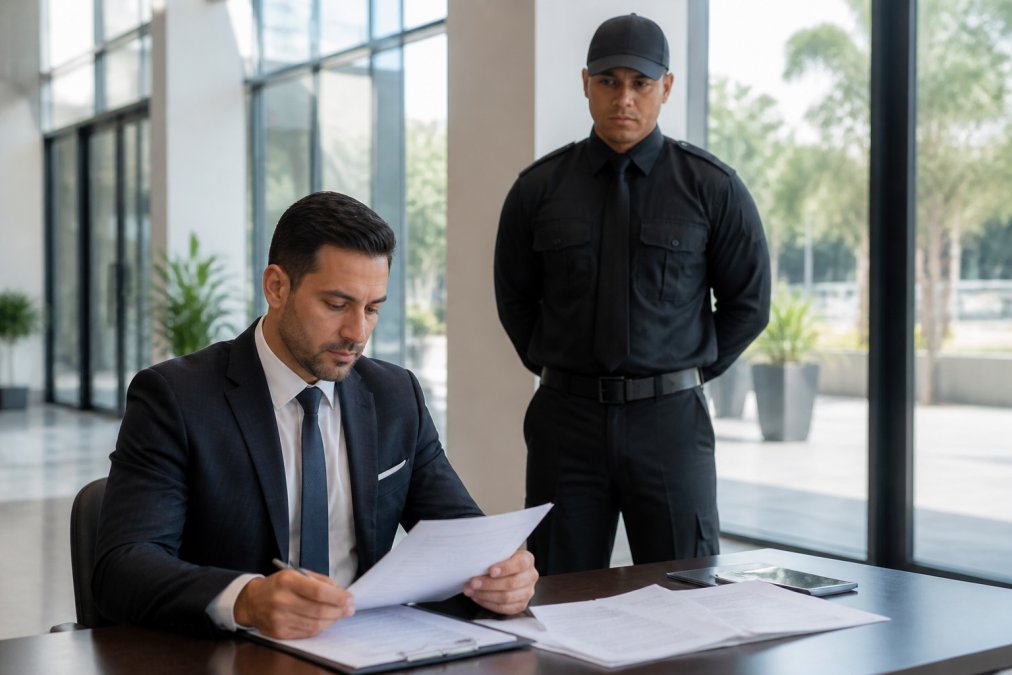
- License verification: Confirm every deployed officer holds a current, state-issued Class D license (and Class G if armed). Verify independently with the state licensing board.
- Background check policy: Ask how far back checks go, whether they include criminal, financial, and sex offender registries, and whether checks are repeated annually.
- Training documentation: Request proof of completed pre-assignment training hours and any post-assignment certifications.
- Insurance certificates: Obtain a Certificate of Insurance naming your property as an additional insured. Verify coverage limits and policy expiration date.
- Incident reporting samples: Ask for redacted sample reports. They should be clear, factual, timestamped, and structured.
- Deployment capability: Confirm the provider can staff your site 24/7/365 without relying on a single officer. What is their backup plan for a no-show?
- Emergency response protocol: Ask what happens when an officer encounters a situation requiring law enforcement. Is there a direct dispatch line?
- Client references: Request references from clients in your industry, not just ones the provider volunteers.
- Contract terms: Review for evergreen renewal clauses, fuel surcharges, and hidden fees.
- Technology and reporting: Does the provider offer real-time tracking, a client portal, or a mobile app for monitoring officer activity?
| Vetting Criterion | What to Ask | Red Flag |
|---|---|---|
| Officer licensing | Request license numbers | Cannot provide verifiable IDs |
| Background checks | Scope and frequency | No annual rechecks |
| Insurance | Certificate of Insurance | Coverage below industry standards |
| Training | Certifications | "On-the-job" only |
| Incident reporting | Sample reports | Vague or unstructured |
| Deployment backup | 24/7 staffing plan | Single-officer dependency |
| Contract terms | Cancellation and fee structure | Evergreen clauses, hidden surcharges |
Cost of 24/7 Security Guard Services: What Drives the Price
The cost of 24/7 security guard services is a function of several overlapping variables. Pricing depends on quantity, dates, and delivery.
5 Things to Check Before Hiring Security Guards | Ohio
ConstantProtectiveSecurity
The primary cost drivers are:
Guard type: Armed officers command higher hourly rates than unarmed officers, reflecting additional training, licensing requirements, and greater liability.
Post complexity: A single-entry office building is straightforward. A multi-building construction site with multiple access points and high-value equipment requires more personnel and sophisticated patrol protocols.
Coverage hours: True 24/7 coverage means three overlapping shifts, overtime provisions, and backup staffing.
Geographic factors: Rural or remote sites may carry a premium due to travel time and officer availability. Urban sites with high crime indices may require armed coverage where unarmed would otherwise suffice.
Technology integration: Providers offering real-time GPS tracking, mobile app reporting, and live dispatch support build those operational costs into pricing.
For current rates, visit the Ranger Operation Services website directly.
Emergency Security Guard Deployment: Speed and Protocols
Emergency security guard deployment is the true test of any provider's operational capability.
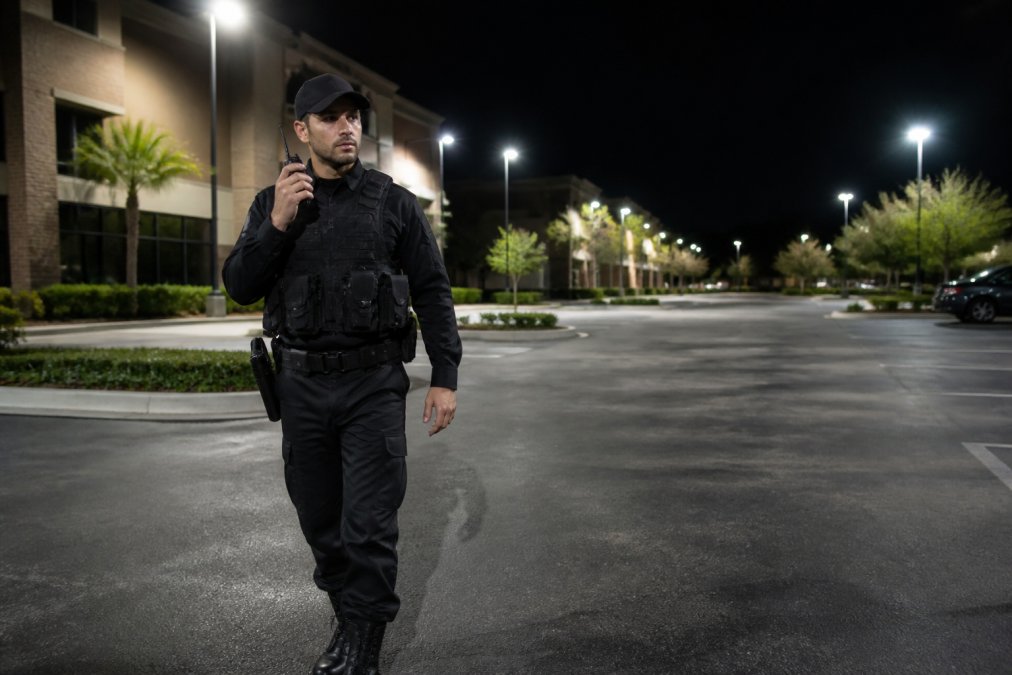
Speed matters because most opportunistic crimes are abandoned when a visible security presence arrives within minutes, not hours. Regulatory environments like cannabis facilities have documentation requirements that begin at the moment of an incident.
The protocols that define capable emergency response include:
24/7 dispatch availability: A live dispatcher, not a voicemail, must be reachable at any hour.
Guaranteed deployment windows: The best providers commit to a specific response time in writing. Ranger Operation Services guarantees deployment within four hours statewide.
Escalation chains: Officers need clear authority to contact law enforcement, document incidents, and notify site supervisors without waiting for unavailable managers.
Post-incident documentation: Every emergency response should generate a timestamped incident report filed within hours of the event.
According to OSHA's guidelines on workplace violence prevention, documented emergency response procedures are a baseline requirement for many regulated industries. An undocumented incident is a liability.
Technology Integration in Modern Security Guard Services
The gap between traditional security firms and modern providers is widest in technology. Modern security guard services integrate technology at every layer:
GPS tracking and geofencing: Officers' locations are logged continuously, creating a verifiable record of patrol coverage. Geofencing alerts supervisors when an officer leaves a designated zone or misses a checkpoint.
Mobile app booking and tracking: Clients can book services, monitor active assignments, and review incident reports from a mobile device.
Digital incident reporting: Structured digital reports with timestamps, photos, and officer signatures replace handwritten logs.
Live dispatch integration: Technology connecting field officers directly to dispatch enables faster response coordination and creates a documented communication record.
Ranger Operation Services operates a proprietary mobile app giving clients real-time assignment tracking from dispatch to completion. Every client is assigned a named regional supervisor accountable for their site.
How Ranger Operation Services Delivers 24/7 Security Guard Coverage
Ranger Operation Services maintains the officer bench strength to cover full 24/7 rotations. Every officer holds a state-certified Class D or Class G license.
The four-hour statewide deployment guarantee is a contractual commitment backed by operational infrastructure: 24/7 dispatch support, a named regional supervisor for every client account, and a proprietary mobile app providing live visibility into officer status and assignment progress.
For specialized environments, medical marijuana facilities requiring armed transport and chain-of-custody documentation, construction sites with multi-point access control, retail locations facing organized theft, Ranger builds purpose-specific security plans.
The firm has operated for over eight years and holds Florida license FL #B32001502. The $5 million general liability coverage represents a meaningful baseline of accountability.
For current pricing, visit the Ranger Operation Services website directly.
Hiring 24/7 security guard coverage is a risk management decision with real consequences for your people, assets, and liability exposure. The vetting checklist, licensing requirements, and deployment standards in this guide give you the framework to evaluate any provider objectively. Ranger Operation Services brings state-certified Class D and G officers, a guaranteed four-hour deployment window, and real-time tracking through its proprietary mobile app to every client engagement. Book Security with Ranger Operation Services and get a purpose-built protection program that holds up when it matters most.
Frequently Asked Questions
What should I look for when vetting a 24/7 security guard company?
Confirm the company holds a valid state security agency license and that individual officers carry Class D or Class G certifications, depending on whether armed coverage is needed. Ask for proof of general liability insurance, $1M per occurrence is a baseline, though $5M is stronger. Request background check procedures, training records, and incident reporting samples. A company that assigns a named supervisor to your account and offers real-time guard tracking gives you meaningful accountability beyond a signed contract.
What is the difference between armed and unarmed 24/7 security services?
Unarmed security officers provide visible deterrence, access control, patrol services, and incident reporting. They suit commercial properties, retail environments, and residential communities where the primary goal is presence and documentation. Armed guards hold additional state certification, a Class G license in Florida, for example, and are appropriate for high-risk environments such as cannabis facilities, financial institutions, or executive protection details. The right choice depends on your risk assessment, regulatory requirements, and the nature of assets being protected.
How quickly can a professional security firm deploy guards to a site?
Response times vary significantly by provider. Some firms commit to a 2-to-4-hour emergency deployment window for urgent situations, which matters most when a site faces an active threat, a staffing gap on a live post, or a sudden event requiring immediate coverage. When evaluating providers, ask specifically about after-hours and weekend deployment, a guarantee that only applies during business hours offers limited protection. Ranger Operation Services maintains a 4-hour statewide deployment window with 24/7 dispatch support.
Are 24/7 security guard services legally required to be licensed and insured?
Yes. In every U.S. state, security guard companies must hold a state-issued agency license, and individual officers must meet state-specific training and licensing requirements before working a post. In Florida, unarmed officers require a Class D license and armed officers require a Class G license, both issued through the Florida Department of Agriculture and Consumer Services. Hiring an unlicensed provider exposes your business to significant liability. Always request license numbers and verify them directly with the issuing state agency before signing any contract.
This article was written using GrandRanker