
Calculate Security Guard Coverage for Large Construction Sites
Learn how to calculate security guard coverage for large construction sites using risk assessment, site mapping, and shift planning. Step-by-step guide.
Table of Contents
- Why Security Guard Coverage Calculation Matters for Construction Sites
- Conduct a Construction Site Security Risk Assessment
- Map Your Site Layout and Define Guard Post Locations
- Develop a Construction Site Security Staffing Plan
- Plan 24/7 Construction Site Security Coverage Options
- Evaluate Construction Site Security Guard Cost and Budget Scenarios
- Validate Coverage Performance and Adjust as Needed
- Frequently Asked Questions
Last Updated: October 17, 2026
Why Security Guard Coverage Calculation Matters for Construction Sites
Calculating security guard coverage construction needs isn't something you should guess at. A site left unprotected becomes a target. Theft of equipment and materials happens fast. Vandalism can shut down operations for days.
The real challenge isn't hiring guards, it's figuring out how many you actually need. Too few, and you have gaps. Too many, and your budget explodes.
This guide walks you through the exact process we use at Ranger Operation Services to calculate security guard coverage construction requirements for large sites.
Conduct a Construction Site Security Risk Assessment
Start here. You can't calculate coverage without understanding what you're protecting against.
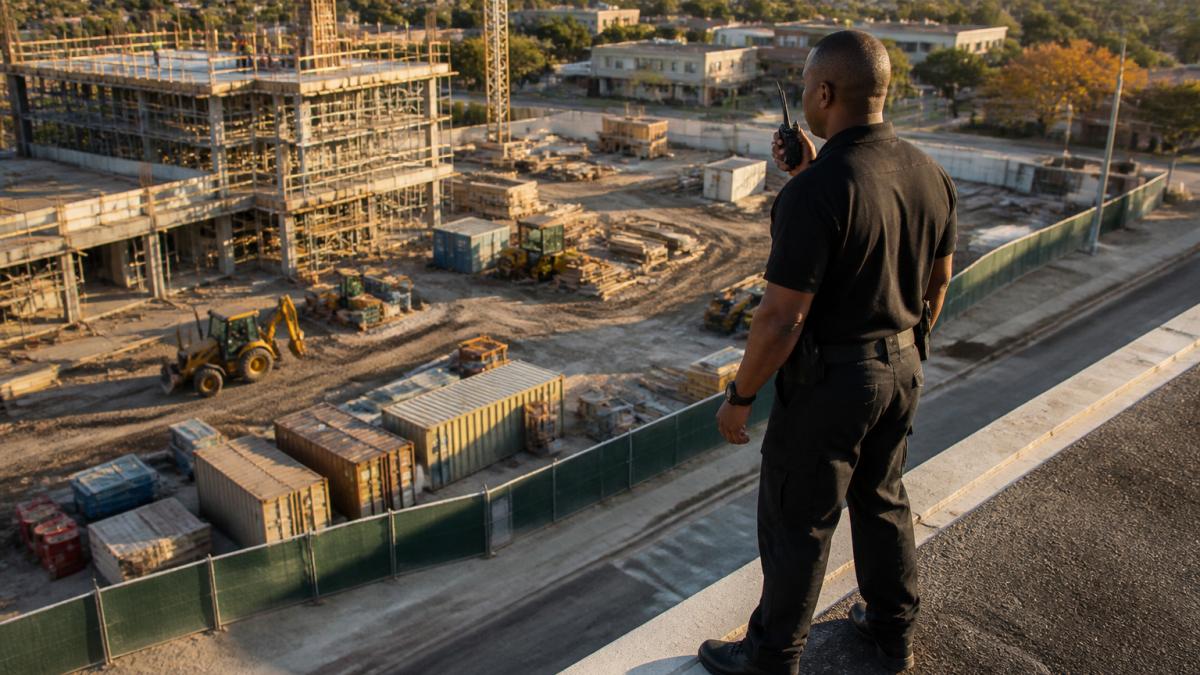
A construction site security risk assessment identifies what's worth stealing, where thieves are most likely to strike, and what gaps exist in your current setup. This isn't theoretical. It directly determines how many guards you need and where they should be positioned.
Identify high-risk areas and theft vulnerabilities
Walk your site. Look for what criminals see: high-value equipment, materials stacked near the perimeter, dark corners, blind spots from the street, equipment left overnight.
Common high-risk areas on construction sites include:
- Equipment staging yards (excavators, generators, compressors)
- Material storage areas (copper wiring, steel beams, HVAC units)
- Tool cages and lockboxes
- Fuel and propane storage
- Office trailers with computers and blueprints
- Parking areas for contractor vehicles
Ask yourself: What would a thief target first? What's easiest to move? What's hardest to replace quickly?
Document the value. A site with $2 million in equipment on-site needs different coverage than one with $200,000. Higher value means higher risk means more guard presence required.
Map entry points and perimeter access control needs
Every way into your site is a potential entry point for theft or vandalism. Your perimeter security and access control strategy shapes your guard coverage needs.
Identify all entry points:
- Main gates and vehicle access
- Pedestrian gates
- Gaps in existing fencing
- Adjacent properties or alleyways
- Rooftop access
- Underground access (tunnels, storm drains)
For each entry point, ask: Can guards see it from their current position? Does it need a fixed post, or can mobile patrol cover it?
Weak perimeter fencing or unmanned gates mean guards must spend more time on access control instead of patrols. Strong perimeter barriers reduce the guard hours you need.
Map Your Site Layout and Define Guard Post Locations
Now translate risk into positions. Where should your guards actually stand or patrol?
This is where most sites get it wrong. They place guards based on habit, not on what the site actually needs. The result: gaps in coverage and wasted guard hours.
Calculate coverage for irregularly shaped sites
Large construction sites are rarely rectangular. They have multiple buildings, equipment yards, parking areas, and natural barriers. Coverage math gets complicated fast.
Here's the practical approach:
Step 1: Divide your site into zones. Break the site into logical sections based on layout and risk. A 10-acre site might have 5-6 zones: perimeter, equipment yard, material storage, office area, parking, and active construction areas. These defined boundaries also serve as the foundational framework for thorough construction site inspection preparation, ensuring that every designated area remains compliant and secure throughout the project lifecycle.
Step 2: Assess each zone's visibility. Can one guard see the entire zone from one position?
Step 3: Calculate sightline coverage. For each zone, determine the maximum distance a guard can effectively monitor.
Step 4: Determine fixed posts versus patrol routes. A zone with one clear entry point and high-value assets might need a fixed post.
Example calculation for a 7-acre site with three main zones:
- Zone A (perimeter): 800 feet of fencing, 150-foot sightline = needs 1 fixed post or continuous patrol
- Zone B (equipment yard): 2 main entry points, 300 feet deep = needs 1-2 fixed posts or frequent mobile patrol
- Zone C (material storage): 400 feet of open area, clear sightlines = can be covered by mobile patrol every 30 minutes
Fixed post versus mobile patrol coverage decisions
This decision shapes your entire staffing plan. Each approach has trade-offs.
Fixed posts mean a guard stays in one location. Best for high-value areas, main entry points, or zones with poor sightlines.
Mobile patrol means guards move through the site on a schedule.
Most large sites use both. A fixed post at the main gate covers access control.
The math: One fixed post requires 3 guards (one per shift, plus one for relief and training) working 24/7.
Develop a Construction Site Security Staffing Plan
Here's where coverage theory becomes a real schedule.
A construction site security staffing plan translates your coverage needs into actual guard hours, shift patterns, and total headcount. This is the number that hits your budget.
Calculate guard hours for multiple shifts and shift relief
Start with your coverage zones and hours of operation. If you need 24/7 coverage, you need multiple shifts.
Basic shift structure for 24/7 coverage:
- Day shift: 6 AM to 2 PM (8 hours)
- Evening shift: 2 PM to 10 PM (8 hours)
- Night shift: 10 PM to 6 AM (8 hours)
If you need 2 guards on-site during day shift and 1 guard during night shift, the math looks like this:
- Day shift: 2 guards × 8 hours = 16 guard-hours
- Evening shift: 2 guards × 8 hours = 16 guard-hours
- Night shift: 1 guard × 8 hours = 8 guard-hours
- Total per day: 40 guard-hours
Account for breaks, training, and total headcount needs
Here's what most sites miss: one guard working one 8-hour shift isn't 8 hours of coverage. Guards need breaks. They need time off. They need training.
The industry standard is a 1.5 multiplier for full-time coverage. This accounts for:
- Meal breaks (typically 30 minutes)
- Bathroom breaks
- Shift relief (time for handoff)
- Vacation and sick days
- Training and certification renewal
So 40 guard-hours of daily coverage actually requires:
40 guard-hours × 1.5 multiplier = 60 total guard-hours per day
Divide by 8-hour shifts: 60 ÷ 8 = 7.5 full-time guard positions
Round up to 8 guards for realistic staffing.
For a site that only needs coverage during business hours (6 AM to 6 PM), the math is simpler:
- 12-hour coverage window
- 2 guards per shift (day and evening)
- 2 shifts × 2 guards = 4 guards on-site per day
- 4 guards × 1.5 multiplier = 6 full-time positions
| Coverage Scenario | Daily Hours | Multiplier | Full-Time Positions |
|---|---|---|---|
| 24/7 with 2 day, 2 evening, 1 night | 40 | 1.5 | 8 |
| Business hours (6 AM-6 PM) with 2 per shift | 24 | 1.5 | 4.5 |
| Overnight only (6 PM-6 AM) with 1 guard | 12 | 1.5 | 2.25 |
| Weekends only with 2 guards | 16 | 1.5 | 3 |
Plan 24/7 Construction Site Security Coverage Options
Not every site needs round-the-clock coverage. But large sites with high-value assets usually do.
Overnight security and weekend coverage decisions
Theft happens when nobody's watching. Weekends and overnight hours are prime time for construction site theft.
Overnight security (10 PM to 6 AM) is worth the cost if:
- Your site has equipment worth over $500,000
- You've had theft incidents at night before
- Your site is in a high-crime area
- You have copper wiring, HVAC units, or other high-demand materials
Weekend coverage is worth it if:
- Your site sits idle on weekends (no workers to deter theft)
- You're in an urban area with active nighttime activity
- You've had weekend theft or vandalism
Many large construction sites run a hybrid model:
- Full 24/7 coverage during peak construction phases (heavy equipment, open site)
- Reduced overnight coverage (1 guard) during slower phases
- Weekend coverage during high-risk periods only
This approach balances risk and budget. You scale coverage to match your actual exposure.
Evaluate Construction Site Security Guard Cost and Budget Scenarios
Your staffing plan has a price tag. Let's look at realistic scenarios.
Scalable coverage options and cost trade-offs
Coverage costs depend on:
- Number of guards
- Shift patterns and hours
- Guard training level (armed versus unarmed)
- Location and market rates
- Contract length
A typical construction site security guard cost structure for a large site might look like this:
Scenario 1: Business hours only (6 AM-6 PM)
- 2 guards per shift, 2 shifts
- 4.5 full-time positions
- Cost: Moderate. Best for sites with active daytime work and low overnight risk.
Scenario 2: Extended hours (6 AM-10 PM)
- 2 guards per shift, 3 shifts
- 6 full-time positions
- Cost: Moderate to high. Covers most theft window. Skips overnight.
Scenario 3: Full 24/7 coverage
- 2 guards day/evening, 1 guard night
- 8 full-time positions
- Cost: High. Maximum protection. Best for high-value sites.
Scenario 4: 24/7 with mobile patrol instead of fixed posts
- 1-2 mobile patrols per shift
- 5-6 full-time positions
- Cost: Lower than full fixed-post coverage. Good for larger sites where mobile patrol can cover multiple zones.
The trade-off is clear: fewer guards cost less but leave gaps. More guards cost more but eliminate risk.
Many large construction sites start with Scenario 2 (extended hours), then add overnight coverage if theft occurs. This is reactive rather than proactive, but it's common.
An approach to consider: Start with Scenario 3 (24/7) during high-risk phases. Scale down to Scenario 2 during lower-risk phases. This matches coverage to actual exposure.
Validate Coverage Performance and Adjust as Needed
Your plan is built. Now monitor it. Coverage needs change as your site changes.
After your security plan launches, track these metrics:
- Incident reports (theft, vandalism, trespassing)
- Guard patrol times and routes
- Access control violations
- Blind spots or gaps identified by guards
- Insurance claims related to theft or loss
Review quarterly. If incidents spike in a particular zone, you need more coverage or better positioning in that area.
The best security guard coverage for large construction sites isn't static. It evolves as your site grows, as risk changes, and as you learn what actually works.
Protecting a large construction site requires more than hiring guards. It requires a plan built on your actual risks, your site layout, and your coverage gaps.
When you're ready to implement your coverage plan with trained, licensed professionals who understand construction site security, Ranger Operation Services delivers rapid deployment, 24/7 dispatch support, and real-time tracking through our mobile app.
Frequently Asked Questions
How many security guards does a large construction site need?
The number depends on site size, layout, shift hours, and risk level. A typical calculation: divide your site into patrol zones (each guard covers 1-2 acres in good visibility), then multiply by the number of shifts. For a 10-acre site with 24/7 coverage and two shifts per day, you may need 4-6 guards per shift, plus relief staff. Start with your risk assessment and adjust based on incident history and valuable equipment on-site.
How do you calculate security guard staffing for a 24/7 site?
Use this formula: (Number of Guards Per Shift) × (Number of Shifts) × (Relief Factor). If you need 3 guards per shift and operate 24/7 (three 8-hour shifts), that's 9 guards. Add 20-30% for vacation, training, and sick leave, bringing your total to 11-12 on payroll. Account for shift overlap during handoff periods and ensure each guard gets proper breaks without compromising coverage.
What factors affect the number of guards needed at a construction site?
Key factors include site size and perimeter length, number and type of entry points, value and visibility of materials and equipment, construction phase (foundation work versus finishing), local theft and vandalism history, lighting and surveillance technology available, hours of operation, and contractor access patterns. High-risk areas like equipment yards and material storage require more frequent patrols. Blind spots and irregular site shapes increase coverage needs.
How can cameras and access control reduce on-site guard requirements?
Video surveillance and remote monitoring let guards cover more ground by reducing time spent on routine patrols. Access control systems (gates, badge readers, visitor logs) cut the staff needed for entry-point management. Together, they enable fewer guards to cover larger areas, typically reducing headcount by 15-25% compared to patrol-only coverage. However, technology cannot replace physical presence for deterrence and rapid incident response.