
How to Improve Construction Site Security: 7-Step Plan
Learn how to improve construction site security with a 7-step plan covering access control, lighting, and theft prevention. Protect your assets today.
Table of Contents
- Step 1: Assess Your Site's Vulnerabilities
- Step 2: Harden the Perimeter and Access Points
- Step 3: How to Secure Construction Equipment
- Step 4: Construction Site Theft Prevention Strategies
- Step 5: The Benefits of Armed Security Guards for Construction Sites
- Step 6: Integrate Technology and Cybersecurity
- Step 7: Train Your Team and Build a Safety Culture
- Frequently Asked Questions
Last Updated: September 14, 2026
Step 1: Assess Your Site's Vulnerabilities
Improving construction site security starts with a hard, honest audit of where your site is exposed. Walk the perimeter at night, not during a busy afternoon. Thieves don't case a site when crews are pouring concrete and cranes are swinging.
A vulnerability assessment is a structured review of every entry point, blind spot, and high-value asset on a jobsite. It maps what a thief sees before you do.
Most crews skip this step because it feels like paperwork. That's the mistake. The sites that get hit hardest are the ones where nobody ever asked, "If I wanted to steal from here, how would I do it?"
Start with a simple walkthrough checklist:
- Photograph every gate, fence gap, and unlit corner
- List high-value assets by location (copper, tools, generators, fuel)
- Note which entry points stay unlocked after hours
- Check whether neighboring properties give a clear sightline onto your site
- Review the last 12 months of incident reports for repeat problem areas
This guide covers the full seven-step process, but step one is where most sites either get serious or keep bleeding materials.
Step 2: Harden the Perimeter and Access Points
Perimeter protection is your first and most cost-effective layer of defense. A construction site without a physical barrier is an open invitation, no matter how many cameras you install inside. The goal is to force every person and vehicle through a controlled point, then make that point expensive to defeat.
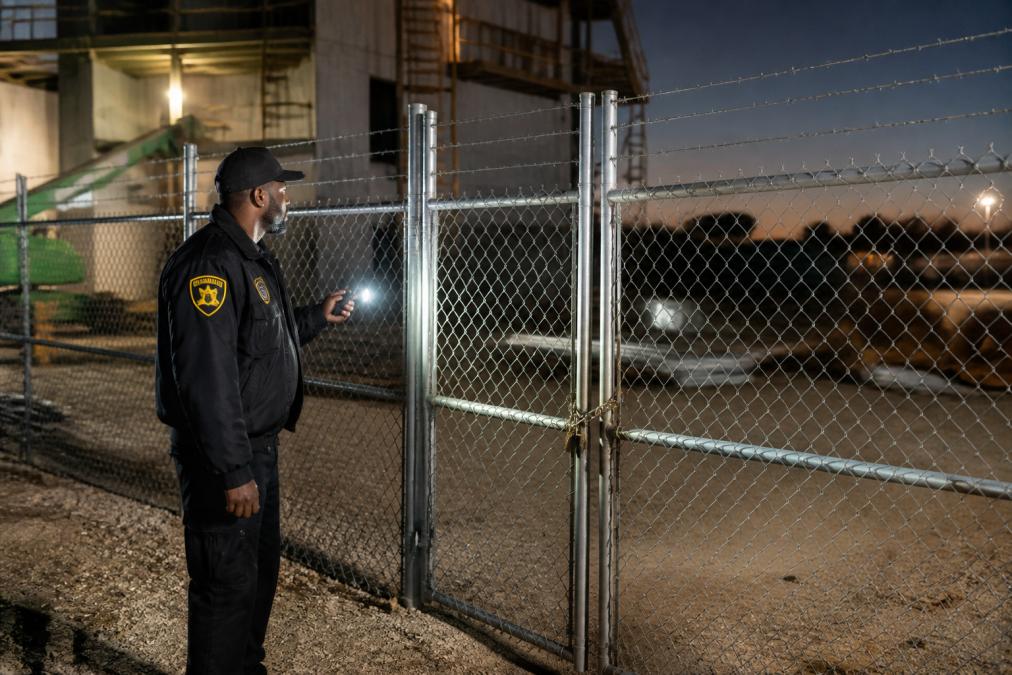
Fencing and Barriers That Actually Delay
A fence is a delay device, not a wall. Its job is to buy time until detection and response kick in. That reframing changes what you buy:
- Chain-link with a top rail and bottom tension wire is the baseline for most sites. Standard 6-foot chain-link stops casual trespassers; 8-foot with a top guard (angled arm holding barbed or razor wire) is the common spec for high-theft sites (osha.gov).
- Anti-climb panels or mesh with no toeholds defeat the "grab and pull up" method that defeats standard chain-link.
- Concrete jersey barriers or water-filled barricades block vehicle ramming at gates and laydown yards.
- Temporary fencing panels work for short phases, but they tip over in wind and lift out of the ground easily, anchor them or accept the risk.
A common pattern is a perfect fence with a gap at the gate. The gate is the weakest link: it needs the same height, the same anti-climb treatment, and a lock that resists cutting and picking, not a hardware-store padlock.
Access Control and Entry Management
Access control decides who gets in and, just as important, creates a record of who did. On active jobsites, that means:
- A single controlled entry point during working hours, with a secondary emergency egress
- Locked gates with tamper-proof locks after hours
- Site access logs signed by every visitor and subcontractor
- Badge or biometric scanners for larger, multi-phase projects
- Turnstile or gate interlock so one person badges in at a time and tailgating is physically blocked
A common mistake is treating access control as a daytime concern only. Theft happens at 2 a.m., when a chain and padlock are the only thing standing between a thief and your equipment.
Match the credential to the risk. A paper sign-in sheet is fine for a small residential remodel. A multi-phase commercial project with dozens of subs needs badge readers tied to a database that can be revoked the moment a worker is terminated or a subcontractor's contract ends.
Lighting and Visibility
Motion-activated lighting does more for theft prevention than almost any other single measure (How Do We Know It Works? Conducting a Rapid Research Police Experiment To Test the...). Thieves want darkness and time. Bright, sudden light removes both.
Lighting design matters more than raw brightness:
- Aim lights at entry points and along the perimeter, not into the site interior where they blind your own cameras.
- Use motion activation on secondary zones so a light snapping on is itself an alert signal.
- Keep a minimum ambient level across the whole site so cameras never lose contrast, even before motion triggers.
- Trim vegetation and remove stacked materials that block sightlines from the street or from guard posts.
Pair lighting with clear sightlines: position lights so they illuminate entry points rather than cast shadows behind them. A light that throws a shadow across a gate is worse than no light at all.
Step 3: How to Secure Construction Equipment
Learning how to secure construction equipment comes down to three principles: make it hard to move, hard to sell, and easy to trace. Equipment theft is rarely opportunistic. It's planned, and it targets the most portable, resellable items on site.
Practical measures that work:
- Secure storage containers for tools and small equipment, anchored to the ground
- Tamper-proof locks and hardened chains on generators and compressors
- Inventory tracking with serial numbers, photos, and a centralized log
- Fuel tank locks and anti-siphon devices
- Motion-activated alarms on high-value assets
The thing nobody tells you about equipment theft is that recovery rates are low once an item leaves the site (nhtsa.gov). Deterrence and tracking beat recovery every time.
Step 4: Construction Site Theft Prevention Strategies
Construction site theft prevention strategies work best in layers. No single measure stops a determined thief. Combined, they make your site the harder target on the block.
A practical layered approach:
| Layer | Measure | Primary Target |
|---|---|---|
| Deterrence | Signage, lighting, visible patrols | Casual trespassers |
| Delay | Fencing, locks, secure containers | Opportunistic thieves |
| Detection | CCTV, alarms, motion sensors | Organized crews |
| Response | Guard dispatch, real-time alerts | Active incidents |
| Recovery | Inventory tracking, serial logs | Post-theft investigation |
Most sites overinvest in one layer and neglect the rest. Cameras without a response plan just record a crime in progress. Fencing without lighting gives thieves cover to work behind.
Step 5: The Benefits of Armed Security Guards for Construction Sites
The benefits of armed security guards for construction sites go beyond visible deterrence. Armed officers provide a trained response, documented incident reporting, and a presence that organized theft crews actively avoid.
Armed guards make the most sense for sites with:
- High-value materials (copper wiring, heavy equipment, fuel)
- Repeated theft or vandalism incidents
- Regulatory or insurance requirements for on-site protection
- Remote locations with slow police response times
For smaller sites, unarmed guards or mobile patrols often provide the right balance of cost and coverage. The key is matching the security level to the actual risk, not overbuying protection you don't need.
Ranger Operation Services deploys state-certified Class D and G officers with Level IV training, and guarantees a four-hour deployment window with 24/7 dispatch. For contractors who need coverage fast, that response time is a key factor.
Step 6: Integrate Technology and Cybersecurity
Modern construction site security runs on software as much as steel. CCTV surveillance, drone monitoring, and digital site management tools all improve coverage. They also create a new attack surface most contractors never consider.
Cybersecurity for construction sites is the angle competitors miss. Most guides stop at physical theft. But if your cameras, access logs, and inventory systems live on a network, that network is a target. A breach doesn't just leak data. It can disable the cameras you're relying on, unlock a gate, or wipe the access log that would have proven who was on site.
The Smart-Site Attack Surface
Every connected device on a jobsite is a potential door:
- IP cameras and NVRs ship with default credentials and often run outdated firmware.
- Access control readers can be spoofed or physically bypassed if the controller isn't hardened.
- Site Wi-Fi shared between crews and security devices puts cameras on the same network as a subcontractor's laptop.
- Cloud dashboards and mobile apps concentrate footage, logs, and dispatch in one account, one stolen password, one compromised site.
- GPS and telematics on equipment can be jammed or spoofed to hide a theft in progress.
A common pattern is a site with excellent physical security and a camera system still running the manufacturer's default admin password. The thief doesn't need bolt cutters.
Basic Protections Worth Putting in Place
- Unique passwords and multi-factor authentication on all security systems
- Separate networks (VLANs) for security devices and general site Wi-Fi
- Regular firmware updates on cameras and access control hardware
- Restricted access to footage and access logs, with an audit trail of who viewed what
- Disabling unused ports, remote-access features, and default accounts on every device
- A written incident response plan for a security-system outage, not just a physical breach
Physical and Digital Layers Working Together
Pair digital tools with physical ones. Real-time alerts, digital site management platforms, and drone monitoring extend your reach across large or multi-phase sites, but only if the data they generate is trustworthy.
- Real-time alerts turn a passive camera into an active deterrent when paired with a dispatch plan.
- Drone monitoring covers large or remote sites where fixed cameras can't reach, but drone feeds are themselves a network asset to protect.
- Digital site management platforms centralize access logs, inventory, and incident reports, which makes them the highest-value target on the network.
Step 7: Train Your Team and Build a Safety Culture
A safety culture is the shared set of habits and expectations that determines whether your written policies actually get followed. Training your crew to spot and report security risks turns every worker into an extra set of eyes.
What effective training covers:
- Hazard identification and how it applies to security, not just injuries
- PPE compliance and why visible standards signal an organized site
- Emergency protocols for trespassing, theft in progress, and suspicious activity
- Fall protection and other safety basics that keep the site credible to insurers
Workplace injury prevention and theft prevention share a foundation: a crew that follows procedure and reports anomalies. Sites with strong safety records tend to have fewer security incidents, because the same discipline that prevents falls prevents open gates at midnight.
Contractor liability and insurance implications are worth raising with your carrier. Many policies reward documented security measures with better terms, and some require them outright.
Construction site security is only as strong as its weakest layer, and most sites have more than one gap. Ranger Operation Services builds full-spectrum protection around your specific risks, from armed guards and access control to 24/7 dispatch and real-time assignment tracking through our proprietary mobile app. With 500+ licensed officers, a named regional supervisor for every client, and a four-hour statewide deployment window, we provide a professional security plan. Get started with Ranger Operation Services.
Frequently Asked Questions
What are the most effective ways to secure heavy equipment on-site?
Secure heavy equipment by parking it in a fenced, well-lit area and removing keys or disabling the battery. Use tamper-proof locks, GPS trackers, and wheel clamps on high-value assets. Keep an inventory log updated daily. For maximum deterrence, combine physical measures with overnight guard patrols or remote video monitoring that triggers real-time alerts.
How does professional guard service improve construction site security?
Professional guards provide visible deterrence and respond to incidents in real time. They verify credentials at access points, log deliveries, and patrol after hours when theft risk peaks. Guards also document incidents for insurance claims. A licensed provider can deploy officers quickly, maintain site access logs, and coordinate with local law enforcement, which reduces liability and improves overall jobsite safety.
What role does lighting play in construction site security?
Lighting eliminates hiding spots and makes intruders visible to guards, cameras, and neighbors. Motion-activated lights around gates, storage containers, and equipment yards are especially effective. Well-lit sites also reduce slip-and-fall risks for workers. Pair lighting with CCTV surveillance for coverage that works day and night, and check that fixtures meet local code requirements for temporary construction sites.
What are the legal requirements for construction site security?
Legal requirements vary by state and local jurisdiction, but most building codes require a site safety plan that addresses perimeter protection, access control, and emergency protocols. OSHA mandates fall protection and PPE compliance, which overlap with security planning. Contractor liability and insurance policies often specify minimum security measures. Check your local building department and insurer for exact rules before finalizing your plan.