
Alternatives to In-House Cannabis Security Teams
Explore outsourced guards, remote monitoring, and hybrid security models as alternatives to in-house cannabis security teams. Compare costs and compliance.
Table of Contents
- Why Cannabis Facilities Reconsider In-House Security
- Outsourced Cannabis Security: Contract Guards and Managed Services
- Remote Video Monitoring for Dispensaries and Cultivation Sites
- Armed vs. Unarmed Security Guards: Which Fits Your Facility
- Building a Cannabis Security Plan Without Full-Time Staff
- Hybrid Security Models: Combining Outsourced Guards and Technology
- Cost Comparison: In-House vs. Outsourced vs. Technology-Led Security
- Selecting the Right Security Alternative for Your Facility
- Frequently Asked Questions
Last Updated: October 21, 2026
Why Cannabis Facilities Reconsider In-House Security
An in-house cannabis security team sounds straightforward, but full-time personnel carry significant overhead: salaries, benefits, workers' compensation, ongoing training, and the challenge of finding reliable talent in a competitive market. Understanding alternatives to in-house cannabis security teams helps operators balance cost, control, and compliance.
In-house teams also struggle to scale. A cultivation site expanding from 10,000 to 50,000 square feet suddenly needs more coverage, and a dispensary adding a second location can't simply duplicate its staff.
Then there's liability. Poor hiring, inadequate training, or lapses in judgment create exposure, and background checks, certifications, and compliance documentation fall on your shoulders. One incident, a missed theft, an improper detention, inadequate reporting, can cost far more than you'd save on staffing.
The alternatives to in-house cannabis security teams have evolved significantly.
Outsourced Cannabis Security: Contract Guards and Managed Services
Contract security providers handle staffing, training, compliance, and accountability. You define your security needs, hours of coverage, access control requirements, incident response protocols, and the provider supplies vetted, licensed personnel. This model fundamentally shifts risk and operational burden away from your facility.
How Contract Security Differs from In-House Teams
Contract providers are security specialists. They maintain pools of trained personnel, rotate staff to prevent complacency, implement standardized protocols, and carry their own liability insurance.
Your in-house team understands your workflows, equipment, and staff, but is constrained by your budget, local hiring pool, and operational capacity. Scaling requires hiring and training, turnover creates gaps, and specialized training, armed response, chain-of-custody documentation, loss prevention, falls on you to arrange and fund.
Staffing Flexibility and Scalability
Contract providers offer flexibility in-house teams can't match. Need extra coverage during inventory counts or a second location? The provider adds personnel from its existing roster. Reducing hours in slow seasons? The provider adjusts without you managing layoffs or underutilized staff.
This scalability matters most for growing operations. Seasonal cultivation cycles, product launches, regulatory inspections, and facility expansions create temporary spikes in security needs. Contract security absorbs these fluctuations, you pay for what you need, when you need it, without permanent overhead.
Remote Video Monitoring for Dispensaries and Cultivation Sites
Remote video monitoring replaces or supplements on-site personnel using surveillance systems, access control integration, and real-time alerting. A monitoring center watches live feeds, responds to alerts, and coordinates incident response.
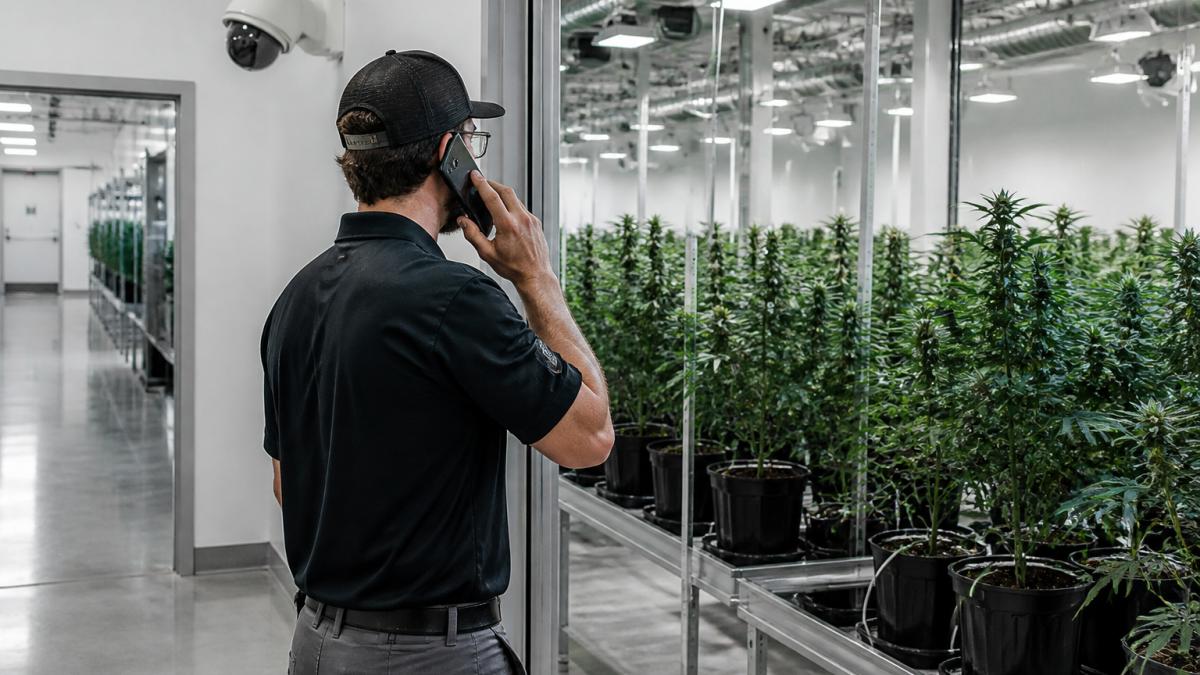
Technology-First Security Without On-Site Personnel
Remote monitoring works because most incidents are preventable through visibility and deterrence.
For dispensaries, remote monitoring covers point-of-sale areas, product storage, cash handling zones, and customer areas. For cultivation facilities, monitoring focuses on restricted access zones, product storage, and perimeter security. Processing facilities require coverage of extraction areas, finished product storage, and shipping zones.
The cost structure differs dramatically from on-site personnel. Initial setup, cameras, servers, monitoring software, access control integration, is the primary investment, while monthly monitoring fees are typically lower than a single full-time officer's salary.
Integration with Access Control and Alarm Systems
Remote monitoring becomes far more powerful when integrated with access control and alarms. A keycard system tracks who enters restricted areas and when, alarms trigger immediate notification, and integration creates a complete audit trail of video footage, timestamped access logs, and system events.
This integration is critical for compliance. Cannabis facilities must document restricted-area access, track product movement, and maintain chain-of-custody records, and integrated systems generate these automatically.
Armed vs. Unarmed Security Guards: Which Fits Your Facility
The decision between armed and unarmed security hinges on your facility's threat level, regulatory environment, and operational philosophy. Both approaches have legitimate applications in cannabis security.
Regulatory Requirements and Liability Considerations
State and local regulations dictate what's permissible. Some jurisdictions allow armed security at cannabis facilities, others prohibit it, and some require specific training certifications or restrict guard positioning and weapons.
Armed security creates additional liability. A firearm incident carries far greater legal and financial consequences, insurance requirements change, training standards must be higher, and incident response protocols must address armed scenarios.
Unarmed security remains highly effective for most cannabis facilities. Trained, professional unarmed guards deter theft, manage access control, respond to incidents, and maintain compliance documentation, at lower cost and liability exposure.
Threat Level Assessment for Your Operation
Assess your actual security risk, not theoretical risk. A dispensary in a low-crime area faces different threats than a remote cultivation facility storing high-value product, and a cash-handling processing facility has different exposure than a delivery operation.
High-threat environments, large cultivation facilities, high-value storage, cash-intensive operations, higher-crime locations, may justify armed security. Medium-threat environments typically benefit from unarmed security paired with technology, while low-threat environments may rely primarily on technology with minimal on-site personnel.
Building a Cannabis Security Plan Without Full-Time Staff
Developing an effective security plan doesn't require full-time in-house personnel. It does require systematic thinking about your risks, your regulatory obligations, and your response protocols.
Risk Assessment and Compliance Documentation
Start with a formal risk assessment. Document your facility's layout, identify high-value areas, map access points, and evaluate vulnerabilities: what products you store and where, how they're accessed, who has keys, and what surveillance and access control systems exist.
From this assessment, build a security plan that addresses identified risks. The plan should specify:
- Physical security measures (cameras, locks, barriers, lighting)
- Access control protocols (who can access what areas, when)
- Personnel requirements (on-site coverage hours, responsibilities)
- Technology systems (surveillance, alarm monitoring, access logs)
- Incident response procedures (what happens when something goes wrong)
- Compliance documentation (records retention, audit trails, reporting)
Many cannabis operators find a hybrid approach, outsourced personnel for key hours plus technology for 24/7 coverage, addresses their risks while managing costs. Outsourced guards cover peak hours and sensitive operations; remote monitoring handles nights and weekends.
Incident Response and Chain of Custody Protocols
Your security plan must include clear incident response procedures: when a theft occurs, unauthorized access is detected, or an alarm triggers, who's notified, how evidence is preserved, and what documentation is required?
For medical marijuana facilities, chain-of-custody protocols are regulatory requirements: every product movement documented, every handler identified, every transfer logged. Your security system, staffed or technology-based, must support this documentation, and incident response must preserve evidence and maintain chain of custody.
Hybrid Security Models: Combining Outsourced Guards and Technology
Most sophisticated cannabis operations use hybrid models: outsourced guards handle critical hours and high-risk activities, remote monitoring provides 24/7 coverage, and access control manages entry and creates audit trails, leveraging each approach's strengths while compensating for limitations.
Hybrid models offer flexibility. As your facility grows or your risk profile changes, you adjust the balance, a new location might start technology-first and add on-site personnel as volume increases, while a facility seeing more theft might add peak-hour coverage. Security adapts to actual needs rather than a fixed staffing model.
Cost Comparison: In-House vs. Outsourced vs. Technology-Led Security
Understanding the financial trade-offs between security approaches is essential for making the right choice for your facility.
Total Cost of Ownership and Hidden Expenses
Outsourced security shifts these costs to the provider. You pay a contracted rate, hourly per guard or a monthly fee for defined coverage, while the provider handles employment costs, training, compliance, and liability.
Technology-based security requires upfront equipment and system investment plus ongoing monitoring fees.
According to Flowhub's cannabis technology cost analysis, security system setup typically ranges from $1,500 to $3,000 for hardware and installation, with ongoing monitoring estimated at $100 per month.
Service-Level Agreements and Accountability
With in-house security, accountability is direct but limited: you manage performance but also own hiring, training quality, and compliance, and bear the consequences when something goes wrong.
Outsourced providers operate under service-level agreements specifying performance standards, response times, coverage hours, personnel qualifications, incident response procedures. When a provider fails to meet them, you have recourse.
Technology-based security includes monitoring SLAs specifying alert response times, monitoring center availability, and escalation procedures, accountability that in-house systems typically lack.
| Security Approach | Primary Costs | Scalability | Compliance Burden | Liability |
|---|---|---|---|---|
| In-House Teams | Salaries, benefits, training, insurance | Difficult; requires hiring/layoffs | High; on your shoulders | High; direct responsibility |
| Outsourced Guards | Hourly rates or monthly fees | High; provider adjusts staffing | Lower; provider manages compliance | Lower; provider carries liability |
| Remote Monitoring | Setup + monthly monitoring fees | High; add cameras/zones as needed | Medium; system provides audit trails | Lower; monitoring center responsible |
| Hybrid Model | Combination of above | High; adjust mix as needed | Medium; shared responsibility | Medium; shared responsibility |
Selecting the Right Security Alternative for Your Facility
Choosing among security alternatives requires honest assessment of your facility's needs, your budget constraints, and your operational priorities.
Decision Framework by Facility Size and Risk Profile
Small dispensaries (single location, under 2,000 sq ft, low-crime area): Remote monitoring with minimal on-site personnel typically provides optimal balance.
Mid-size dispensaries or cultivation facilities (multiple locations or 5,000-20,000 sq ft): Hybrid model works well. Contract security during operating hours, plus remote monitoring for after-hours coverage.
Large cultivation or processing facilities (20,000+ sq ft, high-value inventory): Comprehensive hybrid approach. On-site security during all operating hours, plus remote monitoring 24/7.
High-risk operations (high-crime area, significant cash handling, valuable product): Consider armed security paired with comprehensive technology.
Transition Planning and Implementation
Moving from in-house security to alternatives requires careful planning, abrupt transitions create gaps and disrupt operations.
If transitioning from in-house to outsourced security, plan for overlap.
If implementing remote monitoring alongside existing personnel, start with non-critical areas. Install and test the system with your current team, train staff, verify integration with access control and alarms, then expand coverage systematically.
When selecting an outsourced provider, evaluate cannabis-specific experience: do they understand your regulatory environment, demonstrate compliance with state requirements, and have experience with your facility type?
At Ranger Operation Services, we work with cannabis operators to design security approaches that match their specific needs. Our service-level agreements include 4-hour deployment guarantees and 24/7 dispatch support, ensuring you have responsive security when you need it.
Cannabis facility security doesn't require choosing between expensive in-house teams and inadequate protection. For cannabis operators in Florida, Ranger Operation Services can design a customized security plan tailored to your facility's unique requirements. Book Security today to discuss your options.
Frequently Asked Questions
Can a cannabis dispensary outsource security guards instead of hiring in-house staff?
Yes. Many dispensaries outsource to contract security providers who supply armed or unarmed guards on a flexible schedule. Outsourced cannabis security allows you to scale staffing up or down based on traffic and operating hours without the overhead of recruiting, training, and managing full-time employees. Contract providers handle background checks, licensing compliance, and incident documentation, reducing your administrative burden.
What should a comprehensive cannabis security plan include?
A cannabis security plan must cover physical security (access control, surveillance, safes), personnel screening (background checks, training), incident response protocols, chain-of-custody documentation, and regulatory compliance with state recordkeeping requirements. It should also address cash handling procedures, transport security if applicable, alarm monitoring, and a clear escalation process for unauthorized access or theft attempts.
Can remote video monitoring replace on-site security guards at a cannabis facility?
Remote video monitoring can reduce reliance on full-time on-site staff but typically works best as part of a hybrid model. Cameras deter theft and document incidents, but they cannot physically stop an intruder or respond immediately to an emergency. Most compliant facilities combine remote monitoring with either contract guards, alarm systems that trigger rapid response, or periodic patrol coverage to meet regulatory expectations and insurance requirements.
What is the difference between armed and unarmed security guards for cannabis operations?
Armed guards carry firearms and are trained for high-threat environments; they require additional licensing (Class G in most states) and higher insurance costs. Unarmed guards focus on access control, surveillance, and incident reporting without lethal force capability. Unarmed staff typically cost less and suit lower-risk retail dispensaries, while cultivation or processing facilities with high-value inventory often choose armed coverage or a hybrid approach to meet insurance and regulatory standards.
How do I know if outsourced security is more cost-effective than hiring in-house cannabis security staff?
Compare total cost of ownership: in-house includes salary, benefits, payroll taxes, training, background checks, and management overhead; outsourced includes monthly contract fees and per-guard rates. Outsourced is usually cheaper for facilities operating part-time or with variable staffing needs because you pay only for hours used. Request quotes from both contract providers and calculate your current in-house expenses, including turnover and training costs, to make an accurate comparison.