
10 Essential Cannabis Facility Security Checklist Items
10 essential cannabis facility security checklist items to ensure regulatory compliance, prevent theft, and protect inventory. Pass/fail audit guide.
Table of Contents
- 1. Perimeter Security and Fencing
- 2. Access Control and Restricted Areas
- 3. Video Surveillance and Camera Coverage
- 4. Alarm Systems and Intrusion Detection
- 5. Secure Storage for Cannabis Inventory
- 6. Inventory Tracking and Diversion Prevention
- 7. Cash Handling and Theft Prevention
- Building Your Cannabis Security Plan
- Frequently Asked Questions
Last Updated: October 19, 2026
1. Perimeter Security and Fencing
A cannabis facility's outer boundary is your first line of defense, preventing unauthorized access and signaling that the property is secured and monitored.
Most facilities require fencing at least six feet tall with minimal gaps, completely surrounding the growing, processing, or retail area.
Gates should be lockable and controlled, restricting entry to authorized personnel only.
Perimeter lighting is critical: a well-lit exterior discourages trespassing and makes surveillance footage more useful.
2. Access Control and Restricted Areas
Access control determines who enters your facility and which areas they can reach.
Use badge readers, keypads, or biometric systems to control entry.
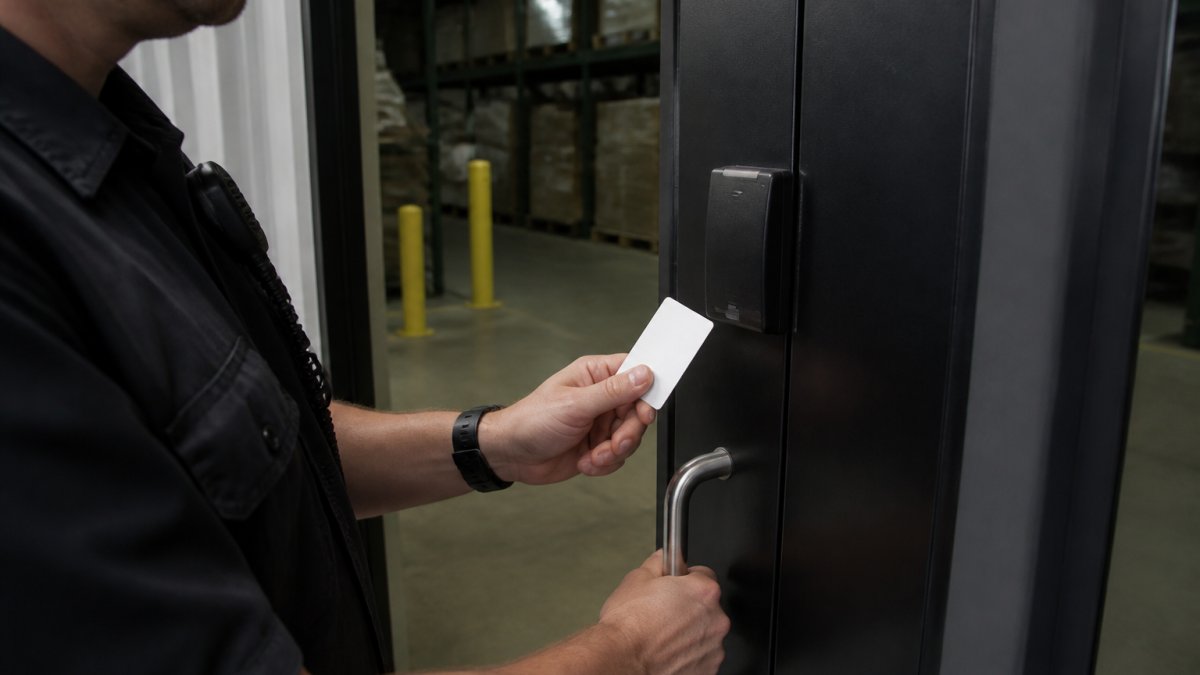
Maintain an access log recording who entered which areas and when.
Credential management is essential: revoke access immediately when an employee leaves, rotate access codes, update badge permissions regularly, and document all changes.
3. Video Surveillance and Camera Coverage
Video surveillance provides continuous monitoring and creates evidence for investigations. A cannabis facility security checklist must include surveillance of all cultivation areas, processing zones, storage vaults, retail floors, and cash handling areas. The difference between a compliant system and a defensible one is whether you can prove, on paper, that it was working when you needed it.
Cannabis Security Best Practices | GSX 2021
ASIS International
Coverage: eliminate blind spots before you buy cameras
Start with a camera coverage map: walk the facility with a floor plan and mark every camera position, its field of view, and the areas it does not see.
Outdoor cameras should cover perimeter fencing, gates, the parking area, and the loading dock, with overlapping fields of view at gates and doors so anyone moving through a controlled entry point appears on at least two cameras.
Measurable inspection criteria
A surveillance checklist item is only useful if it has a pass/fail test. Build your monthly inspection around these checks:
- Recording availability: Confirm every camera is recording and not in a standby or failed state. Most systems show camera status on a dashboard; screenshot it and file it with the inspection record.
- Coverage gaps: Review a sample of footage from each camera and confirm the intended area is actually visible and unobstructed. Re-aim any camera that has drifted or been blocked by new shelving or signage.
- Image quality: Verify that faces and product labels are legible at entry points and storage areas. If you cannot read a label or identify a face in a test recording, the camera is not serving its evidence purpose.
- Retention: Confirm the system is actually holding the required retention period. Retention requirements vary by state and local regulation; many jurisdictions require 30 to 90 days of continuous footage. Do not assume the setting is correct, check the oldest available recording date and confirm it meets your requirement.
Document each test with the date, the tester, the camera identifier, and pass/fail. Retain these records, regulators and insurers increasingly ask for proof of system testing, not just proof of installation.
Uptime and redundancy
Continuous recording is the standard requirement: cameras should operate 24/7 without gaps. Motion-triggered higher-resolution recording can save storage, but confirm the base rate still satisfies your retention requirement. Use an uninterruptible power supply on the recorder and network equipment, and back up to the cloud or off-site, local-only storage means a single failed drive can erase the evidence you need.
Cybersecurity for networked cameras
Modern camera systems are networked devices and a common weak point. Change default passwords before go-live, put cameras on a separate network segment from point-of-sale and inventory systems, apply firmware updates on a schedule, disable unneeded remote access, and track administrator credentials. Review access logs for unusual logins and treat the surveillance system as part of your security perimeter.
4. Alarm Systems and Intrusion Detection
An alarm system detects unauthorized entry and alerts staff or monitoring services.
Most facilities combine door sensors, motion detectors, and glass-break sensors.
Connect your alarm system to a monitoring service or local law enforcement dispatch, a silent alarm nobody knows about is worthless.
Test alarm systems monthly: verify sensors trigger correctly, the alarm sounds, and the monitoring service receives the alert.
5. Secure Storage for Cannabis Inventory
Cannabis inventory must be stored in a locked, monitored vault or secure storage room, physically separated from other facility areas and accessible only to authorized personnel.
The secure storage room should have reinforced walls, a solid door with a quality lock, and video surveillance positioned to record anyone entering or leaving.
Temperature and humidity control may be required depending on product type.
Conduct inventory counts regularly. Most states require daily or weekly counts. Discrepancies should trigger an investigation.
6. Inventory Tracking and Diversion Prevention
Diversion prevention is a core requirement of cannabis facility security. Diversion occurs when cannabis products leave the facility without proper documentation or authorization. A cannabis facility security checklist must include specific controls to prevent diversion, and a specific procedure for what happens when a discrepancy appears. Maintaining rigorous audit readiness documentation ensures that every inventory movement remains transparent and verifiable during regulatory inspections.
Tracking controls
Implement a seed-to-sale tracking system that assigns each plant or product a unique identifier and creates a regulator-reviewable audit trail as staff scan items between areas.
Limit access to inventory records with role-based permissions so employees see only inventory relevant to their job.
Establish clear waste disposal procedures: cannabis waste must be documented and destroyed per regulatory requirements, since unauthorized or undocumented disposal is treated as diversion.
Role-based controls by area
A single checklist does not fit every operation. Tailor the controls to the area:
- Cultivation: Track plant counts by room and by batch. Reconcile plant tags against the tracking system at each stage transition. Control access to each grow room separately so a missing plant can be traced to a room and a time window.
- Processing: Weigh and record inputs and outputs at each step. A yield that falls outside the expected range for a batch is a discrepancy worth investigating, not just a production variance.
- Storage and vault: Require dual control for vault access. Log every entry and every removal. Reconcile vault contents against the tracking system at the start and end of each shift.
- Retail: Reconcile the point-of-sale record against physical inventory and cash at close. Investigate voids, discounts, and no-sale drawer opens as potential diversion or theft indicators.
Diversion investigation procedure
When a discrepancy appears, follow a defined sequence so the response is consistent and defensible:
- Preserve the record. Do not adjust the tracking system to make the numbers match. Export the relevant inventory records, access logs, and camera footage for the affected area and time window before anything is overwritten or aged out of retention.
- Identify the window. Narrow the discrepancy to a time range using scan events, access logs, and shift schedules. The narrower the window, the more useful the footage and logs become.
- Review access and footage. Compare who entered the area during the window against who was authorized. Pull camera footage for the area and confirm it is retrievable and time-synchronized with the access log.
- Interview and document. Record statements from staff with access during the window. Document the interview date, the people present, and what was said. Keep the investigation file separate from routine inventory records.
- Determine cause and correct. Classify the discrepancy as a system error, a procedural error, or a suspected diversion. Correct the process that allowed it, and if diversion is suspected, follow your incident-reporting obligations to the appropriate regulator.
- Close the loop. Record the corrective action, assign an owner and a due date, and verify the fix at the next reconciliation. A discrepancy that is investigated but not corrected will recur.
7. Cash Handling and Theft Prevention
Cannabis retailers handle significant cash because many financial institutions won't work with cannabis businesses.
Store cash in a time-locked safe or vault, similar to product storage, with access limited to authorized personnel.
Use armored transport for large cash transfers, many facilities partner with armored car services for deposits and transfers, reducing robbery or employee theft risk.
Conduct background checks on all staff with access to cash or inventory. Verify employment history and check for prior theft convictions.
Building Your Cannabis Security Plan
A comprehensive cannabis facility security plan integrates all these elements into a coordinated system. Start by identifying your facility's specific risks.
Document security procedures in writing, covering access control, alarm response, inventory management, cash handling, and incident reporting.
Conduct an annual security risk assessment: identify vulnerabilities, test surveillance, alarms, and access controls, review the past year's incident reports, and update your plan accordingly.
Partner with a professional security provider for ongoing support.
Regular security audits keep your plan effective.
Cannabis facility security requires a layered approach: perimeter fencing prevents casual intrusion, access control restricts entry, video surveillance documents activity, alarms detect unauthorized access, secure storage protects inventory, inventory tracking prevents diversion, and cash handling procedures protect revenue. Ranger Operation Services can help you implement and maintain this framework with our rapid-response team and compliance expertise. Book Security with Ranger today and ensure your cannabis facility meets the highest security standards.
Frequently Asked Questions
What are the two biggest security threats to a cannabis facility?
Theft of inventory and cash are the primary threats. Cannabis facilities store high-value product and large amounts of cash due to banking restrictions, making them targets for organized theft. A robust cannabis facility security checklist addresses both through secure storage, surveillance, access control, and dual-control cash procedures. Regular inventory audits and documented chain-of-custody records help detect diversion before loss occurs.
How do you create a cannabis facility security checklist?
Start with your state's regulatory requirements, these form the baseline. Add facility-specific risks: perimeter vulnerabilities, high-theft areas, and cash-handling procedures. Document each control with pass/fail criteria, responsible parties, and inspection frequency. Include physical security (fencing, alarms, cameras), access controls, inventory procedures, and incident response. Test systems quarterly and update the checklist annually or when regulations change. A cannabis security plan should be auditable and linked to your security procedures.
What should a cannabis security plan include?
A cannabis security plan must cover perimeter security, access control with credentialing, video surveillance with continuous recording, alarm systems, secure storage for inventory, inventory tracking procedures, cash-handling safeguards, visitor logs, employee training, and incident response protocols. Include regulatory compliance documentation, maintenance records for all systems, audit trails, and delivery manifests for transport. Your plan should identify roles and responsibilities, emergency contact procedures, and a schedule for system testing and security reviews.
How should cannabis transport security requirements be handled?
Cannabis transport security requires armored or secure vehicles with GPS tracking, armed or trained security personnel, documented delivery manifests, and chain-of-custody records. Verify driver credentials and vehicle maintenance before departure. Use varied routes and unpredictable timing to reduce predictability. Document the time, quantity, destination, and receiving signature for every transport. Maintain communication with dispatch throughout transit. State regulations often mandate specific transport procedures, so verify local requirements before transporting product or cash.
How often should a cannabis facility review its security procedures?
Conduct formal security reviews quarterly at minimum, with full system testing and maintenance logs documented. Review access logs and incident reports monthly to identify patterns or gaps. Perform annual comprehensive audits of all security infrastructure, compliance documentation, and staff training records. After any security incident, breach, or regulatory change, conduct an immediate review. Many states require annual security plan updates. Ranger Operation Services offers 24/7 dispatch and rapid response to ensure your facility can address security gaps immediately when discovered.