Armed Transport for Cannabis in Florida: Legal Requirements
Armed cannabis transport: Is armed transport required for cannabis in Florida?
Table of Contents
- Is Armed Transport Required for Cannabis in Florida?
- Florida Medical Marijuana Transportation Laws and License Requirements
- Medical Marijuana in a Vehicle: Storage, Documentation, and Chain of Custody
- Cannabis Transportation Security Requirements by License Type
- Armed Cannabis Transport: Vehicle Standards and Personnel Qualifications
- Federal Law and Interstate Cannabis Transport Restrictions
- Compliance Checklist and Penalties for Transport Violations
- Frequently Asked Questions
Last Updated: October 13, 2026
Is Armed Transport Required for Cannabis in Florida?
Whether armed transport is required for cannabis in Florida depends on your license type and shipment value. Not all cannabis transport requires armed security, but high-value shipments often do, knowing the difference saves compliance headaches and unnecessary costs.
At Ranger Operation Services, we help Florida medical marijuana treatment centers meet state transport requirements, which vary by license type and carry serious penalties.
This guide covers when armed transport is required, what the law says, and how to build a compliant operation.
Florida Medical Marijuana Transportation Laws and License Requirements
Florida's Department of Health Office of Medical Marijuana Use sets transportation rules for all licensees: cultivators, processors, retailers, and testing facilities. The key requirement is chain of custody documentation, every movement of cannabis must be tracked, logged, and verified.
For medical marijuana in a vehicle, you need:
- A valid transport manifest before the product leaves your facility
- Secure, locked containers that prevent tampering
- A licensed driver with a valid ID
- Documentation of the product's origin, weight, and destination
- Real-time tracking for certain shipments
The armed transport requirement doesn't apply uniformly. License type, transport volume, and even the route can matter.
Many operators assume bigger shipments automatically need armed guards. Florida law focuses on security measures, not armed personnel specifically, though high-value shipments often benefit from armed protection as a risk management choice rather than a legal mandate.
Medical Marijuana in a Vehicle: Storage, Documentation, and Chain of Custody
Once cannabis leaves your facility, Florida requires specific storage and documentation standards regardless of whether armed transport is used.
Storage Requirements:
Cannabis must be stored in a locked, tamper-evident container inside the vehicle.
Documentation Standards:
Every transport requires a manifest that includes:
- Product type and strain
- Weight and unit count
- Origin facility license number
- Destination facility license number
- Driver name and ID
- Date and time of departure
- Expected time of arrival
- Vehicle description and license plate
The manifest travels with the product and is checked at the destination. Missing or incomplete documentation is a violation even if the product is secure.
Chain of Custody Procedures:
Chain of custody means proving who had the product at every moment: the driver signs the manifest when taking possession, the receiving facility signs on delivery, and delays or weight discrepancies are documented and investigated.
Many operators focus on physical security but neglect documentation, yet a perfectly secure transport with missing paperwork is still a violation.
Cannabis Transportation Security Requirements by License Type
Florida's medical marijuana transport rules are built around chain of custody and manifest documentation, not a blanket armed-guard mandate.
The practical answer still changes depending on who you are and what you're moving.
Licensed MMTCs (cultivators, processors, retailers, distributors):
An MMTC moving its own product between facilities must:
- Keep product in a locked compartment not accessible to the driver while in motion
- Carry a manifest listing product type, quantity, origin, destination, driver ID, and vehicle ID
- Maintain documented chain of custody from origin until signed for at the destination
- Use a licensed employee driver with valid ID, listed on the manifest
Retailers (dispensaries):
Retail deliveries follow the same chain-of-custody and manifest principles, but volumes are smaller and routes local. Armed transport is uncommon; the mandatory elements are the locked container, manifest, and documented handoff.
Testing facilities:
Testing labs receive small samples that can represent an entire harvest batch, making them high-value in a different sense.
Patients and caregivers:
Caregivers:
A registered caregiver may transport for a qualified patient within registration limits under the same rules: sealed container, no armed requirement, no manifest.
The bottom line by scenario:
| Scenario | Armed transport required? | What is required |
|---|---|---|
| MMTC bulk transfer between facilities | No, but common and often insurer-driven | Manifest, locked compartment, chain of custody, licensed driver |
| Dispensary retail delivery | No | Manifest, locked container, documented handoff |
| Testing lab sample transport | No | Sealed sample, chain-of-custody documentation |
| Patient personal transport | No | Sealed dispensary container, possession within limits |
| Caregiver transport | No | Sealed container, per-patient separation, registration limits |
To confirm your obligations, rely on the OMMU's published rules and guidance, not a security vendor's sales sheet. A cannabis compliance attorney can map your license type and route profile to the actual text in one review.
Armed Cannabis Transport: Vehicle Standards and Personnel Qualifications
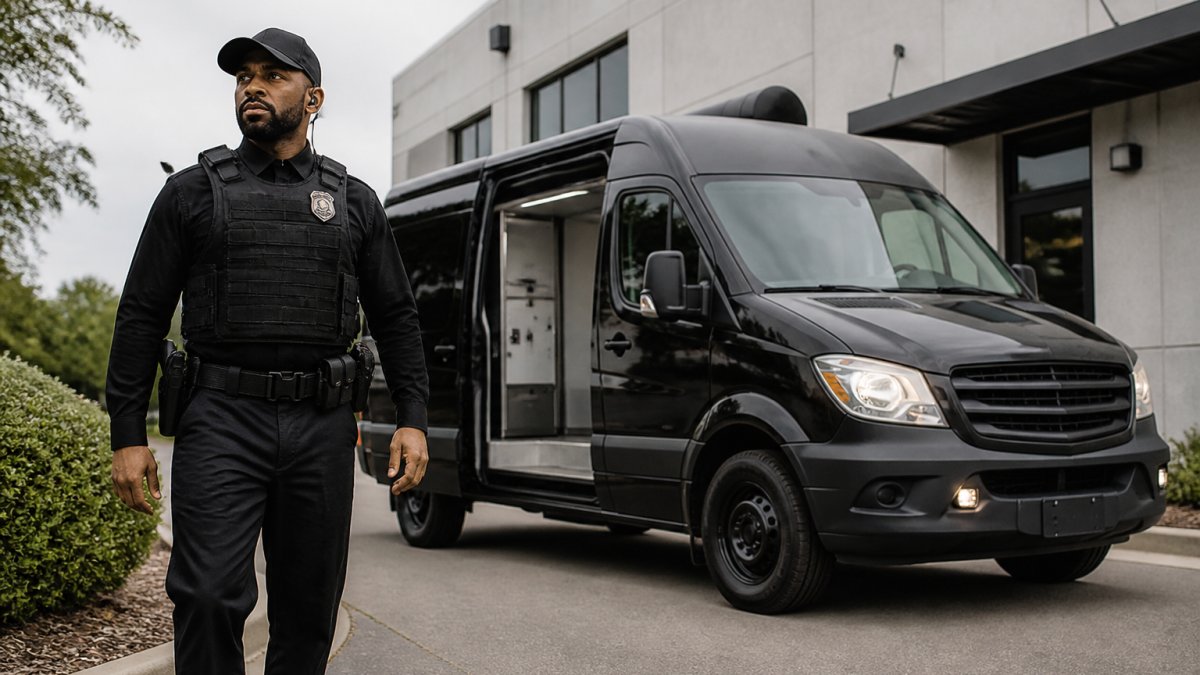
When armed transport is used, whether required or chosen as a risk strategy, specific standards apply.
Vehicle Standards:
Your transport vehicle must be clearly marked or identifiable as a cannabis transport, marked vehicles deter theft more effectively by signaling professional security.
Personnel Qualifications:
Armed security personnel must be licensed by the state, in Florida, a Class D or Class G license depending on the armed work.
Federal Law and Interstate Cannabis Transport Restrictions
Federal law creates a hard boundary: cannabis cannot cross state lines under any circumstances. Federal law treats cannabis as a Schedule I controlled substance, and state legalization doesn't override federal prohibition. You cannot transport cannabis from Florida to another state, bring it in from another state, or cross state lines at all, interstate transport is a federal crime regardless of state laws, even if the destination state also legalized cannabis.
Within Florida, intrastate transport is permitted for licensed facilities, but crossing the state border is a federal violation, a Jacksonville facility cannot transport to a Georgia facility, even if both are licensed.
All transport planning, security measures, and documentation must stay within Florida's borders. If you operate across state lines, each state's product must be managed separately.
Compliance Checklist and Penalties for Transport Violations
Most articles stop at "follow the rules or face penalties", not useful if you're the person signing the manifest.
How to verify the current rules before you rely on them:
- Pull the current Chapter 64-4, Florida Administrative Code, from the OMMU website, it governs MMTC operations including transport.
- Cross-reference Chapter 381, Florida Statutes, for the statutory framework.
- Check the Florida Administrative Register for pending rule amendments affecting transport, manifests, or security.
- If you are an MMTC, confirm obligations against your department-issued license conditions, which can add requirements beyond the general rule.
- Read your insurance transport endorsement, many operators discover their "requirement" for armed transport lives in the policy, not the rule.
Verify at least annually and whenever the department issues a notice of rule development.
Pre-transport checklist:
- Transport manifest completed with product type, quantity, origin license number, destination license number, driver name and ID, vehicle description and plate, departure time, and expected arrival time
- Product weighed and the weight recorded on the manifest at origin
- Product placed in a locked, tamper-evident container inside a compartment not accessible to the driver while the vehicle is moving
- Driver is a licensed employee with valid ID and is listed on the manifest
- Vehicle inspected: locks, lighting, and secure storage all functional
- GPS or equivalent tracking active if your license conditions or insurer require it
- Receiving facility notified of the expected arrival window
- Armed security arranged if required by your license conditions, your insurer, or your own risk assessment
- A copy of the manifest retained at origin
During transport:
- Manifest stays in the vehicle with the product
- Vehicle remains locked when the driver is out of it
- Route follows the planned path; deviations are logged with a reason
- No unauthorized stops
- Communication maintained with dispatch or the receiving facility
At delivery:
- Receiving facility inspects the product and the seal
- Weight is verified against the manifest
- Any discrepancy is documented on the manifest before either party signs
- Both parties sign and date the manifest
- The receiving facility retains its copy; the origin facility retains the original
- Discrepancies above your internal threshold are reported to compliance the same day
What actually triggers enforcement:
In practice, transport violations that draw department attention cluster into four categories:
- Manifest failures, missing fields, unsigned manifests, or manifests that don't match the product in the vehicle. This is the most common finding because it's easiest for an inspector to verify.
- Chain-of-custody breaks, a gap between origin and destination signatures, or an undocumented delay.
- Weight discrepancies, a received weight that doesn't match the manifest beyond reasonable tolerance. A small variance may be a scale issue; a large or repeated variance looks like diversion.
- Security failures, product left in an unlocked vehicle, an unsealed container, or a driver not on the manifest.
Penalty structure, what the consequences actually look like:
Florida's medical marijuana framework gives the department authority over MMTC licenses, and transport violations are handled through that authority. The realistic progression:
- Minor documentation issues typically result in a cited deficiency and a corrective action plan with a deadline.
- Repeated or more serious violations can draw administrative fines and enhanced monitoring, including required reporting on every transport for a period.
- Violations involving diversion, falsified manifests, or large unexplained weight discrepancies can escalate to suspension or revocation of the MMTC license, effectively business-ending, since the license is the only path to legal operation.
- Separately, conduct that looks like theft, fraud, or distribution outside the regulated system can draw criminal exposure under Florida law. Administrative and criminal tracks are independent.
A note on patients and caregivers:
The penalty framework above applies to licensed MMTCs. Patients and caregivers face different consequences, primarily loss of registry status and exposure under general possession law if they exceed limits or transport outside the statute's protections.
The practical takeaway:
Build your transport process around the manifest and chain of custody, the two things the department can verify on the spot. Treat armed transport as a risk and insurance decision layered on top, not the foundation.
Frequently Asked Questions
Is armed transport required for cannabis in Florida?
Armed transport is required for most commercial cannabis operations in Florida, depending on your license type and the amount of product being transported. Retail, wholesale, and cultivation facilities must use armed security personnel during transport of inventory. Patient-to-patient transfers and personal patient transport have different rules. Your specific requirements depend on your license category and the quantity of cannabis being moved. Contact the Department of Health's Office of Medical Marijuana Use or consult your compliance officer to confirm your exact obligations.
What are the main rules for medical marijuana in a vehicle during transport?
Medical marijuana must be transported in sealed, tamper-evident containers with proper labeling that includes the product type, batch number, and weight. The vehicle must have GPS tracking and be operated by authorized personnel with valid identification. All transport must be documented in the state's Metrc tracking system (the Cannabis Tracking System). The product must remain in the vehicle at all times, unattended vehicles are prohibited. Armed security is required for most commercial transport scenarios, with specific exceptions for patient personal use.
Can a medical marijuana patient transport cannabis in a personal vehicle?
Yes, patients with a valid medical marijuana card can transport cannabis for personal use in their own vehicle, but only the quantity allowed under their prescription. Patient transport does not require armed security or commercial-grade vehicle modifications. However, the cannabis must remain in its original, sealed container from the dispensary. The patient must carry their medical marijuana card and identification. Interstate transport remains illegal under federal law, regardless of patient status.
What happens if a cannabis business violates transport compliance rules?
Violations of Florida's cannabis transport requirements can result in fines up to $5,000, suspension or revocation of your operating license, and criminal charges in serious cases. Common violations include transporting without armed security when required, failing to use GPS tracking, improper documentation in Metrc, and using unauthorized personnel. The Department of Health conducts audits and investigations. Penalties increase for repeated violations or large quantities of unaccounted product. Proper training and documentation systems help prevent costly violations.