
Armed Security for Medical Marijuana Facilities: 2026 Guide
Armed security for medical marijuana facilities requires state licensing and specialized training. Compare armed vs unarmed guards and build a compliant.
Table of Contents
- Why Medical Marijuana Facilities Require Specialized Armed Security
- Dispensary Risk Assessment: Identifying Your Facility's Vulnerabilities
- Armed vs Unarmed Security for Dispensaries: Which Model Fits Your Risk Profile?
- Cannabis Security Guard Training Standards and State Licensing Requirements
- Integrating Armed Guards With Surveillance and Access Control Systems
- Managing Liability, Insurance Premiums, and Regulatory Compliance
- Building Your Medical Marijuana Facility Security Plan
- Conclusion
- Frequently Asked Questions
Last Updated: September 9, 2026
Why Medical Marijuana Facilities Require Specialized Armed Security
Medical marijuana facilities hold high-value inventory, operate largely in cash, and face strict regulatory oversight, making them prime targets for organized theft and diversion. Armed security for medical marijuana facilities is a core operational requirement that protects assets, personnel, and your license to operate.
A single security failure can trigger a state compliance audit, result in substantial fines, or lead to suspension of your registration. A visible, professional armed presence deters the most serious threats before they materialize.
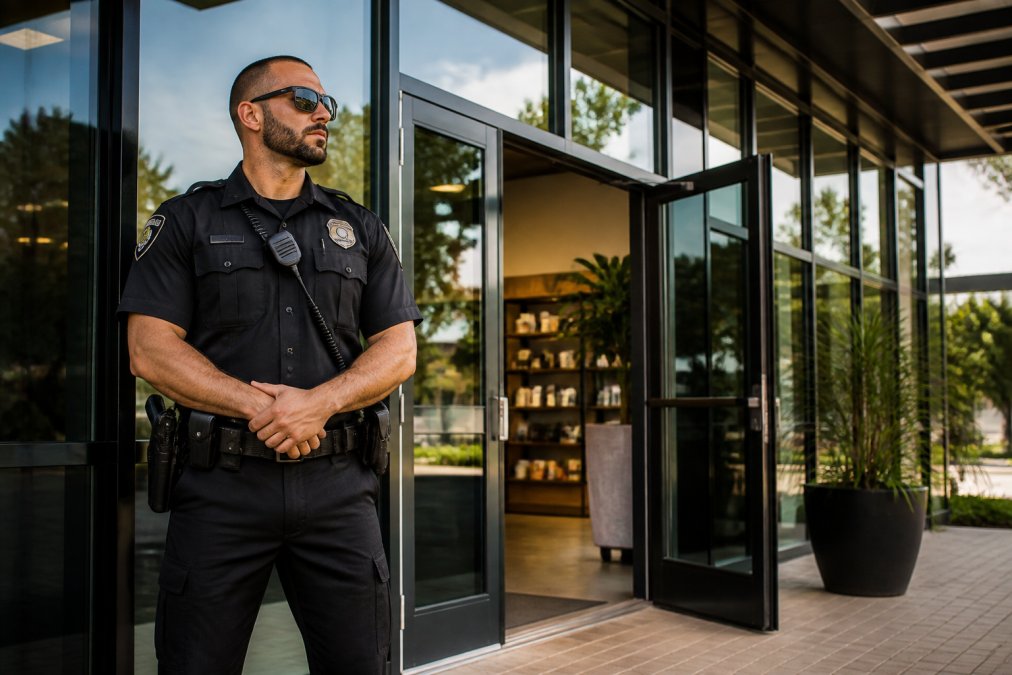
Dispensary Risk Assessment: Identifying Your Facility's Vulnerabilities
A thorough dispensary risk assessment is the foundation of any effective security strategy. You cannot deploy the right resources until you have mapped where your facility is exposed, from the parking lot to the vault.
Start by evaluating these core vulnerability areas:
- Perimeter and entry points: Examine lighting, fencing, and the number of uncontrolled access doors. A poorly lit parking lot or a rear delivery door left unmonitored is an invitation.
- Cash handling and transport: Document every step from point-of-sale to deposit, including how cash moves to the bank and who is involved.
- Inventory storage: Assess the physical security of your vault, storage room, and any processing areas where product sits before packaging.
- Visitor and vendor flow: Trace the path an unauthorized person could take. Does your reception area physically separate the public from operational zones?
Armed vs Unarmed Security for Dispensaries: Which Model Fits Your Risk Profile?
Choosing between armed and unarmed security for dispensaries comes down to a single question: what is the realistic worst-case scenario at your location, and are your guards equipped to handle it?
For a high-volume dispensary in a busy commercial corridor, the presence of an armed security officer is often the decisive factor in preventing a takeover-style robbery, given the large amounts of cash on hand. An armed officer provides a credible deterrent that an unarmed guard, trained primarily for observation and reporting, cannot match. However, armed guards carry a higher liability and require more rigorous training standards.
| Security Model | Best For | Primary Limitation |
|---|---|---|
| Unarmed Security | Low-traffic facilities, delivery logistics, interior customer service | Cannot physically stop an armed robbery attempt |
| Armed Security | High-cash retail dispensaries, grow facilities, transport | Higher liability, requires state-certified licensing |
In practice, many facilities use a hybrid model: an unarmed officer manages the front-of-house and customer flow, while an armed officer controls the vault area, conducts patrols, and handles cash-in-transit movements. This balances deterrence with cost, positioning the armed response exactly where the catastrophic risk lives.
Cannabis Security Guard Training Standards and State Licensing Requirements
Cannabis security guard training standards are a non-negotiable condition of operating legally. Every state with a medical marijuana program imposes specific licensing, background check, and training requirements on security personnel, often exceeding those for general contract security. The specifics vary dramatically by state.
State-by-State Regulatory Models
- Florida (Class D / Class G): Officers must hold a Class D license for unarmed security work and a Class G license to carry a firearm. The Class G requires completion of a state-approved firearms training course, including 28 hours of range and classroom instruction, plus a psychological evaluation. The state also mandates a Level II unarmed training course (40 hours) as a prerequisite.
- California (Guard Card + Firearm Permit): The Bureau of Security and Investigative Services (BSIS) requires a 40-hour training course for the initial guard card (bsis.ca.gov). Armed officers must additionally complete a 14-hour firearms training course and a 4-hour power-to-arrest course, followed by a live-fire qualification. Crucially, California does not have a separate 'cannabis security' license, but the Bureau of Cannabis Control (BCC) regulations require that all security personnel be licensed by BSIS and that the facility's security plan explicitly names the licensed vendor.
- Michigan (CPL + Security License): The Marijuana Regulatory Agency (MRA) requires that all security guards be licensed by the state's Department of Licensing and Regulatory Affairs (LARA). Armed guards must also possess a Concealed Pistol License (CPL) and complete an additional 8 hours of training specific to the MRA's security requirements, which include protocols for transport and diversion prevention.
- New York (New York State Security Guard License): The state requires a 47-hour training course for unarmed guards and an additional 47 hours for armed guards, including firearms qualification. The Office of Cannabis Management (OCM) adds a layer of site-specific security plan approval, which must detail the roles of armed personnel and their interaction with local law enforcement.
The Verification Checklist
Compliance begins with verification. Your security provider must demonstrate that every officer deployed to your site holds the appropriate state license for armed work, which typically involves fingerprinting, a criminal background check, and completion of a certified training course covering firearms proficiency and legal use-of-force. Ask for the following documentation before they ever step on your property:
- Current State Licenses: Request copies of each officer's armed license and verify expiration dates. Do not accept a verbal assurance that they are 'certified.'
- Firearms Qualification Records: Ask for the most recent range qualification scores. Most states require annual or semi-annual re-qualification. A provider that cannot produce these records is a liability.
- Cannabis-Specific Training Certificates: Confirm that officers have completed training on the state's specific cannabis regulations, including chain-of-custody and patient privacy rules (e.g., HIPAA).
- Use-of-Force Policy: Review the provider's written use-of-force policy. It should align with the state's legal standards and your facility's risk assessment.
Beyond the baseline license, look for officers with documented experience in de-escalation and incident response. The regulatory environment demands a guard who understands the legal nuances of a medical facility, including patient privacy laws and the strict rules around inventory access. A guard who cannot articulate the difference between a compliance violation and a security breach is a liability. When vetting a provider, ask for proof of training records and check that their standards align with the state regulations governing medical marijuana security personnel before they ever step on your property.
Integrating Armed Guards With Surveillance and Access Control Systems
The most effective security program treats technology and personnel as a single, integrated system. Armed guards provide the physical response capability, but they are only as effective as the information they receive from your surveillance systems and access control infrastructure.
A modern setup should include high-definition video monitoring covering all entry points, sales floors, and inventory storage areas, with footage retained according to state rules. This camera network is a live feed that allows your security team to spot a threat developing in the parking lot before it reaches the door. Access control systems, using keycards or biometric readers, ensure that only authorized personnel can enter the vault or processing areas, creating a digital audit trail that satisfies compliance audits.
Your armed officer must be trained to monitor these systems, not just stand at the door. When the access control system flags an anomaly, such as an after-hours entry attempt, the officer needs a clear protocol for verification and response. This convergence of human judgment and technological reach separates a professional operation from a static guard post. A provider that cannot articulate how its officers interface with your existing systems is offering a warm body, not a security solution.
Managing Liability, Insurance Premiums, and Regulatory Compliance
Deploying armed security introduces a new layer of risk management that extends beyond the physical threat. You must carefully manage liability exposure, the impact on insurance premiums, and the constant requirement for regulatory compliance. The presence of firearms on your premises fundamentally changes how insurers underwrite your policy and how much you pay for coverage.
How Armed Security Affects Your Insurance Premiums
Most commercial property and casualty insurers view armed guards as a double-edged sword. They reduce the risk of catastrophic loss from robbery, which can lower theft and property damage premiums, but they introduce a new liability vector: the risk of negligent discharge, wrongful shooting, or excessive force. The presence of firearms on your premises fundamentally changes how insurers underwrite your policy and how much you pay for coverage.
To manage this cost, you must understand the specific coverage types at play:
- General Liability (GL): This covers third-party bodily injury or property damage. If a guard accidentally injures a customer, this policy responds. Insurers will scrutinize the guard's training hours and your provider's vetting process.
- Professional Liability (Errors & Omissions): This covers claims of inadequate security performance, such as failure to prevent a foreseeable robbery. If a plaintiff argues that your armed guard failed to act, this coverage is critical.
- Workers' Compensation: Armed guards are classified as higher-risk employees. Your provider's workers' comp premium will be higher, and that cost is typically passed on to you in the hourly rate.
The Additional Insured Endorsement
One of the most significant oversights is failing to vet the security provider's own insurance coverage. If an incident occurs and the guard's employer lacks adequate general liability and professional liability coverage, the lawsuit lands at your facility's door. Verify that your provider carries sufficient coverage and that your facility is named as an additional insured on their policy. This single step can protect you from catastrophic financial exposure. For context on why this matters, the broader security industry sees frequent litigation over inadequate vetting and training, as documented in industry analyses of security contractor liability.
A standard additional insured endorsement should include:
- Primary and Non-Contributory Language: This ensures that if a claim arises, the security provider's policy pays first, before your own.
- Waiver of Subrogation: This prevents the provider's insurer from suing you to recover costs paid out on a claim.
- Contractual Liability Coverage: This covers liabilities you assume in the security services contract.
Regulatory Compliance as a Continuous Process
Regulatory compliance is a continuous process, not a one-time checkbox. State agencies conduct unannounced audits, and they will scrutinize your security logs, incident reports, and training documentation. Your security team must maintain meticulous records of every patrol, every alarm response, and every visitor. A strong compliance posture requires a partner who understands that the paper trail is as important as the patrol itself.
Building Your Medical Marijuana Facility Security Plan
Synthesizing these elements into a written security plan is the final, essential step. A verbal agreement or a handshake with a security firm is not a compliance strategy. Your plan must be a living document that details protocols for every scenario.
Structure your plan around these core components:
- Site-Specific Post Orders: Define exactly what the armed guard does at each location, from opening procedures to vault access and closing checks.
- Emergency Protocols: Outline specific responses to robbery, fire, medical emergencies, and security breaches, including who to contact and when to involve law enforcement.
- Chain-of-Custody Documentation: Establish a clear process for tracking inventory and cash movements, with sign-offs at every transfer point.
- Communication Procedures: Define how your security team communicates with management and local law enforcement, ensuring a rapid, coordinated response.
This plan should be reviewed and updated at least annually or whenever you expand your facility. When you partner with a provider, ensure they are willing to collaborate on this document rather than forcing you into a generic template. The right partner will conduct a site survey, review your dispensary risk assessment, and tailor post orders to your specific layout and operational hours.
Conclusion
Securing a medical marijuana facility demands a specialized approach that balances physical deterrence, technological integration, and strict adherence to state regulations. The margin for error is thin, and the consequences of a security failure extend far beyond lost product to include legal liability and potential loss of your license.
Building this level of protection requires a security partner with the scale and expertise to handle the unique demands of the cannabis industry. Ranger Operation Services deploys state-certified Class D and G officers with Level IV training, supported by a four-hour statewide deployment window and 24/7 dispatch. Our team of over 500 licensed professionals provides the armed and unarmed coverage needed for dispensaries, grow facilities, and transport, with a proprietary mobile app that gives you real-time tracking from dispatch to completion. Book Security with Ranger Operation Services and establish a security posture that protects your assets and your compliance standing.
Frequently Asked Questions
Why do medical marijuana facilities require specialized armed security?
Medical marijuana facilities hold high-value inventory in cash-heavy environments, making them frequent targets for robbery and diversion. State regulations often mandate a documented security presence with specific training. Specialized armed security personnel understand chain-of-custody documentation, inventory control protocols, and the compliance standards set by state regulators. Their role goes beyond deterrence to include visitor management, escorting staff during cash drops, and providing a trained response during an active threat or attempted theft.
What are the legal requirements for armed security guards in cannabis facilities?
Legal requirements vary by state, but most mandate a state-issued armed guard license, which requires classroom training, range qualification, and a clean criminal background check. Many states add cannabis-specific rules covering surveillance integration, incident reporting timelines, and coordination with local law enforcement. Guards must also maintain current certifications and complete ongoing training to stay compliant. A reputable security provider handles these licensing and compliance steps so your facility does not risk fines or license suspension from regulatory violations.
How does armed security differ from unarmed security for dispensaries?
Unarmed guards focus on access control, customer service, and observation. They can de-escalate situations but cannot stop an armed robbery. Armed guards provide a visible deterrent against violent crime and are trained to respond to active threats. For dispensaries in high-crime areas or those handling substantial cash volumes, the presence of an armed security officer reduces response time during a critical incident. The choice depends on your risk assessment, local crime data, and the specific requirements of your state license.
What training should armed security guards have for high-risk cannabis sites?
Beyond standard armed guard certification, guards at cannabis sites need training in de-escalation, emergency protocols, and state-specific cannabis regulations. Look for guards with Level IV training and experience in cash management, chain-of-custody procedures, and coordination with local law enforcement during an incident. They must be able to write accurate incident reports that satisfy regulatory review. Ask your provider how they verify ongoing training and whether their officers receive site-specific orientation before their first shift.
How do you choose between armed and unarmed security for a medical marijuana facility?
Start with a facility risk assessment that examines your location, layout, cash handling procedures, and local crime statistics. Compare the value of your inventory and the volume of daily transactions. If your assessment shows elevated risk of robbery or diversion, armed security is the appropriate choice. Also review your state regulations, since some jurisdictions require armed personnel for certain facility types. A security consultant can help you document this decision for your compliance file.