
Rapid Deployment Security for Emergencies: A 2026 Guide
Learn how rapid deployment security for emergencies protects sites in hours. Explore guard deployment times, surveillance trailers, and real-time tracking.
Table of Contents
- What Rapid Deployment Security for Emergencies Actually Means
- Emergency Security Guard Deployment Time: What Response Speed Is Possible
- Rapid Deploy Surveillance Trailers: Mobile Deterrence in Hours
- The Benefits of Real Time Security Tracking During an Incident
- Building a Rapid Deployment Security Plan for Your Facility
- Cybersecurity and Data Recovery for Mobile Security Networks
- Cost-Benefit Analysis: Emergency Preparedness vs. Incident Losses
- Conclusion: Building a Rapid Deployment Security Strategy
- Frequently Asked Questions
Last Updated: September 6, 2026
What Rapid Deployment Security for Emergencies Actually Means
Rapid deployment security for emergencies is the structured process of placing security personnel, surveillance assets, and physical deterrents at a threatened site within hours of an incident alert, rather than days. It is a pre-planned operational capability, not a reactive scramble. The goal is to restore order, protect critical infrastructure, and maintain operational continuity before a situation escalates into significant loss.
Most facility managers do not realize how fast a minor incident becomes a major liability. A trespasser on a construction site can strip high-value materials overnight. A loitering issue at a commercial property can drive tenants away. In an emergency, every hour of unprotected exposure compounds the risk. At Ranger Operation Services, we have spent over eight years building a deployment model that treats speed as the primary security variable, which is why we guarantee a four-hour statewide deployment window backed by 24/7 dispatch.
The distinction between a standard security contract and rapid deployment capabilities comes down to readiness. Traditional firms staff recurring posts. A rapid deployment model holds personnel, equipment, and surveillance assets in a state of constant availability. This guide explains how that readiness works, what response speeds are realistic, and how to build a plan that protects your facility when minutes matter most.
Emergency Security Guard Deployment Time: What Response Speed Is Possible
A realistic emergency security guard deployment time for a professional firm with standing resources is four hours or less from the initial call (fema.gov). This window covers dispatch coordination, travel to the site, and the initial post establishment. Faster response is possible in urban cores where officers are already patrolling nearby, but four hours is the benchmark a facility manager should demand from any provider.
The logistics behind that timeline require a specific operational structure. First, the provider must have a 24/7 dispatch center that answers immediately, regardless of whether the call comes at 2 AM on a Sunday. Second, the responding officers must be licensed and trained in advance, not hired and vetted on the spot. Third, the firm needs a regional footprint large enough to have personnel within driving distance of your site.
When vetting a provider, ask directly about their after-hours staffing model. Many firms advertise rapid response but rely on on-call officers who may be hours away. A genuine rapid deployment capability means a named supervisor coordinates your response and a licensed team is rolling before you hang up the phone.
Rapid Deploy Surveillance Trailers: Mobile Deterrence in Hours
Rapid deploy surveillance trailers are self-contained mobile security units that provide high-visibility deterrence, real-time monitoring, and autonomous operation at a site within hours of arrival. These trailers function as a temporary security command post, bridging the gap between the moment an incident is reported and the establishment of a permanent security presence.
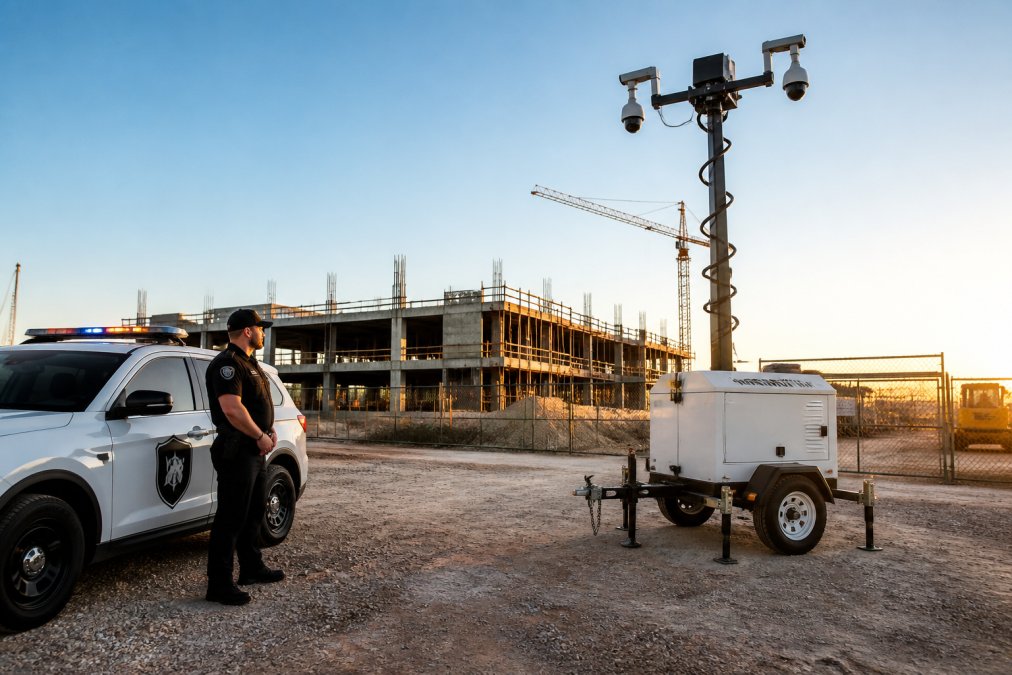
A typical deployment involves positioning the trailer at a chokepoint or perimeter breach, extending the camera mast for maximum sightlines, and connecting to a wireless network for remote access. Because these units run on off-grid power sources, they function independently of the site's electrical infrastructure. This makes them effective for disaster response scenarios where standard utilities are compromised.
The deterrence value is immediate. A well-lit trailer with visible cameras and motion-activated lighting signals to trespassers that the site is under active surveillance. For construction sites suffering material theft or commercial properties facing loitering, the visual presence of a surveillance trailer often resolves the issue without requiring an arrest. The trailer provides situational awareness while your security personnel manage access control and incident response on the ground.
The Benefits of Real Time Security Tracking During an Incident
Real time security tracking transforms a security deployment from a static presence into an active intervention tool. The benefits of real time security tracking include immediate visibility into officer location, live status updates on incident resolution, and a verifiable record of activity that protects both the client and the security provider.
During an emergency, information is the most valuable asset. A property manager needs to know if the responding officer has arrived, what they are observing, and whether the threat is contained. Traditional security firms provide this information through phone calls and paper logs, which are slow and often inaccurate. A modern deployment uses GPS-enabled tracking and a dispatch platform that shows assignment status from dispatch to completion.
This transparency matters for compliance-heavy industries. A medical marijuana treatment center, for instance, requires documented chain-of-custody for transport and a clear record of any security incidents. Real time tracking provides an audit trail that satisfies regulatory scrutiny. For a retail chain dealing with organized crime, the data helps loss prevention managers coordinate with local law enforcement on active incidents.
Building a Rapid Deployment Security Plan for Your Facility
A rapid deployment security plan is a pre-written operational playbook that specifies the trigger events, response protocols, and asset assignments for your facility before an emergency occurs. The plan should detail who to call, what assets are required, and how the site will be secured until the threat is neutralized.
The first step is a vulnerability assessment. Walk your property and identify the highest-risk entry points, the most valuable assets, and the areas where loitering or theft typically occurs. For a construction site, this might be the equipment storage yard. For a commercial property, it might be the parking garage or loading dock. This assessment determines where your mobile surveillance and officers will focus during an emergency response.
Next, establish your trigger events. Define the specific incidents that warrant a rapid deployment call, such as a break-in attempt, a fire, a civil disturbance, or a public health emergency requiring site closure. Clear triggers prevent hesitation during a crisis. Finally, select a primary security provider and a backup. Document their phone numbers, your account details, and the specific deployment assets you expect them to bring. Review this plan annually and after any major incident.
A common mistake is treating the plan as a one-time document. Facility layouts change, new construction phases open new vulnerabilities, and staffing rotates. An outdated plan is as dangerous as no plan. Schedule a quarterly review to confirm contact information is current and the response strategy still matches the physical reality of your site.
Regulatory and Compliance Standards to Review First
Before contracting for emergency security services, verify that the provider holds the required state licenses and that their officers meet the mandated training standards for your jurisdiction. In Florida, this means state-certified Class D and G officers (fdacs.gov). Class D covers security officer training, while Class G authorizes armed officers. Compliance officers at sensitive facilities, such as medical marijuana treatment centers, should confirm that the provider's chain-of-custody documentation meets state reporting requirements.
The legal framework for private security is enforced at the state level, so the specific requirements vary by location. Review your state's licensing board regulations to confirm the provider's credentials are current and that their insurance coverage is adequate. A reputable firm carries general liability insurance, and you should request a certificate of insurance naming your facility as an additional insured before any deployment occurs.
Cybersecurity and Data Recovery for Mobile Security Networks
The cameras and sensors on a mobile surveillance trailer are network endpoints, which means they are vulnerable to the same cyber threats as any other connected device. If an attacker compromises the trailer's network, they could disable the cameras, spoof the video feed, or use the connection as a foothold to attack your facility's broader IT infrastructure.
The first defense is network segmentation. The mobile security network should operate on a separate, isolated connection from your facility's business network. This limits the blast radius if the surveillance system is breached. The second defense is encryption. All video feeds and remote access connections should be encrypted in transit and at rest to prevent interception. The third is access control. Limit administrative access to the surveillance platform to named individuals, and require strong, unique credentials.
Post-incident data recovery is a critical but often overlooked capability. If the emergency involves a criminal act, the video footage becomes evidence. Your security provider should have a protocol for preserving and exporting footage in a format that maintains its chain of custody for law enforcement. Ask your provider how they handle forensic data recovery and whether their storage infrastructure has redundancy to survive a physical attack on the trailer itself.
Cost-Benefit Analysis: Emergency Preparedness vs. Incident Losses
The cost of a rapid deployment security contract is almost always lower than the financial loss from a single unprotected incident. The calculation is straightforward: compare the annual cost of a standby deployment capability against the cost of one major theft, one liability lawsuit from an on-site injury, or one week of operational downtime.
For a construction site holding high-value materials, a single overnight theft can easily exceed the annual cost of a mobile surveillance and patrol contract. The same logic applies to a commercial property facing a lawsuit over a security failure on the premises. The Federal Emergency Management Agency guidance on business preparedness consistently emphasizes that mitigation investments made before a disaster are significantly more cost-effective than recovery expenses after one.
A full cost-benefit analysis should include both direct and indirect losses. Direct losses include stolen materials, damaged equipment, and legal settlements. Indirect losses include project delays, tenant attrition, and reputational damage. When both categories are factored in, the return on investment for emergency preparedness becomes clear. The question is not whether you can afford a rapid deployment plan, but whether you can afford to operate without one.
| Cost Factor | Without Rapid Deployment | With Rapid Deployment |
|---|---|---|
| Overnight material theft | Full replacement cost | Deterred or interrupted |
| Liability from on-site incident | Legal fees + settlement | Managed access control |
| Operational downtime | Extended shutdown | Rapid restoration |
| Tenant / client confidence | Eroded | Reinforced |
| Regulatory compliance | At risk | Documented |
Conclusion: Building a Rapid Deployment Security Strategy
The most dangerous assumption in facility management is that an emergency will not happen on your watch. Theft, loitering, and civil disturbances are not hypotheticals; they are recurring operational risks that require a planned response. A rapid deployment security strategy shifts your posture from reactive to prepared, ensuring that personnel and surveillance assets are on site within hours, not days.
Building that strategy starts with selecting a partner who operates with the speed and accountability the situation demands. Ranger Operation Services provides a four-hour deployment window across Florida, staffed by over 500 licensed Class D and G officers. Our proprietary mobile app gives you live tracking of your assignment from dispatch to completion, and a named regional supervisor oversees every client engagement. For construction sites, commercial properties, and compliance-sensitive facilities, we build security plans around your specific risks, not a standard package.
Get started with Ranger Operation Services and put a rapid deployment plan in place before you need it. Book Security to discuss your facility's emergency response requirements.
Frequently Asked Questions
What does rapid deployment mean for security services?
Rapid deployment means a security provider can have personnel and equipment on site within hours of a request, not days. For emergencies like break-ins, vandalism, or severe weather damage, this speed prevents further loss. A reasonable benchmark is a guaranteed deployment window of four hours or less, backed by 24/7 dispatch. Ask any provider for their documented average response time before signing a contract.
How does rapid deployment security differ from standard guard services?
Standard guard services typically operate on a fixed schedule at a permanent location. Rapid deployment security is designed for sudden, temporary needs: a burst pipe flooding a retail store, a trespassing surge at a vacant property, or a high-value asset arriving at a construction site. Providers use mobile units, on-call officers, and surveillance trailers to establish a security presence quickly, then scale down when the risk passes.
What industries benefit most from rapid deployment security?
Property managers facing loitering incidents, general contractors protecting materials after a break-in, and loss prevention teams responding to organized retail crime all rely on rapid deployment. Facilities managing public health emergencies or critical infrastructure issues also use these services to maintain operational continuity. The common thread is a sudden security gap that needs immediate coverage to prevent theft, damage, or liability.
Why is 24/7 dispatch support critical for emergency security?
Emergencies do not follow business hours. A break-in at 2 AM on a Sunday requires the same response as one at 2 PM on a Tuesday. Dispatch support that operates around the clock ensures a licensed officer is assigned immediately, not when the office reopens. This continuous coverage is what separates a rapid deployment provider from a traditional firm with limited after-hours staffing.