
How to Secure Construction Equipment: 2026 Guide
Learn how to secure construction equipment with FMCSA tie-down rules, theft prevention tactics, and site security checklists. Get expert guidance today.
Table of Contents
- What You'll Need Before Securing Construction Equipment
- FMCSA Tie-Down Requirements for Heavy Equipment Transport
- Step-by-Step: How to Secure Construction Equipment on a Trailer
- Construction Site Theft Prevention: Overnight and Long-Term Security
- Insurance, Liability, and Post-Theft Recovery Protocols
- Best Security Guards for Construction Sites: What to Look For
- Common Mistakes That Leave Equipment Vulnerable
- Frequently Asked Questions
Last Updated: September 2, 2026
Securing construction equipment correctly is one of those things that looks straightforward until something goes wrong, and when it goes wrong, the consequences range from a DOT citation to a catastrophic road accident or a six-figure theft loss. At Ranger Operation Services, we work with general contractors and site managers daily, and the same vulnerabilities come up repeatedly: improper tie-downs, no overnight access control, and zero post-theft protocol. This guide covers how to secure construction equipment from the ground up, spanning FMCSA-compliant transport procedures, site theft prevention, and the human security layer that technology alone can't replace.
Below, we'll walk through every stage, what to check before you load, how to meet federal tie-down standards, and what a professional site security plan actually looks like in practice.
What You'll Need Before Securing Construction Equipment
Preparation determines everything. Most transport incidents and theft events share a common root: someone skipped the pre-job checklist.
Assessing Load Capacity and Weight Distribution
Load capacity is the non-negotiable starting point for any equipment transport. Every trailer has a Gross Vehicle Weight Rating (GVWR) that defines the maximum combined weight it can legally and safely carry. Before loading any heavy equipment, confirm the machine's operating weight against the trailer's rated capacity, and account for fuel, attachments, and any material still in the bucket or bed.
Weight distribution matters just as much as total weight. Placing too much mass toward the rear causes trailer sway; front-loading creates steering instability in the tow vehicle. A general rule of thumb is to position approximately 60% of the load weight forward of the trailer's axle centerline. For wider or asymmetric equipment, consult the manufacturer's load chart.
Inspecting Tie-Downs, Chains, and Securing Hardware
Never assume last week's chains are still serviceable. Before every load, inspect each securing device for:
- Cracks, kinks, or deformation in chain links
- Worn or stretched ratchet binder mechanisms
- Frayed wire rope or broken strands
- Bent, cracked, or elongated hooks and shackles
- Corrosion that compromises working load limit ratings
Any hardware showing visible damage must be retired immediately. The working load limit (WLL) stamped on each device is based on undamaged, properly maintained equipment. Using compromised securing hardware doesn't just risk a citation, it risks losing the load at highway speed.
FMCSA Tie-Down Requirements for Heavy Equipment Transport
Federal Motor Carrier Safety Administration regulations govern how heavy equipment must be secured during transport on public roads. According to the FMCSA cargo securement rules for heavy vehicles, Part 393 of the Federal Motor Carrier Safety Regulations establishes specific tie-down requirements for equipment in the heavy vehicle and construction equipment category. Compliance isn't optional, violations carry fines, out-of-service orders, and potential liability in the event of an incident.
Working Load Limits and Attachment Points
Working load limit (WLL) is the maximum load a single tie-down device is rated to restrain under normal transport conditions. FMCSA regulations require that the combined WLL of all tie-downs used equals at least half the weight of the article being secured.
Attachment points are equally regulated. Tie-downs must connect to dedicated anchor points on the trailer, not to structural members not designed for that purpose. Equipment being secured must also have its own attachment points (typically manufacturer-installed D-rings or tie-down lugs) rated to handle the applied forces. Improvised attachment to bucket arms, cylinders, or cab structures is a compliance violation and a safety hazard.
Chains, Ratchet Binders, and Lever Binders: Choosing the Right Device
The choice between ratchet binders and lever binders comes down to application and operator preference, but both must meet Grade 70 or higher chain standards for heavy equipment transport.
| Device | Best For | Key Advantage | Key Limitation |
|---|---|---|---|
| Ratchet binders | Long hauls, highway speeds | Precise tension control | Slower to apply |
| Lever binders | Short hauls, frequent stops | Fast application | Less consistent tension |
| Wire rope | Irregular load shapes | Flexible routing | Lower WLL per diameter |
| Steel strapping | Machinery with smooth surfaces | Broad contact area | Single-use, specialized |
Grade 70 transport chain is the standard for heavy equipment. Grade 43 chain is not compliant for this application. Always match chain size and grade to the WLL requirement calculated for the specific load.
Step-by-Step: How to Secure Construction Equipment on a Trailer
Knowing the rules is one thing. Executing the load correctly under time pressure on a job site is another. This is where most compliance failures actually happen.
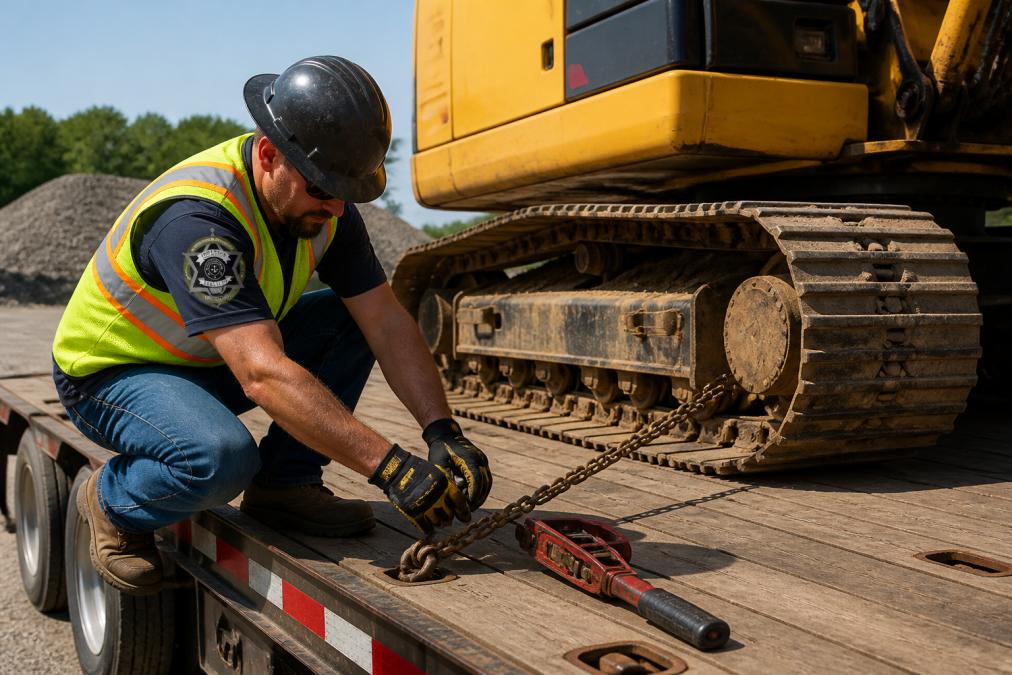
Loading Procedures and Independent Corner Tie-Downs
Position the equipment on the trailer before attaching any tie-downs. Drive or lift the machine to its intended transport position, then:
- Engage the parking brake and lower all attachments to the deck
- Shut off the engine and remove the key
- Chock the wheels with rated wheel chocks fore and aft on at least one axle
- Attach the first tie-down to the forward driver-side attachment point
- Attach the second tie-down to the forward passenger-side attachment point
- Repeat for the rear attachment points, these four independent corner tie-downs are the baseline requirement for most heavy equipment
Independent corner tie-downs mean each of the four corners has its own chain and binder, running to a dedicated trailer anchor. Crossing chains from front to rear (X-pattern) adds additional lateral stability and is recommended for equipment over 10,000 lbs.
Slack Adjustment and Mid-Trip Inspection Checks
After all tie-downs are connected, tension each binder until there is no visible slack in the chain. The chain should be taut but not stretched, over-tensioning can damage attachment points and distort the trailer deck.
FMCSA regulations require a mid-trip inspection after the first 50 miles of transport, and thereafter at each change of duty status or every 150 miles, whichever comes first. During each inspection, check:
- Chain tension (re-tighten any that have loosened)
- Binder handle position (should still be in locked position)
- Wheel chock placement
- Any visible equipment movement relative to the trailer deck
Construction Site Theft Prevention: Overnight and Long-Term Security
Heavy equipment theft is a persistent and expensive problem across the construction industry. The National Insurance Crime Bureau tracks construction equipment theft as a significant loss category, and recovery rates remain low because stolen equipment is difficult to identify without proper asset documentation. The best approach to theft prevention layers physical deterrents, electronic monitoring, and human oversight.
Access Control and Site Perimeter Measures
A construction site without defined access control is an open invitation. Effective site security starts at the perimeter:
- Fencing: Minimum 6-foot chain-link with locked gates at all entry points. Temporary fencing should be anchored to prevent displacement.
- Lighting: Motion-activated lighting at equipment storage areas, material stockpiles, and entry gates significantly reduces opportunistic theft.
- Key control: Equipment keys should never be left in machines overnight. Maintain a key log and restrict access to authorized operators only.
- Equipment immobilization: Hydraulic locks, fuel shutoffs, and battery disconnect switches add a mechanical layer that slows theft even when other controls fail.
Signage indicating active surveillance and security patrol presence acts as a deterrent before an intruder commits to entry.
GPS Tracking, Surveillance Cameras, and Digital Asset Management
GPS tracking is now standard practice for any fleet of heavy equipment. Modern telematics systems provide real-time location data, geofence alerts when equipment leaves a defined area, and engine hour monitoring that can flag unauthorized use outside scheduled shifts. According to the National Equipment Register theft recovery resources, equipment registered with a national asset database has significantly higher recovery rates after theft.
Surveillance cameras should cover all equipment storage zones with overlapping fields of view. Cameras positioned at entry and exit points capture vehicle and personnel movement that becomes critical evidence after an incident.
Digital asset management integration, maintaining a digital record of each machine's serial number, PIN, photos, and ownership documentation, is the step most contractors skip and most regret. When equipment is stolen, the ability to provide law enforcement with complete asset records accelerates recovery and insurance claims.
Insurance, Liability, and Post-Theft Recovery Protocols
Insurance coverage for construction equipment is more nuanced than most contractors realize. Standard commercial general liability policies typically do not cover equipment theft, that requires a separate inland marine or equipment floater policy. Before assuming coverage, verify:
- Whether the policy covers equipment in transit separately from equipment on-site
- The deductible structure for theft claims versus damage claims
- Whether coverage requires proof of specific security measures (locked storage, GPS tracking)
Liability exposure during transport is equally important. If improperly secured equipment falls from a trailer and causes injury or property damage, the carrier, the contractor, and potentially the equipment owner all face exposure. FMCSA violations documented at the time of an incident are treated as evidence of negligence in civil litigation.
Post-theft recovery protocols should be established before a theft occurs, not after. A documented response plan includes:
- Immediate notification to local law enforcement with complete asset records
- Filing a report with the National Insurance Crime Bureau
- Notifying your insurance carrier within the required reporting window
- Alerting regional equipment dealers and auction houses, who often encounter stolen equipment
- Providing GPS tracking data to law enforcement if available
The FBI's National Crime Information Center equipment theft guidance recommends filing reports as quickly as possible to maximize the window for recovery before stolen equipment crosses state lines or is disassembled.
Best Security Guards for Construction Sites: What to Look For
Physical security personnel remain one of the most effective deterrents against both theft and unauthorized access. The best security guards for construction sites bring a combination of licensing, site-specific training, and the judgment to de-escalate situations before they become incidents.
What separates an effective construction site guard from a warm body holding a flashlight:
- State licensing: Guards must hold a valid Class D license at minimum. Armed guards require a Class G license. Verify credentials before deployment, not after a problem surfaces.
- Incident reporting capability: A guard who cannot produce a clear, accurate written incident report creates liability, not protection. This is a non-negotiable baseline.
- Site familiarity: Effective guards understand the equipment, the layout, and the access patterns of the specific site they're protecting.
- Communication protocols: Guards should have direct lines to a 24/7 dispatch center, not just a supervisor's cell phone.
Ranger Operation Services deploys state-certified Class D and G officers to construction sites, with a named regional supervisor assigned to every client account. The 4-hour statewide deployment window means that when a site's security situation changes overnight, coverage can be adjusted before the next shift starts.
Common Mistakes That Leave Equipment Vulnerable
Most equipment losses are preventable. The same mistakes appear across job sites of every size:
- Leaving keys in equipment overnight. This single habit accounts for a disproportionate share of opportunistic theft. No exceptions.
- Using non-compliant securing hardware. Grade 43 chain, worn binders, and improvised attachment points fail both legally and physically.
- Treating perimeter fencing as the only control. Fencing slows entry; it doesn't stop a determined thief with bolt cutters and 20 minutes.
- No documented asset records. Without serial numbers, photos, and ownership documentation, stolen equipment is nearly impossible to recover or claim on insurance.
- Skipping mid-trip inspections. Chains loosen during transport. An inspection that takes 10 minutes prevents a load shift that causes a multi-vehicle accident.
- Relying on surveillance cameras without monitoring. Cameras that record but aren't monitored are evidence tools, not prevention tools.
The most effective sites treat transport compliance and on-site security as a continuous system, not two separate checklists. According to the OSHA construction site safety standards, documented safety and security procedures also reduce regulatory exposure across other areas of site management.
Construction equipment losses, through accidents, theft, or regulatory fines, are almost always the result of skipped steps and assumed coverage. Ranger Operation Services provides construction site security with licensed Class D and G officers, 24/7 dispatch support, and a 4-hour deployment guarantee. Book Security with Ranger Operation Services and get a site-specific protection plan built around your equipment, your schedule, and your risk profile.
Frequently Asked Questions
What are the FMCSA tie-down requirements for heavy equipment?
FMCSA regulations under 49 CFR Part 393 require that heavy equipment be secured with tie-downs whose combined working load limit equals at least half the weight of the load. Equipment over 10,000 lbs must have a minimum of four tie-downs, one at each independent corner. Chains, wire rope, ratchet binders, and steel strapping are all accepted securing devices provided they meet the working load limit thresholds. Mid-trip inspections are required after the first 50 miles and periodically thereafter.
How many chains are required to secure an excavator on a trailer?
At minimum, four chains are required to secure an excavator on a trailer under FMCSA load securement rules, one at each independent corner of the machine. For heavier excavators, additional chains may be needed to meet the working load limit requirement that combined tie-down capacity equals at least half the machine's weight. Always verify the attachment points on the excavator frame are rated for transport loads, and use appropriately graded chain with lever or ratchet binders to maintain tension.
How do you secure construction equipment on a job site overnight?
Overnight site security should layer multiple measures. Start with physical deterrents: lock cabs, remove keys, and engage equipment immobilizers. Install GPS tracking devices on high-value machines so any movement triggers an alert. Secure the perimeter with fencing, lighting, and surveillance cameras covering all entry points. Access control, whether a manned security guard post or electronic gate system, significantly reduces theft risk. Posting a licensed security guard overnight is one of the most effective deterrents against both opportunistic and organized theft.
What are the most effective ways to prevent construction equipment theft?
Construction site theft prevention works best as a layered strategy. GPS tracking allows real-time location monitoring and rapid post-theft recovery. Surveillance cameras and motion-activated lighting deter trespassers. Access control limits who enters the site. Marking equipment with VIN etching or paint codes makes resale harder. Operator training ensures staff recognize and report suspicious activity. Finally, on-site or roving security guards provide a visible human deterrent that cameras alone cannot replicate, especially during overnight hours.
This article was written using GrandRanker