
Modernizing HOA Gatehouse Security Operations
Modernize HOA gatehouse security operations with cloud access control, visitor management software, and integrated guard protocols. Learn how.
Table of Contents
- Why Traditional Gatehouse Operations Are Failing HOAs
- Cloud-Based Access Control and Visitor Management Software
- Best Practices for HOA Gatehouse Security
- Integrating Security Guards With Access Control Systems
- Camera Verification, Digital Audit Trails, and Remote Monitoring
- Cybersecurity, Data Privacy, and PMS Integration
- ROI and Long-Term Maintenance Costs
- Frequently Asked Questions
Last Updated: September 29, 2026
Why Traditional Gatehouse Operations Are Failing HOAs
Modernizing HOA gatehouse security operations starts with admitting the old model is broken. Paper visitor logs, clipboards, and a single guard booth cannot keep up with how people actually move through a gated community in 2026. This guide from Ranger Operation Services breaks down what to replace, what to keep, and what it costs to get it right.
Cloud-Based Access Control and Visitor Management Software
Cloud-based access control is a system that stores credential data, visitor records, and entry permissions on remote servers rather than on a local gatehouse computer. It lets boards manage access from anywhere and gives guards real-time information instead of a paper log.
| Function | Manual Gatehouse | Cloud-Based System |
|---|---|---|
| Visitor check-in | Clipboard, guard call | Automated check-in, pre-authorization |
| Resident database | Paper binder | Live, editable, searchable |
| Audit trail | None or inconsistent | Digital audit trail, timestamped |
| Vendor access | Ad hoc | Credential access with expiration |
| Remote management | Not possible | Full remote monitoring |
Best Practices for HOA Gatehouse Security
The best practices for HOA gatehouse security come down to three rules: verify every entry, log every event, and review the log weekly. Systems that skip any one of these create gaps that trespassers and vendors exploit.
- Assign every resident a unique credential, never a shared code
- Set vendor access to expire at the end of the scheduled window
- Require photo ID for all non-resident entries
- Review the digital audit trail every Monday morning
- Test the gate fail-safe and fail-secure modes quarterly
- Update the resident database within 48 hours of any move-out
Integrating Security Guards With Access Control Systems
Integrating security guards with access control systems means the guard becomes a decision-maker, not a data entry clerk. The software handles routine entries. The guard handles exceptions, disputes, and anything that requires judgment.
Camera Verification, Digital Audit Trails, and Remote Monitoring
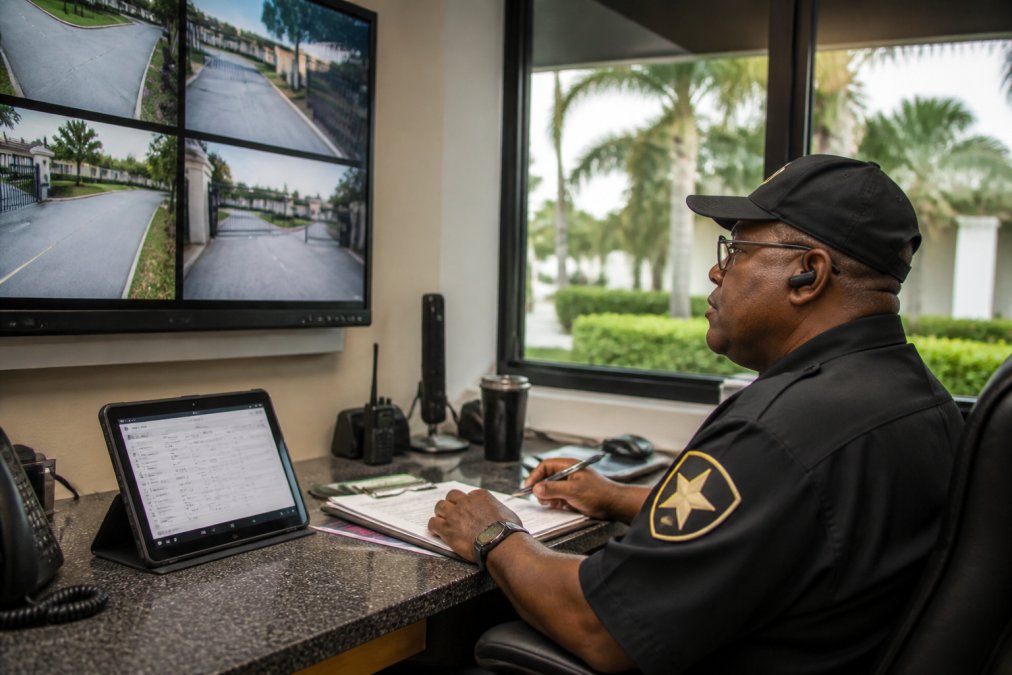
Cybersecurity, Data Privacy, and PMS Integration
The actual threat model
Gate systems fail in three predictable ways, and each has a different fix.
- Credential compromise. A resident shares a guest code, a vendor reuses a PIN, or a board member's login is phished. The fix is per-person credentials with expiration, plus multi-factor authentication on any account that can grant access. A compromised board login is a compromised gate.
- Network exposure. Gate controllers and cameras are frequently installed on the same flat network as the clubhouse Wi-Fi, the irrigation system, and the leasing office printer. A single unpatched device becomes a pivot point. The fix is network segmentation: put gate hardware and cameras on a dedicated VLAN with no route to resident-facing networks, and change default credentials on every device before it goes live.
- Vendor and integrator access. Whoever installs the system usually keeps remote admin access forever. The fix is a written offboarding clause: named accounts, no shared logins, and remote access revoked at project close unless the board renews it in writing.
Data minimization and retention
Collect only what the gatehouse needs to make an access decision. That is typically name, unit, vehicle plate, and timestamp. You do not need a copy of the driver's license image for a routine guest, and storing one creates liability with no operational benefit. Set explicit retention windows: many communities land on 30 to 90 days for camera footage and 12 months for visitor logs, then purge automatically.
A shared gate code is a shared liability. If the same code opens the gate for a resident, a dog walker, and a contractor, you cannot attribute an entry to a person, which defeats the audit trail and weakens the HOA's position in any incident dispute.
How PMS integration actually works
Integration with property management software (PMS) is the second gap, and it is the one boards feel every month. The mechanism is a two-way sync between the PMS resident record and the access control system's credential database. When the leasing office marks a resident as moved out, the PMS pushes a status change; the access system deactivates that resident's credential, revokes their guest codes, and logs the deactivation with a timestamp.
The practical requirements are unglamorous but decisive:
- A stable resident identifier. Both systems must key on the same unique ID (usually the unit number plus a resident record ID). If the PMS uses one identifier and the gate system uses another, someone reconciles them by hand every week.
- A defined sync cadence. Real-time webhooks are ideal; nightly batch syncs are common and acceptable. What is not acceptable is a manual export that someone remembers to run.
- Exception handling. Sublets, long-term guests, and adult children returning home all break a naive sync. The policy needs a documented path for each.
ROI and Long-Term Maintenance Costs
The ROI case for gatehouse modernization rests on three numbers: guard hours redeployed, incidents prevented, and insurance exposure reduced. Most boards focus only on the first and miss the other two. A neutral total cost of ownership (TCO) model lets a board compare a vendor quote against the status quo on the same five-year footing instead of arguing about year-one sticker price.
Build the TCO model in five lines
Every gatehouse modernization decision reduces to five cost lines. Put them in a spreadsheet, run them over five years, and the comparison stops being a debate.
- Labor. Current annual guard hours times the loaded hourly rate (wages plus payroll taxes, insurance, and uniform or training costs). Do not use the base wage; the loaded rate is typically 25 to 40 percent higher.
- Hardware and installation. Gate operators, controllers, readers, cameras, network gear, and the labor to install them. This is the line vendors quote.
- Recurring software and support. Per-door or per-unit subscription, camera storage, cellular or network connectivity, and any remote-monitoring fee. This is the line vendors under-quote.
- Maintenance and refresh. Gate operators have moving parts. Budget for service calls, battery and reader replacement, and a hardware refresh cycle. Cloud infrastructure shifts some refresh cost to the vendor but does not eliminate it at the gate.
- Incident and liability exposure. Harder to quantify, but real: documented deterrence, fewer unauthorized entries, and a defensible audit trail when a claim is filed.
The line most boards get wrong
Automated check-in cuts the time guards spend on routine entries. That does not automatically mean fewer guard hours. In most communities it means the same hours go further, covering patrol, exception handling, and incident documentation instead of clipboard work. A board that assumes headcount reduction on day one will be disappointed; a board that redeploys those hours into visible patrol and faster exception response usually sees the resident-complaint line drop within a quarter.
Maintenance is the long tail
Cloud-based infrastructure shifts hardware refresh cycles from the gatehouse to the vendor. The trade-off is a subscription cost that never fully goes away, and a gate operator that still needs physical service. Model both over a five-year horizon, not just year one. A useful sanity check: if the five-year TCO of the modernized model is not within roughly the same range as the status quo, ask which cost line is being underestimated, it is usually labor or maintenance.
| Cost Category | Traditional Model | Modernized Model |
|---|---|---|
| Guard labor | High, routine-heavy | Moderate, exception-focused |
| Hardware refresh | Capital expense every 5-7 years | Partly included in subscription; gate operators still serviced |
| Software licensing | None | Recurring, per-unit or per-door |
| Maintenance | Reactive, unpredictable | Scheduled, with subscription support |
| Incident liability | Higher, undocumented | Lower, full audit trail |
| Resident complaints | Frequent | Reduced via automation |
Questions to ask every vendor before signing
- What is the per-unit recurring cost in year three, not year one?
- What happens to the hardware if we cancel the subscription?
- Who owns the resident data, and how do we export it if we switch vendors?
- What is the service-level agreement for a gate-down event, and what is the credit if it is missed?
- Does the quote include network segmentation and camera storage, or are those add-ons?
The strongest ROI argument for HOA gatehouse security modernization is not labor savings. It is documented deterrence. A gatehouse with camera verification and a digital audit trail changes how trespassers, vendors, and even residents behave, and that change shows up in the incident line long before it shows up in the payroll line.
Frequently Asked Questions
What are the benefits of integrating cloud-based access control in gated communities?
Cloud-based access control gives HOA boards real-time visibility into who enters and exits, automates visitor logs, and eliminates paper-based errors. It supports remote monitoring, so guards and managers can verify credentials from anywhere. The system also integrates with visitor management software to speed up check-in and reduce wait times. For HOAs, this means fewer unauthorized entries, better audit trails, and lower long-term staffing costs.
How do you transition from traditional gatehouse logs to digital visitor management?
Start with a security assessment to map current workflows and identify gaps. Choose a gated community visitor management software that supports license plate recognition, automated check-in, and resident databases. Train guards on the new system and run it in parallel with paper logs for two weeks. Then phase out paper entirely. This approach minimizes disruption and ensures no visitor data is lost during the switch.
What role do armed and unarmed guards play in modern gatehouse security?
Armed and unarmed guards remain essential for verifying credentials, handling exceptions, and responding to incidents. In a modern setup, guards use tablets or mobile apps to check visitors against a resident database and camera feeds. They also manage vendor access and enforce security protocols. Technology handles routine check-ins, freeing guards to focus on suspicious activity and emergency response.
What are the legal considerations for HOA gatehouse surveillance and data privacy?
HOAs must comply with state wiretapping and privacy laws, and clearly post signage where cameras and audio recording are in use. Visitor data should be stored securely and retained only as long as needed. Boards should adopt a written policy covering data logging, access to footage, and resident consent. Consulting legal counsel before installing surveillance systems helps avoid liability and ensures compliance with local regulations.