
HOA Gatehouse Security Best Practices
Gatehouse security best practices: Master HOA gatehouse security with proven access control, visitor management, and emergency protocols. Learn what works.
Table of Contents
- Perimeter Risk Assessment and Access Control System Selection
- HOA Security Guard Protocols and Gatehouse Staffing
- Visitor Management Software for HOAs and Entry Procedures
- License Plate Recognition and Surveillance Technology
- HOA Security Liability and Risk Management Framework
- Emergency Response Planning and Mobile Patrol Integration
- Implementing Gatehouse Security Best Practices: A Checklist
- Frequently Asked Questions
Last Updated: September 27, 2026
Perimeter Risk Assessment and Access Control System Selection
The foundation of effective gatehouse security best practices starts with understanding your perimeter vulnerabilities. Before selecting technology or staffing models, you need to know what you're actually protecting against. Most HOA boards skip this step entirely, jumping straight to whatever vendor shows up first with a slick pitch.
A proper risk assessment examines three critical areas: unauthorized vehicle entry, pedestrian breach points, and credential fraud. Document which access points are currently monitored, which are blind spots, and where incidents have actually occurred in your community. The data matters more than assumptions. If you've never had a vehicle theft but face constant package theft at delivery areas, your security investment should reflect that reality.
Once you understand your perimeter risks, access control system selection becomes clearer. The choice between license plate recognition (LPR), RFID credentials, biometric systems, and video intercom platforms depends entirely on your specific threat profile. A small, single-gate community has different needs than a large multi-entrance development. According to the National Sheriffs' Association guidance on gated community security, perimeter control systems should be layered, combining physical barriers with technology and human verification.
The best access control systems integrate with your visitor management workflow. If your chosen platform requires residents to manually verify every guest while guards stand idle, adoption will fail. Look for solutions that automate routine access while preserving human judgment for edge cases. This balance between automation and discretion is where most implementations stumble.
HOA Security Guard Protocols and Gatehouse Staffing
Staffing decisions define the personality of your gatehouse security best practices program. A guard at the gate is the first impression residents and visitors have of your community's security posture. That person needs clear protocols, proper training, and the authority to make judgment calls under pressure.
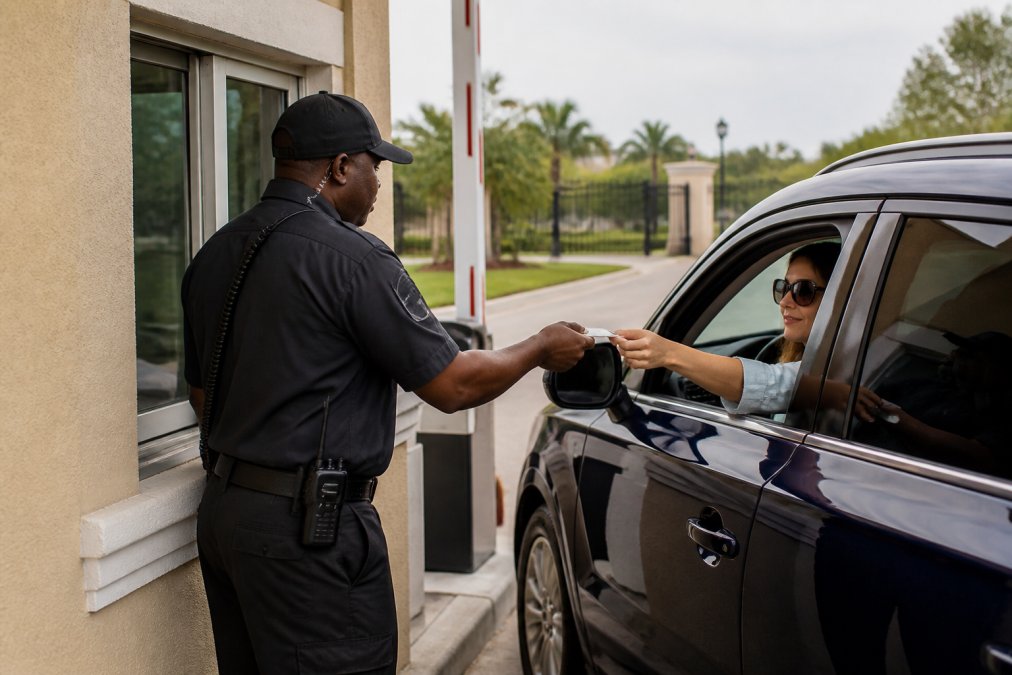
Effective gatehouse staffing requires three layers: written protocols, documented training, and ongoing accountability. Your protocols should specify exactly what guards are checking for, valid resident ID, expected visitor names, vehicle registration verification. Too vague, and guards become bottlenecks. Too rigid, and they lack judgment when situations don't fit the script.
Training matters more than most boards realize. A guard who can't write an incident report properly, doesn't know how to de-escalate a confrontation, or misses obvious credential fraud becomes a liability. According to the Florida Department of Law Enforcement requirements for security officer licensing, guards must meet specific training standards and maintain current certifications. Ranger Operation Services maintains state-certified Class D and G officers with Level IV training, ensuring gatehouse staff meets professional standards.
Shift coverage creates practical challenges. A single guard cannot provide 24/7 coverage, yet many HOAs attempt exactly that through unrealistic scheduling.
Visitor Management Software for HOAs and Entry Procedures
Visitor management software transforms gatehouse operations from paper logs and memory into auditable, searchable records. Without it, you have no way to answer basic questions: Who visited unit 304 last Thursday? Has this service provider been here before? Did a particular vehicle enter during the incident window?
License Plate Recognition and Surveillance Technology
License plate recognition (LPR) technology has become standard in gatehouse security best practices. It provides a permanent record of every vehicle entering your community, enables alerts for stolen or wanted vehicles, and creates accountability without requiring human memory.
HOA Security Liability and Risk Management Framework
Legal liability is the hidden cost of inadequate gatehouse security best practices. Your HOA has a duty to protect residents from foreseeable harm. If a criminal gains access through a negligent gatehouse process, and that criminal commits a crime, your community faces potential liability claims.
Emergency Response Planning and Mobile Patrol Integration
Gatehouse security best practices must include procedures for when normal operations break down. What happens when a resident reports an active threat in the community? What if a vehicle refuses to leave the gatehouse area? What if power fails and your electronic gate stops functioning?
Implementing Gatehouse Security Best Practices: A Checklist
A practical implementation checklist ensures your gatehouse security best practices program covers all essential elements. Use this checklist to audit your current operations and identify gaps.
| Element | Current Status | Target Implementation | Responsibility |
|---|---|---|---|
| Perimeter risk assessment completed | Yes / No | Complete within 60 days | Security Committee |
| Access control system selected and installed | Yes / No | Operational within 120 days | Property Manager |
| Gatehouse staffing model documented | Yes / No | Staffing plan approved within 30 days | Board & Manager |
| Guard training program established | Yes / No | Initial training within 45 days | Security Vendor |
| Visitor management software deployed | Yes / No | Live within 90 days | IT & Property Manager |
| License plate recognition system operational | Yes / No | Integrated within 120 days | Security Vendor |
| Surveillance cameras installed and monitored | Yes / No | All cameras operational within 60 days | Security Vendor |
| Emergency response procedures documented | Yes / No | Written plan within 45 days | Security Committee |
| Mobile patrol service contracted | Yes / No | Patrols begin within 30 days | Property Manager |
| Staff training on emergency procedures | Yes / No | Quarterly drills scheduled | Manager |
| Privacy policy reviewed with legal counsel | Yes / No | Approved within 60 days | Legal Counsel |
| Insurance coverage verified for security | Yes / No | Coverage confirmed within 30 days | Broker |
Frequently Asked Questions
What are the best security protocols for gated communities?
Effective gated community protocols combine physical barriers, trained personnel, and technology. Start with a perimeter risk assessment to identify vulnerabilities. Implement credential verification (ID checks, resident databases), visitor management procedures with sign-in logs, surveillance cameras at entry points, and clear incident reporting processes. Layer these with access control systems like license plate readers and video intercoms. Regular security committee meetings and staff training on emergency response ensure protocols stay current and staff can execute them consistently.
How do you improve gatehouse security in an HOA?
Improvements follow a three-phase approach: assess current gaps through a professional risk assessment, upgrade physical infrastructure (gates, barriers, lighting), and deploy technology (LPR cameras, visitor management software, real-time monitoring systems). Staff training is critical, guards must follow consistent protocols for credentialing, unauthorized entry prevention, and incident documentation. Consider hybrid models: on-site guards for deterrence and resident relations, paired with remote monitoring for 24/7 coverage. Mobile patrol integration strengthens perimeter security beyond the gatehouse itself.
What is the role of a security guard at an HOA gatehouse?
Gatehouse guards serve four primary functions: controlling access by verifying resident identity and authorizing visitors, managing traffic flow and preventing congestion, detecting and reporting security incidents, and providing customer service to residents. Guards must maintain resident databases, operate access control systems, document all entry/exit activity, and respond to emergencies. Professional HOA security guard protocols require trained, licensed personnel who understand both access control procedures and liability documentation. Guards act as the first line of defense against unauthorized entry and loitering.
How can technology enhance HOA gatehouse security?
Technology multiplies guard effectiveness and reduces manual errors. License plate recognition (LPR) automatically flags unauthorized or flagged vehicles. Visitor management software creates digital audit trails, eliminates paper logs, and allows residents to pre-authorize guests via mobile app. Video intercoms enable remote verification without opening gates. Real-time monitoring dashboards track all entry activity, and cloud-based incident reporting ensures documentation is immediate and searchable. Integration with resident databases and law enforcement systems strengthens threat detection. Mobile patrol apps coordinate ground patrols with gatehouse alerts.
What are the legal liabilities for HOA gatehouse security?
HOA security liability stems from negligent access control (unauthorized entries causing theft or harm), inadequate incident documentation, privacy violations in data collection, and failure to maintain security infrastructure. Federal Fair Housing Act and state privacy laws govern how resident data is handled. Document all incidents, maintain clear credentialing procedures, and ensure staff understand chain-of-custody protocols, especially critical for communities with high-value assets. Carry adequate liability insurance. Regular compliance audits and legal review of security policies reduce exposure.
How do you manage visitor access in a gated community?
Visitor management requires a documented system: residents pre-register guests via mobile app or call ahead, gatehouse staff verify the resident and guest identity, visitors sign in with date/time and vehicle information, and staff issue temporary credentials (passes, codes, or escort). Visitor management software automates this workflow and creates searchable audit trails. Set clear policies on guest duration, parking, and restricted areas. Require escorts for unfamiliar vendors. Cross-check guest lists against incident reports to identify patterns. Regular review of visitor logs helps identify loitering or unauthorized repeat visits.
What should be included in an HOA gatehouse emergency response plan?
A complete emergency response plan covers unauthorized entry, medical emergencies, fires, and active threats. Establish clear escalation procedures: gatehouse staff initiate immediate response, alert residents if needed, contact emergency services (911), and notify the security supervisor and board. Define roles: who locks down the community, who coordinates with law enforcement, who documents the incident. Conduct quarterly drills with staff and mobile patrol teams. Maintain current resident emergency contact lists and medical information. Document every incident with timestamps, descriptions, and actions taken. Coordinate with local law enforcement on access for emergency vehicles.