
Are Mobile Surveillance Trailer Rentals Worth the Cost?
Mobile surveillance trailer rental benefits explained: compare cost, rent vs. buy, and how trailers stack up against guards and fixed cameras. Get a quote.
Last Updated: October 25, 2026
Quick Summary
A mobile surveillance trailer delivers elevated, self-powered camera coverage to temporary or remote sites within days, without trenching cable or pouring concrete. Rental converts a capital purchase into a monthly line item, and the provider carries maintenance, relocation, and repair. Rental usually wins for sites needing coverage under roughly 18 months.
- Four equipment factors move the rate: camera count and resolution, power source, connectivity, and monitoring.
- Ask in writing about deposits, delivery fees, monitoring charges, minimum terms, service calls, and insurance.
- Compare total contract value, not the headline rate, since a low rate with a 12-month minimum can cost more.
- Rent when the site is temporary, moving, or unapproved; buy only when permanent with staff to maintain it.
- A trailer repositions in an afternoon and puts lenses eight to ten meters up, above the fence line.
Table of Contents
- Why Mobile Surveillance Trailer Rental Benefits Temporary and Remote Sites
- Mobile Surveillance Trailer Rental Cost: What Drives the Monthly Rate
- Rent vs. Buy Surveillance Trailer: Total Cost of Ownership Compared
- Mobile Surveillance Trailer vs. Fixed Security Cameras
- Mobile Surveillance Trailer vs. Security Guards: Coverage, Cost, and Response
- Remote Monitoring, Live Intervention, and Incident Workflow
- Rental Readiness Checklist: Site Planning, Power, and Connectivity
- Book Mobile Surveillance Trailer Rental with Ranger Operation Services
- Frequently Asked Questions
Why Mobile Surveillance Trailer Rental Benefits Temporary and Remote Sites
A mobile surveillance trailer is a towable, self-powered camera platform that brings live video coverage to a site without trenching cable or pouring concrete.
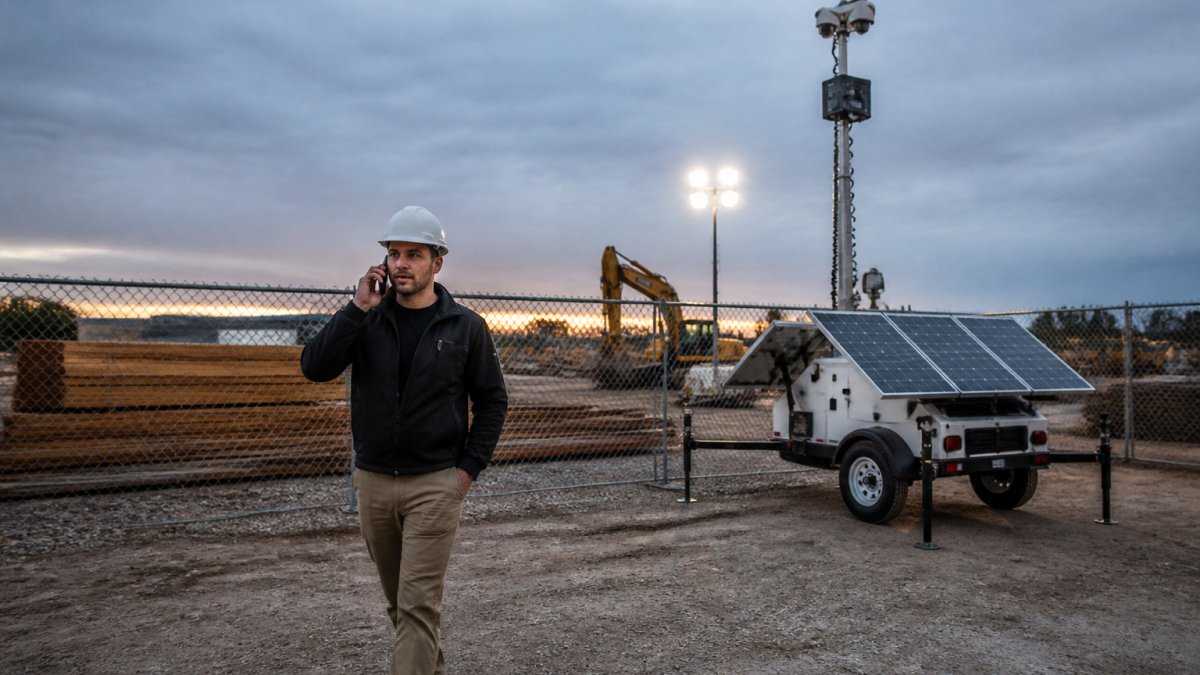
Temporary and remote sites are where fixed infrastructure fails hardest. A construction site has no power pedestal for six months, then has one forever.
The economics follow the same logic. Rental converts a capital purchase into a monthly line item, and the provider carries maintenance, relocation, and repair.
Mobile Surveillance Trailer Rental Cost: What Drives the Monthly Rate
Published rental figures for mobile surveillance trailer rental cost vary widely, and that spread is not random. It reflects what is bolted to the mast, who is watching the feed, and, the part most quotes hide, what the contract says happens when the job ends early or the unit takes a hit.
Backstreet Surveillance's rental cost guide describes rental terms running from a week to a year, with entry-level weekly rates. DuckView Systems' cost breakdown separates the trailer rental from monitoring service, which is priced as its own monthly line.
The line items behind a quoted rate
Four equipment factors move the number:
- Camera count and resolution. More lenses and higher resolution raise the rate.
- Power source. Solar panels and battery banks cost more than a shore-power unit but eliminate generator refueling.
- Monitoring. Live human review is the largest variable. Vision Detection Systems' rental overview notes that hidden costs, including monitoring and installation, often decide the rent-versus-buy question.
Then there are the contract line items that never appear in a headline rate. Ask about each one in writing:
- Security deposit and damage liability. Expect a refundable deposit held against the unit; confirm who pays for a broken camera, a cracked panel, or a bent mast, and whether normal wear is excluded.
- Delivery, setup, and pickup fees. These are frequently quoted per mile or per trip and are not part of the monthly rate. A remote site can carry a meaningful delivery surcharge.
- Monitoring charges. Priced per camera, per hour, or as a flat monthly fee, and the difference between passive alerting and live operator review is large.
- Minimum term and early termination. Most contracts carry a minimum rental period. If your project wraps early, you may owe the balance of the term; negotiate a buyout or a month-to-month tail before signing.
- Service calls and maintenance. Confirm whether a site visit to swap a battery or reseat a camera is included or billed per trip.
- Insurance. Either the provider insures the unit and passes the cost through, or you add it to your policy. Know which.
Total cost of ownership, not just the monthly rate
The honest way to compare quotes is to build a total cost of ownership for the rental period: first month plus deposit, delivery and setup, monitoring for every month of the term, expected service calls, insurance, and any early-termination exposure.
Pricing for our own trailer deployments depends on site layout, camera count, monitoring scope, and contract length, so we quote per site rather than publish a flat rate. Current figures are on our pricing page.
Rent vs. Buy Surveillance Trailer: Total Cost of Ownership Compared
Buying wins on a long enough timeline and almost nowhere else. The break-even math is straightforward once you count everything ownership carries, but "long enough" is doing a lot of work in that sentence, so here is how to decide rather than guess.
A purchased trailer means upfront capital, insurance, registration, maintenance, firmware updates, battery replacement every few years, storage between jobs, and a tow vehicle or hauling contract for every move. Rentals fold all of that into the monthly rate. WCCV's analysis of solar trailer deployment points out that installation and operating costs, plus theft and vandalism exposure, are the figures buyers most often underestimate.
| Factor | Rent | Lease | Buy |
|---|---|---|---|
| Upfront outlay | Low, first month plus deposit | Low to moderate, often first and last | High, full unit cost |
| Maintenance | Provider | Usually provider | Owner |
| Relocation | Provider hauls | Varies by contract | Owner arranges |
| Flexibility | Swap or return monthly | Fixed term, buyout at end | Sell or store |
| Best fit | Sites under ~18 months, changing footprints | Predictable multi-year programs | Permanent, multi-site programs |
A four-question decision framework
Work through these in order; the first "yes" usually settles it.
- How long will the site need coverage? Under roughly 18 months, rental almost always wins once you count storage, maintenance, and resale loss. Beyond that, the ownership math starts to close.
- Will the site change shape? If the perimeter moves, construction phases, seasonal layouts, event footprints, rental's ability to reposition or swap units is worth more than the per-month savings of ownership.
- How much upfront budget do you have? Rental converts capital into an operating line item. If capital is tight or the project is not yet approved, rental keeps the decision reversible.
- Who do you want maintaining it? Ownership means you own the battery swap, the firmware update, the camera cleaning, and the 2 a.m. connectivity call. Rental means you own a phone number.
The mistake that erases the savings
The common error is buying for a 12-month project and discovering the trailer sits idle for four months afterward, dead capital plus storage plus a battery slowly discharging. The second most common is signing a 12-month rental for a six-month job without checking the early-termination clause. Both are contract problems, not equipment problems, and both are avoidable with one question at signing: what happens if the project ends early?
For a fuller cost-and-risk comparison between patrol visits and stationed coverage, see our breakdown of mobile patrol vs. stationed guard coverage.
Mobile Surveillance Trailer vs. Fixed Security Cameras
Fixed cameras are cheaper per camera and better when the perimeter will not move. Trailers win when it will.
A permanent install needs conduit, power, mounting, and network drops. Those costs are sunk the moment the site changes shape, and construction sites change shape weekly.
The trade-off is honest: fixed systems integrate more cleanly with existing access control and can cover more angles per dollar on a stable property.
Mobile Surveillance Trailer vs. Security Guards: Coverage, Cost, and Response
Guards deter people. Trailers document them. Most serious sites need both, but the split is not even.
A single stationed officer covers one viewpoint for one shift and costs far more per month than a trailer.
American Security Force's use-case review highlights parking lots as a prime example, where vehicle theft and break-ins happen fast and footage is what closes cases.
Best for: trailers on large, dark, or remote perimeters. Skip if: you need hands-on access control at a single entrance all night.
Remote Monitoring, Live Intervention, and Incident Workflow
Detection without response is just recording. The value sits in what happens in the ninety seconds after an alert.
A working workflow runs in four stages: the camera detects motion in a defined zone, an operator verifies it on live video, the operator issues an audio warning through the speaker, and if the person stays, a dispatch request goes out with location and description. Recorded footage and a written incident report follow automatically.
That last step is where providers separate. A trailer with no monitoring contract sends alerts to a phone nobody checks at 2 a.m. For why round-the-clock dispatch coverage changes the outcome, read our article on why 24/7 dispatch support is critical for site security.
Rental Readiness Checklist: Site Planning, Power, and Connectivity
Most deployment delays are site problems, not equipment problems. Run this list before the trailer arrives.
- Confirm a level, firm pad within reach of the target camera angles
- Verify cellular signal strength at the exact parking spot
- Map solar exposure; shade kills battery runtime
Privacy and data handling deserve real attention. Post visible notice, restrict footage access to named staff, and set a retention window rather than keeping everything indefinitely. If your site is a construction project, our guide to securing a construction site in Florida covers perimeter, lighting, and power planning in more depth.
Book Mobile Surveillance Trailer Rental with Ranger Operation Services
Rental only pays off when the unit is deployed fast and watched by someone who acts. That is the gap we built around.
Ranger Operation Services deploys across the state within a four-hour window, backed by 24/7 dispatch and more than 500 licensed officers and employees. Every client gets a named regional supervisor, and our proprietary mobile app tracks each assignment from dispatch to completion, so you see status without chasing a phone call. State-certified Class D and G officers with Level IV training staff the response side.
If your operation also needs rapid crisis coverage, our special response team handles civil unrest and hurricane recovery deployments. Ready to schedule? Here is how to book 24 hour security services fast.
Frequently Asked Questions
How much does it cost to rent a mobile surveillance trailer?
Published rental rates from trailer providers range from about $250 per week to roughly $1,000 to $1,500 per month for the base unit. Monitoring is often priced separately, with one provider estimating $400 to $500 per month. Your actual mobile surveillance trailer rental cost depends on camera count, solar and connectivity setup, monitoring level, rental term, and delivery distance. Ranger Operation Services publishes current pricing on its website and offers a free trial, so you can get an exact quote for your site.
What are the benefits of renting a mobile surveillance trailer instead of buying one?
Renting avoids the upfront purchase price, installation costs, maintenance, and storage that come with ownership. You also keep cash flow flexible: a weekly or monthly rental term lets you scale coverage up during high-risk phases, such as a construction project's material-delivery window, and remove it when the site clears. Maintenance and repairs stay with the provider, and you can relocate the unit as the site changes. For short-term or seasonal needs, renting usually costs less than buying a trailer that sits idle for months.
Are mobile surveillance trailers better than fixed security cameras?
They solve different problems. Fixed cameras work well for permanent locations with reliable power and network drops, but they cannot move when a site layout changes. A mobile surveillance trailer vs. fixed security cameras comparison usually favors trailers for temporary sites, parking lots, and construction zones because the elevated camera view covers more ground, solar power allows off-grid operation, and rapid deployment gets eyes on a problem in hours rather than weeks. Fixed cameras still make sense for long-term coverage of a stable building perimeter.
When should a business rent a surveillance trailer instead of hiring security guards?
Choose a trailer when you need continuous visual coverage, recorded footage, and real-time alerts across a large area at a lower cost per hour than a staffed post. Choose guards when you need physical presence, access control, or someone who can physically intervene. Many sites combine both: a trailer handles perimeter monitoring and deterrence, while a guard responds to incidents the monitoring center flags. If your risk is concentrated in after-hours theft or vandalism, a trailer with live monitoring often covers more ground for less money.
Temporary sites fail when security is treated as an afterthought and stood up after the first theft. Get the trailer positioned, monitored, and connected before materials land, and the deterrence works from day one. Get started with Ranger Operation Services and put a monitored camera mast on your site this week.
