
7 Emergency Security Staffing Steps for Facility Lockdowns
Emergency security staffing for facility lockdowns needs a clear plan. Learn 7 steps to size, source, deploy and stand down guards fast.
Last Updated: October 31, 2026
Quick Summary
Emergency security staffing for facility lockdowns is the process of calculating, sourcing, deploying, and releasing trained security personnel to seal a building, control access points, and support staff during a lockdown. Size the need by counting posts, not people, then add a relief factor of about 1.2 to cover absences, meals, and call-offs.
- Build a post inventory of every entrance, dock, lobby, stairwell, and chokepoint that must be sealed or watched.
- Build three tiers into your plan: perimeter only, full interior, and full plus command.
- Drill at least twice a year, vary the scenario, and debrief within 48 hours.
- Demobilize in reverse order of activation and hold perimeter posts until police release the scene.
- Name three vendor contacts: the dispatcher, the assigned supervisor, and a regional manager above the supervisor.
Table of Contents
- 7 Emergency Security Staffing Steps for Facility Lockdowns
- What Counts as a Lockdown Trigger
- Step 1: Size the Staffing Need Before the Incident
- Step 2: Put It in Writing With a Workplace Lockdown Plan Template
- Step 3: Define Security Guard Lockdown Duties by Post
- Step 4: Build a Lockdown Communication Plan for Staff and Guards
- Step 5: Activate a Vendor and Hold Them to Service Levels
- Step 6: Run Lockdown Drill Best Practices With Your Security Team
- Step 7: Demobilize and Review After the Lockdown Lifts
- Frequently Asked Questions
7 Emergency Security Staffing Steps for Facility Lockdowns
A lockdown is only as strong as the people at its doors. Emergency security staffing for facility lockdowns is the process of calculating, sourcing, deploying, and releasing trained security personnel to seal a building, control access points, and support staff during a lockdown.
They describe the alarm, the announcement, the locked doors, but rarely answer who is physically at each entrance, and how fast more can arrive.
What Counts as a Lockdown Trigger
A lockdown trigger is any event that requires people to shelter behind locked doors instead of evacuating. Triggers fall into a few broad groups:
- Active threat incidents, including a person with a weapon on or near the property
- Violence response situations such as a fight, assault, or hostage situation
- Police activity next door, where an armed suspect may enter your building
The distinction that matters most for staffing is evacuation versus lockdown. Fires and gas leaks mean get out; a direct threat inside means lock in and wait.
Ready.gov guidance on active shooter and lockdown response lays out the run-hide-fight framework that most facility lockdown procedures now follow. Your staffing plan exists to buy time for the hide and support the run.
Step 1: Size the Staffing Need Before the Incident
Size the staffing need by counting posts, not people. Every entrance, loading dock, lobby, stairwell, and chokepoint that must be sealed or watched is one post. Multiply posts by shifts, then add relief officers for breaks, meals, and call-offs. Headcount math is where lockdown plans quietly fail, because a plan written for a weekday daytime assumes staffing that does not exist at 2 a.m. on a Sunday.
Build a post inventory first
Walk the property and list every opening a person could enter through. A typical commercial building produces a post inventory like this:
- Main lobby and visitor entrance
- Employee entrances (each one)
- Loading dock and service corridor
Then rank each post by criticality. Lobby and dock doors usually outrank interior stairwells because they are the most likely entry points. Mark which posts can be covered remotely by camera and which require a physical presence.
The headcount formula, with a worked example
A simple formula works for most commercial facilities:
Officers needed = (posts × hours per shift ÷ 8) + relief factor
Use a relief factor of about 1.2 to cover absences, meals, and call-offs. Here is how that plays out across three facility profiles:
| Facility profile | Posts | Shift length | Base officers | With 1.2 relief |
|---|---|---|---|---|
| Single-tenant office, 1 lobby + 1 dock | 2 | 12 hours | 3 | 4 |
| Mid-size commercial building, 4 entrances + dock | 5 | 12 hours | 8 | 9 |
| Multi-tenant campus, 8 entrances + 2 docks + garage | 11 | 12 hours | 17 | 20 |
Those numbers assume continuous coverage for a full shift. A two-hour lockdown needs far fewer bodies than an overnight event, so build the model around the longest plausible duration, not the average.
Adjust for threat level and trigger type
Not every trigger demands the same footprint. A police-activity-next-door lockdown may only require perimeter posts and a lobby officer. An active-threat response inside the building may require every post filled plus a roving officer and a command-post liaison. Build three tiers into your plan:
- Tier 1, Perimeter only: exterior doors, dock, and lot. Suitable for external police activity or a threat that has not entered the property.
- Tier 2, Full interior: all entrances plus interior sweep and shelter-in-place support. Suitable for a credible internal threat.
- Tier 3, Full plus command: every post, a roving officer, and a dedicated liaison to police and facility leadership. Suitable for an active threat or hostage situation.
Two inputs that sharpen the estimate
- Response time expectations. How fast must a post be covered after the trigger? See Rapid Deployment Security for Emergencies for how fast emergency guards can actually be deployed. That answer decides whether you need officers on site or on call. If the answer is "within 15 minutes," on-call staffing will not get you there.
- Post criticality and redundancy. A post that can be watched by camera plus a roving officer is cheaper to staff than one that requires a standing presence. Build redundancy into the highest-ranked posts so a single call-off does not open a door.
Step 2: Put It in Writing With a Workplace Lockdown Plan Template
Write the plan before the incident, and write it so a relief officer can follow it cold. A workplace lockdown plan template should cover, at minimum:
- Trigger definitions and who can call a lockdown
- Post assignments with a named officer for each post
- Access point list with lock-down methods for each
- Communication tree, including backup contacts
- All-clear authority and reopening procedures
- Drill schedule and after-action review steps
Keep the template short enough to fit in a binder at each post. A four-page plan that gets drilled beats a 60-page one that sits in a drawer.
Build the lockdown section into your broader emergency response framework.
Step 3: Define Security Guard Lockdown Duties by Post
Security guard lockdown duties vary by post, and each duty needs a written checklist. The lobby officer does not do the same job as the loading dock officer.
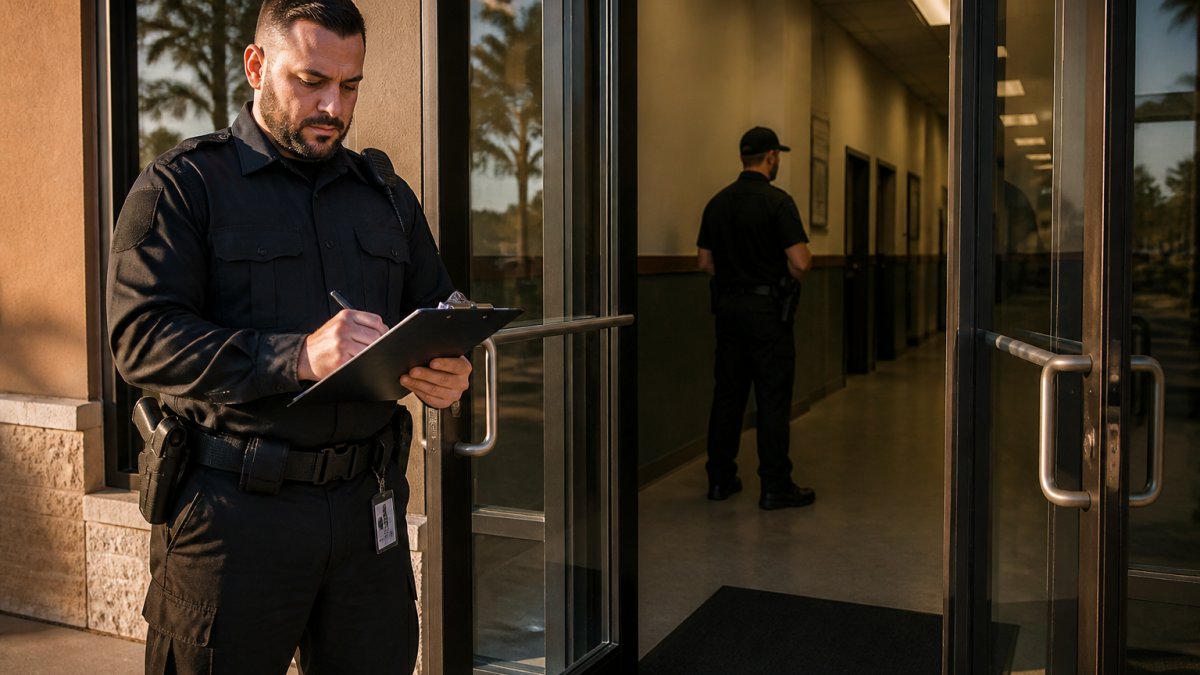
A workable duty set for most facilities:
- Lobby or main entrance: stop entry, verify credentials of anyone already inside, direct visitors to the secured space, monitor camera feeds
- Loading dock and service doors: lock or barricade, check for stragglers, watch for approach from the lot
- Interior posts: sweep assigned zones, guide patients and staff to shelter, report door status by radio
Some posts call for armed coverage, particularly cash handling areas, executive suites, and high-risk retail locations.
Watch out: assigning a guard to "the building" without a specific post is the most common failure we see.
Step 4: Build a Lockdown Communication Plan for Staff and Guards
A lockdown communication plan is the set of messages, channels, and backups that keep staff and officers working from the same information.
Build the plan around four message types:
- Lockdown activation: what happened, where, and the immediate action required
- Status updates: every 10 to 15 minutes so people do not guess
- All-clear: only from the named authority, never from a rumor
Use at least two channels. Mass alerts by text and email reach most staff. Radio or a guard-tracking app reaches officers who may not check a phone mid-post.
A common mistake is testing the alert system only during business hours. Test it at shift change and overnight, when skeleton crews are on duty.
Step 5: Activate a Vendor and Hold Them to Service Levels
Activate the vendor through a single named contact, and hold them to written service levels. Emergency security staffing fails when the request goes to a general line and no one owns the clock.
The callout procedure
A workable callout procedure has five parts, and each one should be written into the contract:
- A single activation number that reaches a live dispatcher 24/7, not a voicemail or a sales line.
- A required information set the dispatcher collects: facility address, post list, shift length, threat tier, on-site contact, and police incident number if one exists.
- A confirmation callback within a stated window, commonly 15 minutes, that names the supervisor assigned and the estimated arrival time for the first officer.
- A backup staffing commitment that states how the vendor fills a post if the first assigned officer calls off or is delayed.
- A demobilization instruction that tells the vendor who has authority to release officers and how hours are logged.
Response-time targets to write into the contract
Response time is not one number. Break it into three, and hold the vendor to each:
- Dispatch acknowledgment: how long until the vendor confirms the request and names a supervisor.
- First officer on site: how long until the first officer arrives and reports to the on-site contact.
- Full post coverage: how long until every post in the requested tier is staffed.
A common pattern is to set the first-officer target tighter than the full-coverage target, because the first officer can begin securing the highest-ranked post while the rest of the team is en route. Use these security guard deployment time standards to set the numbers.
Escalation contacts and backup staffing
Name three contacts in the contract, not one: the dispatcher, the assigned supervisor, and a regional manager above the supervisor. If the supervisor does not answer within the response window, the plan should say who the on-site contact calls next. Backup staffing should be a stated commitment, for example, a standby pool large enough to replace any single call-off within the full-coverage window.
Contract terms that matter in an emergency
Emergency procurement moves fast, so the terms have to be settled before the event. The clauses worth negotiating in advance:
- Rate structure: straight-time versus emergency premium, and whether the premium applies from the moment of activation or only outside scheduled hours.
- Minimum call-out: the smallest billable block, which is often four hours even if the incident resolves in one.
- Overtime and holiday multipliers: state them explicitly so the invoice does not surprise you.
Do not vet a vendor for the first time during an incident. Work through this security guard company vetting checklist before you activate them.
Integrating temporary officers with incident command
Temporary officers who arrive without a briefing create conflicting instructions. Build an integration step into the callout procedure:
- A written post brief handed to each arriving officer that names the post, the duty checklist, the radio channel, and the on-site contact.
- A clear chain of command that states the temporary officers report to the vendor supervisor, who reports to the facility's incident commander, not directly to individual employees.
- A coordination point with police so the vendor supervisor knows which officer is the police liaison and does not duplicate or contradict police instructions.
The most common integration failure is a temporary officer who takes direction from a well-meaning employee and abandons a post. The written post brief and the single chain of command are what prevent it.
Ranger Operation Services guarantees deployment within four hours statewide, backed by 24/7 dispatch and a named regional supervisor for every client.
Step 6: Run Lockdown Drill Best Practices With Your Security Team
Lockdown drill best practices come down to frequency, realism, and review. Drill at least twice a year, vary the scenario, and debrief every time.
What a good drill includes:
- A surprise start time, announced to leadership only
- Real door checks, not a walkthrough
- Radio traffic logged and timed
Vary the scenario. A drill that always starts at the front door trains guards to watch the front door. Test a dock entry, a parking lot approach, and an after-hours event.
Track two numbers: time to secure all posts, and time to account for staff. Both should improve with each drill. If they do not, the plan has a gap the drill just found.
Step 7: Demobilize and Review After the Lockdown Lifts
Demobilize in reverse order of activation, and review within a week.
A clean demobilization looks like this:
- Confirm all-clear from the named authority
- Hold perimeter posts until police release the scene
- Release interior posts in stages, starting with the least exposed
- Log hours, incidents, and any use of force
- Collect officer reports before they leave the site
Then run the after-action review. Ask what worked, what failed, and what the timeline shows. Compare actual response time to the service level in your vendor contract.
That review is also where cost gets settled. Emergency call-outs often carry premium rates, so reconcile invoices against the agreed terms before you close the file.
Frequently Asked Questions
How many security officers are needed during a facility lockdown?
There is no fixed number. Size the team by post, not by headcount: one officer per controlled entrance, one per loading dock or rear exit, one mobile officer for interior sweep and escort, and one supervisor who reports to incident command. A single-building office might run four posts; a campus with multiple access points may need ten or more. Count exits first, then add relief officers so nobody works a post past a normal shift.
What should security guards do during a lockdown?
Security guard lockdown duties typically include locking and holding assigned entrances, screening anyone who approaches an access point, directing staff and visitors away from windows and exterior doors, reporting observations to the supervisor, and logging every action with timestamps. Guards should not attempt to confront an active threat unless their post orders and training authorize it. De-escalation and containment come first; law enforcement handles the direct threat.
What is the difference between a lockdown and a shelter-in-place?
A lockdown responds to a direct threat, such as an active threat, hostage situation, or police activity nearby, and focuses on denying entry and keeping people out of sight. Shelter-in-place responds to an environmental hazard like severe weather or a chemical release, where people stay indoors but normal movement continues. The two call for different staffing: a lockdown needs officers on access points and perimeter security, while shelter-in-place usually needs guards to guide people inside and monitor conditions.
How often should a facility review its lockdown staffing plan?
Review the plan at least once a year and after every drill, real incident, or major building change such as a renovation or new tenant. An after-action review should confirm post assignments still match the floor plan, contact lists are current, and vendor response times held up. Facilities with high turnover in support staff or security vendors should review twice a year, since a plan that names people who have left is worse than no plan.
A lockdown plan is only as good as the officers who show up when it matters. If your facility needs trained, licensed personnel on short notice, Ranger Operation Services can help. Our team of 500+ licensed officers deploys within four hours, with 24/7 dispatch, a named regional supervisor for your account, and live assignment tracking through our mobile app from dispatch to completion. Get started with Ranger Operation Services and know exactly who is standing at every door.
