
7 Steps to Evaluate Security Guard Company Insurance
Learn how to evaluate security guard insurance in 7 steps. Check limits, exclusions, and certificates of insurance before you sign a guard contract.
Last Updated: October 30, 2026
Quick Summary
To evaluate security guard insurance, match the policy to your contract requirements, then verify the certificate line by line with the carrier by phone and state license lookup. Compare limits, sublimits, and exclusions against your site risks, and require a pass on every checklist item before signing.
- Write your contract's coverage requirements into a one-page sheet before speaking to any vendor.
- A certificate of insurance is not the policy and does not guarantee coverage until you verify it.
- Call the carrier's agent line printed on the certificate to confirm the policy is in force.
- Compare limits coverage by coverage, since a strong general liability limit does not fix a missing abuse sublimit.
- A sublimit smaller than your contract floor is a coverage gap even if the aggregate looks adequate.
Table of Contents
- Why Security Guard Insurance Evaluation Matters Before You Sign
- Step 1: Match Security Guard Company Insurance Requirements to Your Contract
- Step 2: Read the Security Company Certificate of Insurance Line by Line
- Step 3: Compare Security Guard Insurance Coverage Limits and Sublimits
- Step 4: Hunt for Security Guard Insurance Exclusions That Shift Risk Back to You
- Step 5: Test the Policy Against Real Security Operation Scenarios
- Step 6: Ask How Claims, Deductibles, and Disputes Are Handled
- Step 7: Score the Vendor With a Reusable Insurance Review Checklist
- Frequently Asked Questions
Why Security Guard Insurance Evaluation Matters Before You Sign
A guard firm's insurance is the only thing standing between your property and a liability claim you never agreed to carry.
A security company can hold a valid license and still carry coverage that leaves your building exposed.
Below are seven steps that take an afternoon and close the gaps. Each tells you what to request, what to compare, and what to reject.
Step 1: Match Security Guard Company Insurance Requirements to Your Contract
Start with your own contract, not the vendor's paperwork. Your lease, client agreement, or lender covenant usually names minimum coverage. Those numbers are your baseline.
Pull the insurance section of every agreement that touches the property. Look for four things:
- Required coverage types
- Minimum policy limits
- Additional insured status
Write those requirements into a one-page sheet before you speak to any vendor. A common mistake is letting the security company define what "adequate" means.
If your contract is silent, set your own floor based on risk.
Step 2: Read the Security Company Certificate of Insurance Line by Line
A certificate of insurance is a one-page summary showing what a policy covers, who the carrier is, and when coverage ends.
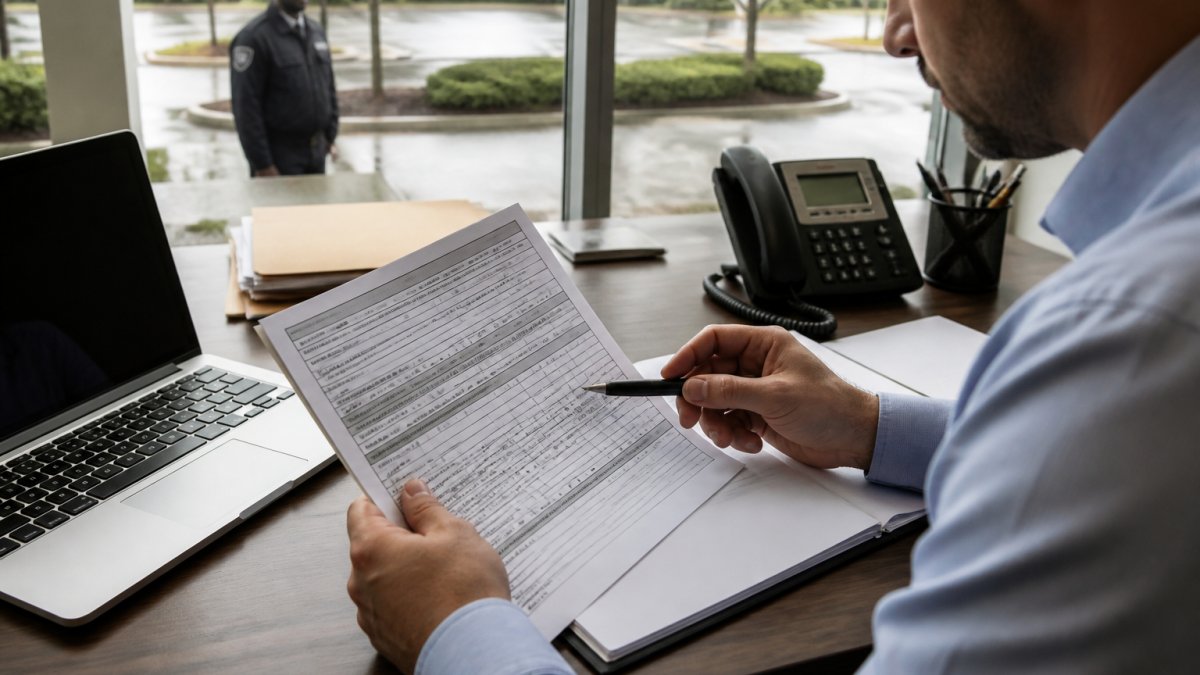
Check these fields on every certificate:
- Named insured matches the company you are hiring, not a parent or affiliate
- Policy effective and expiration dates cover your full contract term
- Coverage types match your requirement sheet
A mismatch on the named insured is a red flag. If the certificate lists a different legal entity than the one signing your contract, ask why in writing.
How to Verify a Carrier and Policy
Verification means confirming the carrier is real and licensed, the policy exists, and coverage is active on the date you need it.
Run these checks in order:
- Call the carrier's agent line listed on the certificate. Use the number printed on the certificate, not a number the vendor gives you. Ask the carrier to confirm the policy number, named insured, coverage types, limits, effective dates, and current status. Ask specifically whether the policy is in force today and whether any cancellation notice has been issued.
- Check the carrier's license. Most state departments of insurance publish an online license lookup. Confirm the carrier is authorized to write that line of coverage in your state. An unauthorized carrier may not be backed by your state's guaranty association if it fails.
- Check financial strength. Ratings from A.M. Best, S&P, or Moody's are commonly used to gauge an insurer's ability to pay claims. A carrier rated in the secure range is a safer counterparty than one with a weak or missing rating. Ask the broker for the current rating and confirm it yourself.
- Confirm the policy dates against your contract term. If your contract runs twelve months and the policy expires in six, you need a renewal commitment in writing before you sign.
- Confirm additional insured status directly with the carrier. A certificate that lists you as additional insured is not the same as an endorsement that names you. Ask the carrier to confirm the endorsement form and date.
Watch out for a vendor who resists carrier verification or offers to "handle it" for you. Verification is your job, not theirs; a legitimate security company will expect you to call the carrier and give you the policy number without hesitation.
If the carrier cannot confirm active coverage, stop. Do not accept a promise that the policy will be bound next week. Ask for a binder or a written confirmation from the carrier before any officer sets foot on your property.
Step 3: Compare Security Guard Insurance Coverage Limits and Sublimits
Limits are the most misunderstood part of security guard insurance. A policy might advertise a large aggregate limit while burying a much smaller sublimit on the exact claim you are most likely to face.
Read every limit as a pair: per occurrence and aggregate. Then hunt for sublimits and endorsements that change either number.
| Limit Type | What It Means | What to Check |
|---|---|---|
| Per occurrence | Most paid for one incident | Matches your contract floor |
| Aggregate | Most paid across the policy term | Covers multiple incidents |
| Sublimit | Smaller cap inside a coverage | Applies to assault, abuse, or force claims |
| Deductible or SIR | What the vendor pays first | Low enough to keep them solvent |
| Endorsement | A form that adds, removes, or caps coverage | Read the form number and date |
A policy with a strong general liability limit but a thin sublimit on use-of-force claims is a headline, not strong coverage.
Build a Side-by-Side Limit Comparison
Before you compare vendors, build a one-page grid with your contract floor in the first column and each vendor's numbers in the next columns. Compare these rows:
- General liability per occurrence and aggregate
- Products-completed operations aggregate, if applicable
- Personal and advertising injury limit
A vendor who cannot produce the declarations page for each policy is not giving you a comparable bid. The certificate may not list sublimits, endorsements, or the deductible. Ask for the declarations page and the endorsement schedule for every policy that touches your contract.
Match Limits to Your Contract and Client Requirements
Your lease, client agreement, or lender covenant usually names minimum limits. Those numbers are your floor, not your target, a vendor at exactly that level has no cushion for a serious claim.
Check whether your contract requires the limit to apply per location, per project, or per occurrence. A policy that meets the aggregate on paper may fail the requirement if the aggregate is shared across dozens of locations.
Confirm Sublimits and Endorsements for High-Risk Exposures
Sublimits matter most where claims are most likely. For a security operation, that usually means assault and battery, use of force, false arrest, abuse and molestation, and armed duty.
If your operation uses armed officers, confirm the policy includes an armed-guard or firearms liability endorsement. If it uses subcontractors, confirm the policy covers subcontractor acts or that the subcontractor carries its own coverage naming you as additional insured.
Ask for the declarations page. That page shows the real numbers, including sublimits the certificate may not list. Compare those numbers against your grid, note every gap in writing, and require the vendor to close each gap with an endorsement or a different policy before you sign.
Step 4: Hunt for Security Guard Insurance Exclusions That Shift Risk Back to You
Exclusions decide who pays. Every policy has them; the question is whether the ones that matter to your site are carved out.
Read the exclusion section and flag anything touching:
- Assault, battery, or use of force
- False arrest or false imprisonment
- Abuse and molestation
If an exclusion covers a risk your site creates, the vendor's policy will not respond.
Ask the vendor and their broker to explain, in writing, how each relevant exclusion applies to your operation. Vague verbal reassurance is worth nothing after an incident.
Step 5: Test the Policy Against Real Security Operation Scenarios
Paperwork only proves so much. Walk the policy through scenarios your site actually faces, and see where coverage holds.
For a construction site, ask about theft of materials after hours. For a retail floor, ask about a detention that goes wrong. For a gatehouse, ask about a resident dispute that escalates.
Armed vs. Unarmed, Use of Force, and False Arrest Claims
Armed guards raise the stakes on every claim. For a deeper comparison of when each guard type is appropriate, see armed vs unarmed security. Readers evaluating unarmed-scenario risk can review our unarmed security guards service and its coverage context before signing.
If your operation requires armed coverage, confirm the policy names it. Many policies treat armed duty as a separate exposure.
Step 6: Ask How Claims, Deductibles, and Disputes Are Handled
Claims handling tells you what the relationship feels like when something goes wrong. Ask three questions before you sign.
First, who reports a claim and within what window? Second, what is the deductible, and can the vendor pay it without stalling? Third, who is the broker of record, and will they speak to you directly if a dispute arises?
A vendor who cannot name their broker or explain their deductible is not ready for a serious contract, and neither is one who promises to "handle everything" without detail.
Ask for a sample incident-to-claim workflow. It should show who notifies the carrier, who documents the event, and who updates you.
Step 7: Score the Vendor With a Reusable Insurance Review Checklist
Score every vendor on the same sheet so the comparison is honest. Use this checklist and mark each line pass or fail.
- Certificate names the correct legal entity
- Policy dates cover the full contract term
- Coverage types match your requirement sheet
Require a pass on every line before you sign. When you are ready to move forward, our security company contract transition guide covers the transition to a new security contract.
At Ranger Operation Services, we carry $5M in General Liability insurance and our officers are state-certified Class D and G. Ask us for our certificate of insurance before you commit.
Frequently Asked Questions
What insurance should a security guard company carry?
At minimum, a guard company should carry general liability for third-party bodily injury and property damage, professional liability (errors and omissions), and workers' compensation for its officers. If guards drive patrol vehicles, commercial auto is required. Many clients also ask for excess or umbrella liability and abuse and molestation coverage. The right mix depends on your contract and the operation, so match the policy to the services being performed rather than accepting a generic certificate.
How do I verify a security company certificate of insurance?
Ask for a certificate naming your organization as additional insured, then call the carrier's number listed on the certificate to confirm the policy is active and the limits match. Check the named insured matches the contracting entity, confirm the policy dates cover your contract term, and request the declarations page for the full picture. A certificate is evidence of coverage, not the policy itself, so keep both on file and re-verify at each renewal.
What liability limits should a security guard company have?
Limits should reflect your risk exposure, not a default number. A retail or construction site with high theft and injury exposure typically warrants higher general liability and umbrella limits than a small gatehouse account. Review per-occurrence and aggregate limits, plus any sublimits for assault and battery or abuse claims, since a high headline limit can hide a low sublimit. Compare the limits against your contract requirements and the value of the property being protected.
Does a security guard company's general liability insurance cover assault or battery?
Often it does not. Many general liability policies exclude assault and battery, use of force, false arrest, and similar claims, or cover them only through a separate endorsement or sublimit. For armed guards or any operation where physical intervention is possible, ask specifically how those claims are covered and at what limit. If the exclusion stands, negotiate an endorsement or confirm the vendor carries separate coverage before signing the contract.
Insurance review is tedious, and most buyers rush it. Do not be most buyers. Ask for the declarations page, verify the carrier, and score every vendor on the same sheet.
Ranger Operation Services makes that review simple. We provide named regional supervisors, 24/7 dispatch, and a proprietary app that tracks every assignment from dispatch to completion. Get started with Ranger Operation Services and sign your next security contract with full confidence in the coverage behind it.
