
How to Get Emergency Armed Guard Deployment in Florida
Need an emergency armed guard deployment in Florida? Learn how to request coverage, confirm officer licensing, and prepare your site before they arrive.
Last Updated: October 29, 2026
Quick Summary
Emergency armed guard deployment in Florida means placing licensed, armed security officers on site on short notice, often within hours, to protect people and property while a threat is stabilized. To request one, call a 24/7 dispatch line, give a structured threat summary, complete a site intake, and confirm scope in writing.
- Call a 24/7 dispatch line, not a sales line, and give the site address first.
- Prepare a threat summary covering what, when, where, who, and what is at risk.
- Choose armed officers for cash, valuables, violent history, or credible threats against people.
- Verify the provider's Florida agency license and each armed officer's license before deployment.
- Count simultaneous posts and add relief and a supervisor for multi-post or high-risk sites.
Table of Contents
- What Emergency Armed Guard Deployment Covers
- Armed vs Unarmed Security Guards: Choosing the Right Coverage
- Florida Armed Security License and Legal Requirements
- How to Request an Emergency Armed Guard Deployment in Florida
- Emergency Security Deployment Checklist
- Temporary Armed Security: Costs, Contract Terms and Guard Count
- Booking Armed Coverage With Ranger Operation Services
- Frequently Asked Questions
What Emergency Armed Guard Deployment Covers
When a property faces an active threat, a theft ring, or a crowd that is turning hostile, waiting until morning is not an option.
Emergency coverage differs from a standing contract. A standing contract gives you a planned post, a predictable schedule, and time to vet the team. An emergency deployment compresses that into a single call: officers arrive, assess the site, establish a presence, and hand the post back once the immediate risk is under control.
Typical reasons businesses request emergency armed coverage include:
- An active or threatened break-in, vandalism spree, or theft of high-value materials
- Escalating loitering, trespass, or harassment that staff cannot safely manage
- Large events, unexpected crowds, or a sudden need for controlled access
The goal is visible deterrence first and rapid response second.
Armed vs Unarmed Security Guards: Choosing the Right Coverage
Choosing between armed and unarmed officers is the first decision in any emergency request. Armed vs Unarmed Security for Private Events compares the two options side by side. Armed officers carry firearms and hold the state licensing that permits them to do so. Decision guide: armed or unarmed security guards can help you confirm which fits your situation. Unarmed officers focus on observation, access control, reporting, and calling in law enforcement.
Choose armed officers when the risk includes:
- Cash handling, valuables, or controlled substances
- A history of violent incidents at the site
- Credible threats against people, not just property
Choose unarmed officers when the primary need is deterrence, access control, customer-facing courtesy, or incident documentation. Ordering armed coverage when the real problem is a lack of visible presence can be a costly misstep, since an unarmed officer with clear reporting procedures may address it.
Two points matter in practice. Armed officers escalate the level of response a situation may attract, so the decision should be deliberate rather than reflexive. A mixed model is also common: an armed officer on a perimeter or transport detail, paired with unarmed officers handling entry points and visitor logs.
Florida Armed Security License and Legal Requirements
Florida regulates private security through its state licensing agency. Anyone providing armed security must hold the correct license class and firearm authorization before carrying a weapon on duty. Verify current requirements directly with the state, since licensing rules, training hours, and fees are updated periodically.
Key points to confirm when vetting any provider, including us:
- The company holds a valid Florida agency license, which can be verified through the state's public licensing records
- Each armed officer holds the active firearm license category required under Florida law
- Officers have completed the required firearms training and carry current credentials on their person
Ranger Operation Services holds Florida license number B32001502, and our officers are State-certified Class D and G licensed with Level IV training. We carry $5M in General Liability insurance.
How to Request an Emergency Armed Guard Deployment in Florida
This section is a step-by-step guide for a business owner, property manager, or event organizer requesting private armed coverage on short notice.
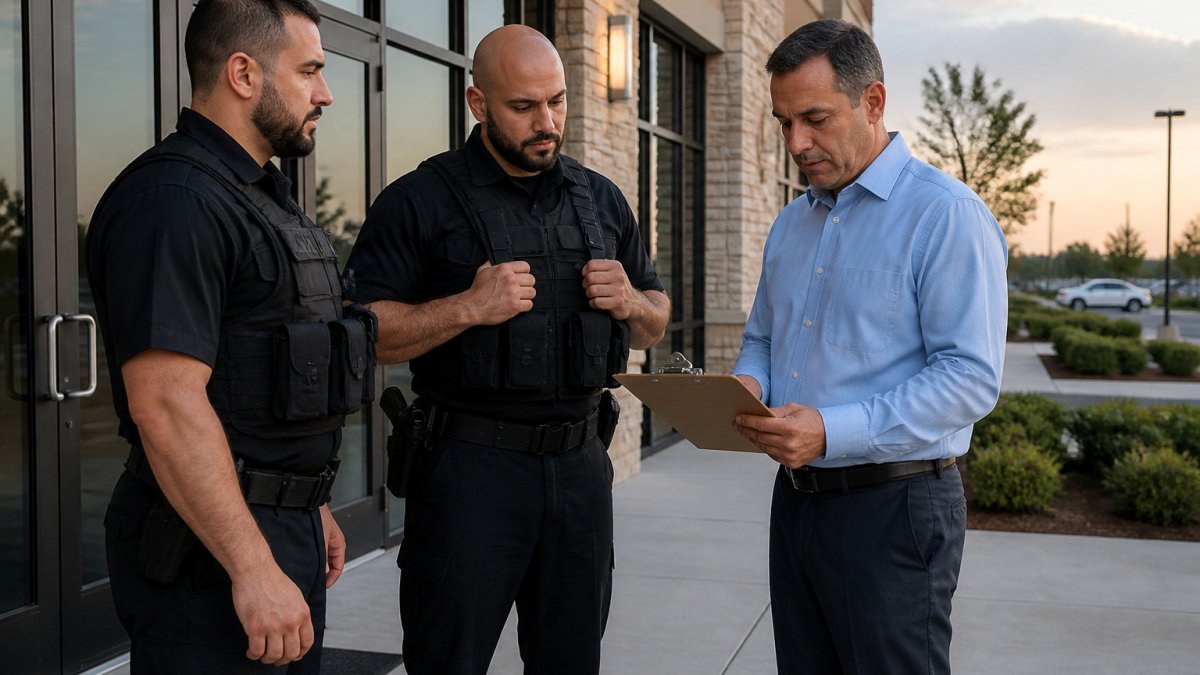
Step 1: Call the dispatch line, not a sales line
Emergency requests should go to a 24/7 dispatch number staffed by a person who can commit officers, not a contact form that waits for business hours. State up front that this is an emergency deployment request and give the site address first. Dispatch will open a ticket and assign a deployment coordinator.
Step 2: Deliver a structured threat summary
The single biggest cause of delay is a vague description of the problem. Prepare a short summary covering:
- What happened or is threatened, break-in, trespass, harassment, crowd, post-incident protection, cash or asset movement
- When, date, time, and whether the threat is active right now or expected
- Where, exact address, building, floor, gate, or lot
A one-paragraph summary with those five elements lets a provider scope the request in minutes instead of hours.
Step 3: Complete the site assessment intake
Before officers post, the provider needs enough site detail to write post orders. Have the following ready:
- Entry and exit points, including service doors, loading docks, and fire lanes
- Access instructions, gate codes, keys, fobs, or a contact who can admit officers
- A site map or sketch showing where you want officers positioned
If the site is a construction site, multi-tenant property, or event venue, note that in the intake, post orders differ substantially by property type.
Step 4: Confirm scope and authority
Agree in writing on the number of officers, armed or unarmed status, shift length, expected duration, and who on site has authority to direct the officers. Clarify the escalation protocol: when officers call 911, when they call your contact, and when they call the provider's supervisor. This prevents the most common post-deployment dispute, officers standing idle because no one defined their authority.
Step 5: Receive the deployment window and confirm
The provider should give you a specific deployment window, not a range like "sometime today." Confirm it in writing, along with the supervisor assigned to your account and officer names once assigned. Ask how you will be notified of status changes.
Step 6: Conduct a handoff at shift change
At the end of the emergency period, require a written handoff documenting incidents, observations, and any unresolved risks. This record matters for insurance claims, police reports, and any decision to convert to standing coverage.
What to have ready when you call
- The exact site address and the entry points officers will need to cover
- Access instructions, gate codes, and a contact who can admit officers on arrival
- A summary of the threat, including any incident reports or police case numbers
Emergency Security Deployment Checklist
Use this checklist to shorten the time between a request and a secure site:
- Written threat or incident summary with time, location, and type of event
- Site map or list of entry and exit points
- Access credentials and a designated site contact available by phone
Keep a current copy of this checklist in your facilities or property management file so it is ready when an incident occurs.
Temporary Armed Security: Costs, Contract Terms and Guard Count
Pricing depends on quantity, dates, threat level, and shift length. This section explains the cost drivers, billing mechanics, and guard-count framework you need to evaluate any quote, and Ranger Operation Services can provide current pricing and a quote on its website.
What drives the cost of emergency armed coverage
- Armed vs. unarmed status, armed officers carry higher insurance, training, and licensing costs, so armed posts price above unarmed posts for the same hours.
- Response timeline, a deployment inside a few hours carries a premium over a next-day posting because the provider must pull officers from standing assignments or call in off-duty staff.
- Shift length and time of day, overnight, weekend, and holiday shifts typically carry differentials, and short shifts under a minimum length are often billed at the minimum.
Billing mechanics to confirm before you sign
Ask every provider to put the following in writing:
- Minimum engagement, the shortest billable block, often stated in hours or shifts
- Overtime and emergency surcharges, whether they apply and at what trigger
- Cancellation and notice terms, how much notice is required to avoid a cancellation fee, and whether notice can be given mid-shift
How to size guard count for an emergency deployment
Guard count is the most common point of confusion. Use this framework:
- Count simultaneous posts. List every location that must be staffed at the same time, main entrance, secondary entrance, loading dock, parking lot, perimeter gate, interior asset room. Each simultaneous post needs one officer.
- Add relief for breaks and shift changes. A single officer cannot cover a post continuously through a full shift without relief. For shifts longer than a standard work period, plan a relief officer or a second post rotation.
- Add a supervisor for multi-post sites. Three or more simultaneous posts, or any site with high incident risk, generally warrants a supervisor to coordinate, liaise with law enforcement, and handle reporting.
- Match shift length to the threat window. If the threat is concentrated overnight, staff the overnight window fully rather than spreading thin coverage across 24 hours.
- Plan for surge. Identify one or two additional posts that could be added if the situation escalates, and confirm the provider can fill them.
A common pattern is to under-staff overnight shifts. Fatigue and gaps during breaks are real risks, and a single officer covering a large property often cannot maintain the visible presence that produces deterrence.
Contract terms specific to emergency coverage
Emergency engagements should address the following beyond standard terms:
- Scope of authority, what officers may and may not do, and when they escalate to law enforcement
- Post orders, the written duties, reporting intervals, and escalation steps for each post
- Reporting deliverables, daily activity reports, incident reports, and a final handoff report
For current pricing and a quote tailored to your site, request a quote directly from Ranger Operation Services through its website. Bring the post count, shift length, and threat summary from the intake process so the quote reflects the actual scope.
The article lists the main cost drivers and how to size guard count for an emergency deployment; the table below summarises them for quick scanning.
| Factor | Effect on cost or staffing | Note |
|---|---|---|
| Armed vs. unarmed status | Armed posts price above unarmed | Higher insurance, training and licensing costs |
| Response timeline | Faster deployment carries a premium | Officers may be pulled from standing assignments |
| Shift length and time | Overnight, weekend and holiday differentials apply | Short shifts often billed at a minimum |
| Simultaneous posts | One officer needed per post | Each post must be counted separately |
| Relief and breaks | Continuous coverage needs relief | Plan relief for shifts longer than a standard period |
| Supervisor | Recommended for 3+ posts or high-risk sites | Coordinates officers and law enforcement liaison |
Booking Armed Coverage With Ranger Operation Services
Ranger Operation Services provides armed and unarmed guard services, executive protection, and construction site security across Florida. We operate with more than 500 licensed officers and employees, assign a named regional supervisor to every client, and offer real-time assignment tracking through our mobile app.
If you need emergency armed coverage, call our dispatch line or use the booking option on our website to start a request. Have your site details and threat summary ready, and our team will confirm officers, timing, and scope before deployment.
Frequently Asked Questions
How quickly can emergency armed guards be deployed?
Ranger Operation Services guarantees deployment within four hours across its Florida service area, with 24/7 dispatch support. Actual arrival time depends on the site's location, the number of officers requested and the detail of the situation you report. Calling dispatch immediately with your address, the threat and any access instructions gives the team the best chance of meeting that window. For current availability and coverage details, contact Ranger Operation Services directly.
What information is needed to request emergency security?
Dispatch will typically need the exact site address and entry points, a contact name on site, the nature of the incident or threat, the number of officers you need, the hours of coverage and any access or credential requirements. Having a site map and a list of after-hours contacts ready speeds up intake and site assessment. Clear information at the start of the call helps the team match the right officers to the assignment.
How do I verify an armed security guard's Florida license?
Florida security officers are licensed by the Florida Department of Agriculture and Consumer Services, Division of Licensing, which maintains a public license lookup. Ask any provider for the license numbers of the officers assigned to your site, and verify them with the state licensing agency before deployment. Ranger Operation Services lists its state license, FL #B32001502, and its officers hold Class D and G licenses.
Can armed guards provide temporary security after a disaster?
Private armed guards can provide temporary security for property and personnel after a storm or other emergency, but they do not replace law enforcement or emergency management. Their role is to deter theft and unauthorized access, protect damaged property and control entry to a site. Coordinate with local law enforcement and your insurer before deployment, and confirm the contract covers the duration and scope of the disaster response you need.
