
How Executive Protection Works for Travel
Executive protection travel: Learn how executive protection teams secure business travel.
Table of Contents
- Understanding Executive Protection for Travel
- Executive Protection Travel Risk Assessment
- Executive Protection Advance Work and Destination Intelligence
- Executive Protection Itinerary Planning and Route Security
- Executive Protection Airport Security and Transport
- Real-Time Monitoring and On-Site Protection During Travel
- Traveler Preparation and Communication Protocols
- Frequently Asked Questions
Last Updated: October 15, 2026
Understanding Executive Protection for Travel
Executive protection travel is a security framework that safeguards high-profile individuals during business trips, personal travel, and special events.
Executives face distinct vulnerabilities when traveling: unfamiliar environments, disrupted routines, public visibility, and compressed timelines create gaps adversaries exploit. Executive protection work addresses these through intelligence gathering, route planning, secure transportation, and coordinated response protocols.
Effective executive protection for travel requires layered teamwork: intelligence specialists assess destination threats, advance teams prepare venues and routes, protective agents maintain close proximity, and command center staff monitor conditions and coordinate responses.
Executive Protection Travel Risk Assessment
Risk assessment is where executive protection for travel begins.
Protective intelligence gathers data across multiple dimensions:
- Destination threat environment: Political stability, crime rates, civil unrest, terrorism indicators, and local security challenges
- Traveler profile: Public visibility, industry, previous threats, family status, and travel patterns
- Trip specifics: Duration, venues, public appearances, meetings with government or corporate figures, and media exposure
- Local resources: Quality of law enforcement, private security availability, hospital facilities, and security infrastructure
A CEO visiting a stable metropolitan area faces different risks than an executive attending a conference in a region with active civil unrest.
Effective risk assessment also identifies secondary vulnerabilities. Hotel choices, restaurant preferences, and meeting locations present opportunities for reconnaissance or attack, so the assessment maps these touchpoints and flags which require protective measures.
Executive Protection Advance Work and Destination Intelligence
Advance work is the operational foundation of executive protection for travel. An advance team deploys days or weeks ahead to prepare the environment, establish local contacts, and identify security gaps.
Advance teams typically perform these core functions:
- Venue assessment: Physical security of hotels, conference centers, restaurants, and offices where the executive will spend time
- Route reconnaissance: Driving routes between venues, identifying choke points, alternate pathways, and emergency exits
- Local coordination: Meeting with law enforcement, embassy staff, hotel security managers, and private security providers
- Communications testing: Verifying radio frequencies, cell coverage, and secure communication channels
- Emergency protocols: Identifying hospitals, police stations, safe houses, and evacuation routes
Advance work informs the executive about destination-specific risks.
Local security providers play a vital role in advance work, offering current threat intelligence, knowledge of local criminal patterns, and established law enforcement relationships.
Executive Protection Itinerary Planning and Route Security
Itinerary planning transforms the executive's travel needs into a secure operational schedule. Every meeting, meal, and movement is plotted with security integrated throughout, not to restrict activities, but to enable them safely.
Secure itinerary planning addresses:
- Timing and predictability: Varying departure times and routes to prevent pattern recognition by adversaries
- Venue selection: Choosing locations with adequate security infrastructure and emergency access
- Public exposure management: Limiting advance notice of appearances while maintaining necessary business communications
- Buffer time: Building schedule flexibility to accommodate security sweeps or route changes
- Backup plans: Identifying alternative venues and routes if primary options become compromised
Route security is the operational core of travel protection. A primary route is planned with checkpoints and contingency options, and alternates are researched and tested in case the primary becomes blocked or unsafe.
The advance team physically drives proposed routes to identify hazards: construction zones, traffic patterns, potential ambush points, and chokepoints.
Executive Protection Airport Security and Transport
Airport environments present concentrated security challenges. High-volume foot traffic, multiple access points, and public visibility create both complexity and protective opportunity.
Airport security protocols typically include:
- Advance coordination with airport security: Meeting with airport operations, TSA, and private security to facilitate expedited processing and secure holding areas
- Arrival procedures: Direct vehicle access to secure areas, bypassing public terminals when possible
- Baggage handling: Controlling luggage throughout the journey to prevent tampering or loss
- Flight operations: Coordinating with airline crews, verifying passenger manifests, and positioning protective staff on aircraft when appropriate
- Departure procedures: Controlled exit from the aircraft with protective agents positioned to secure the traveler immediately upon deplaning
Ground transport coordination bridges airport and destination arrival. A protective driver meets the executive at the aircraft or secure terminal with a pre-positioned vehicle, possibly armored, equipped with communications, and pre-swept for threats.
The protective driver is trained in evasive driving, threat recognition, and vehicle security.
Real-Time Monitoring and On-Site Protection During Travel
Real-time monitoring transforms static planning into dynamic protection.
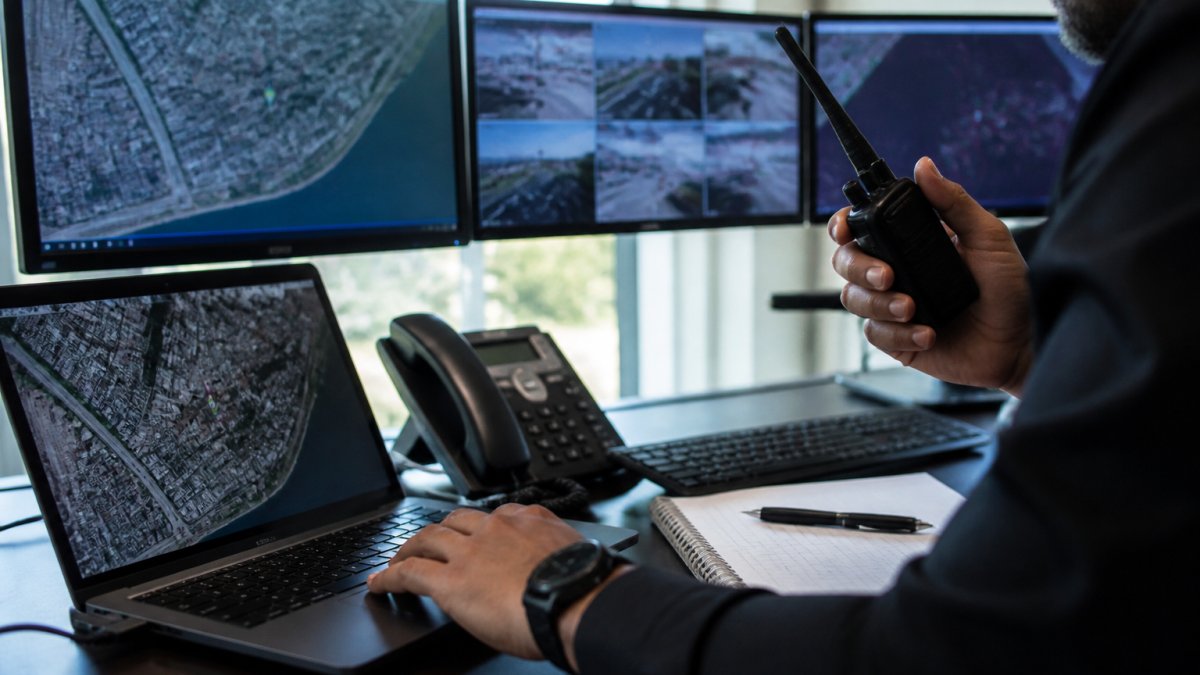
Movement one (hotel to first venue). The principal is moved in a vehicle with the driver and at least one close protection agent.
Evening and overnight. The close protection agent confirms the room is secure, reviews the next day's schedule, and coordinates with hotel security for overnight coverage.
On-site protection roles during this sequence include:
- Close protection agents: Trained personnel maintaining proximity to the executive, positioned to respond to threats immediately and to move the principal out of a developing incident.
- Perimeter security: Additional protective staff managing access to venues, screening visitors, and maintaining secure boundaries at larger events.
- Advance agents: Team members positioned ahead of the executive at each venue, conducting final security sweeps and identifying emerging threats.
- Communication coordination: Constant radio or encrypted-app contact between all protective team members, the command center, and local security partners.
- Contingency response: Pre-positioned resources for rapid response to medical emergencies, security incidents, or operational disruptions.
Location monitoring provides real-time awareness of the executive's position.
Close protection agents maintain situational awareness by scanning crowds, identifying threats, and positioning themselves to intercept danger before it reaches the executive. Their presence deters opportunistic threats while their training enables response to serious ones.
How protection plans are tailored to individual risk. The sequence above is not fixed. A low-profile executive traveling to a familiar city may use a single close protection agent and a vetted driver, with the command center monitoring remotely. A high-profile principal traveling to an elevated-threat destination may require a full detail: multiple vehicles, advance agents at every stop, a dedicated command center, and coordination with local law enforcement. Variables that drive staffing and procedure include:
- Threat level: A written assessment that weighs destination risk, the principal's public profile, and any specific threats.
- Destination: Familiarity, local security infrastructure, language, and the reliability of local partners.
- Public profile: Whether the principal's presence is announced, likely to attract media, or can be kept private.
- Itinerary: Number of stops, public appearances, and the amount of time spent in uncontrolled environments.
- Traveler preferences: Some principals want visible protection as a deterrent; others want a low-profile posture. Both are workable, but they change the plan.
Measuring effectiveness. Incident-free travel is welcome, but not proof that risk was absent.
Traveler Preparation and Communication Protocols
Executive protection for travel depends on active participation from the executive.
Pre-trip briefings cover:
- Security overview: Destination threat assessment, specific risks identified during advance work, and protective measures being implemented.
- Communication protocols: How to contact protective staff, emergency procedures, and restrictions on public communications about travel plans.
- Operational procedures: What to expect during airport processing, vehicle transport, venue security, and daily movements.
- Threat recognition: How to identify potential surveillance or suspicious activity and when to alert protective personnel.
- Family protocols: How family members are protected during travel, communication procedures, and emergency contacts.
Practical communication mechanics. A briefing is only useful if the traveler knows what to do in the moment. Most details establish a small set of simple rules:
- One primary channel. The traveler has one number or app to use for the protection team, and the team has one way to reach the traveler that is checked regularly. Multiple channels create confusion.
- Check-in cadence. The team confirms the traveler's location at each transition, arrival at a venue, departure, arrival at the hotel. The traveler does not need to initiate these; the close protection agent does.
- Schedule changes. If the traveler wants to add a stop, leave early, or change a meeting, the change goes to the detail leader before it happens, not after. The detail leader evaluates the security implications and either approves, modifies, or proposes an alternative.
- Code words. Many details use a simple code word or phrase the traveler can say in a meeting or on a call to signal that they feel unsafe without alerting anyone else in the room.
- Emergency signal. A separate, unambiguous signal, a word, a text, a gesture, that means "extract me now." This is rehearsed, not improvised.
Itinerary sharing. The traveler should share the full itinerary with the protection team as early as possible, including low-risk meetings, personal time, and expected guests or drivers.
Privacy, consent, and data handling. Executive protection involves collecting and handling sensitive information: the traveler's location, schedule, contacts, and sometimes health or family details.
- What is collected. Typically: itinerary, contact information, vehicle and flight details, and location data from team devices. Some details also collect open-source information about the destination and any public events the traveler will attend.
- How it is stored. Reputable providers keep this information in access-controlled systems, limit it to team members who need it, and have a retention policy, for example, deleting trip files after a set period unless there is an ongoing need.
- Who has access. The traveler should know which team members can see their location and schedule, and whether any of that information is shared with third parties such as hotels, drivers, or local partners. Consent for sharing should be explicit.
- Boundaries. Protection teams respect the traveler's need for confidentiality, business discretion, and personal time. The team does not need to be in the room for every conversation; it needs to know where the traveler is and be able to reach them.
- Location tracking. If the team uses location tracking, the traveler should understand what device is being tracked, when tracking is active, and how to turn it off if they choose. Some travelers prefer a team-issued device; others prefer an app on their own phone. Both are workable, but the choice should be made before the trip, not during it.
Family and other travelers. If family or colleagues travel with the principal, the briefing should cover how they are protected, how they communicate with the team, and what to do if separated. In many details, a second agent is assigned to family members so the principal's close protection agent isn't split.
Effective communication between the executive and protective team prevents misunderstandings that could compromise security.
Frequently Asked Questions
What is the difference between executive protection and travel security?
Executive protection encompasses close protection, advance work, and real-time coordination before, during, and after travel. Travel security focuses specifically on mitigating risks during the journey itself. Executive protection is broader and proactive; it includes threat assessment, destination research, and contingency planning. Travel security is reactive, addressing immediate threats during transit, airport transfers, and hotel stays. Both work together as part of a comprehensive protective detail.
How do protection teams assess travel risks before an executive travels?
Risk assessment begins with destination research, including crime statistics, political stability, health threats, and local security contacts. The advance team evaluates the executive's profile, travel purpose, and previous threat history. They identify high-risk periods (arrival, departure, public events) and assess exposure at hotels, venues, and transportation hubs. Situational awareness and local intelligence help teams determine whether additional protective agents, secure transportation, or law enforcement coordination is needed for that specific journey.
What should an executive tell their protection team before traveling?
Executives should provide complete itinerary details, including flight times, hotel addresses, meeting locations, and attendee lists. Share any known threats or security concerns, previous incidents, and family members traveling. Disclose mobility limitations, medical needs, or dietary restrictions that affect protection planning. Confirm communication preferences and emergency contact protocols. The more transparent the traveler, the more tailored and effective the protective detail becomes. This information remains confidential and is used solely for advance work and contingency planning.
How do security teams coordinate with airport security and law enforcement?
Protection teams establish relationships with local law enforcement and airport security before travel. They coordinate passenger screening procedures, arrange expedited processing when appropriate, and confirm secure holding areas. Real-time communication between protective agents and airport personnel ensures seamless handoffs from curb to gate. For high-profile travelers, teams may request law enforcement presence or coordinate with TSA for additional screening protocols. Post-arrival coordination includes communication with destination-based security providers and local authorities to maintain situational awareness throughout the stay.