
Armed Guard Licensing Rules: A 2026 Guide
Learn armed guard licensing rules, Class D and Class G requirements, training, background checks, and renewal procedures. Start your security career today.
Table of Contents
- Armed Guard Licensing Rules: What You Need to Know
- Class G License Eligibility Requirements
- Understanding the Class D Security Officer License
- Armed Security Guard Training Curriculum and Certification
- Background Checks, Fingerprinting, and Application Process
- Security Guard License Renewal Process and Compliance
- Career Path and Salary Expectations for Armed Security Professionals
- Common Disqualifying Factors and Legal Limitations
- Frequently Asked Questions
Last Updated: September 18, 2026
Armed Guard Licensing Rules: What You Need to Know
Armed guard licensing in the United States involves specific state-level requirements that vary significantly by jurisdiction. Understanding these regulations is essential for anyone pursuing a career in armed security or hiring licensed professionals. States like New Jersey impose rigorous standards on applicants, making a thorough grasp of NJ SORA license requirements a fundamental prerequisite for professional compliance.
The armed guard licensing process involves meeting eligibility criteria, completing mandatory training, passing background checks, obtaining fingerprinting, and submitting applications to the appropriate regulatory authority.
Class G License Eligibility Requirements
The Class G license is a primary credential for armed security professionals, requiring age, residency, and background criteria.
Most jurisdictions require applicants to be at least 18 years old (some mandate 21), with residency established via valid driver's license or state identification.
A clean criminal history is required; felony convictions, domestic violence charges, or certain misdemeanors result in immediate disqualification.
Some jurisdictions require mental health evaluations and proof of citizenship or legal residency status.
Understanding the Class D Security Officer License
The Class D security officer license is a foundational credential that often precedes Class G armed guard licensing. While Class D does not authorize firearm carry, it establishes baseline competency in professional security operations and is frequently a prerequisite for armed guard work.
Class D vs. Class G: Understanding the Relationship
Class D covers non-armed security work (access control, perimeter patrol, incident reporting, emergency procedures, legal liability awareness) with 40 to 60 hours of instruction. Class G builds on Class D foundations and adds firearms-specific training.
Class D authorizes non-armed security work; Class G authorizes firearm carry in security work. Some applicants pursue Class D first, then Class G; others pursue both concurrently.
Class D Training Curriculum and Requirements
Class D training covers essential security fundamentals that apply across all security roles. The curriculum typically includes:
Legal Framework and Authority, Understanding your legal authority, limits on detention and questioning, and when force is permissible under trespass and property laws.
Access Control and Identification, Procedures for verifying credentials, managing entry points, maintaining logs, and handling unauthorized access attempts.
Incident Reporting and Documentation, Accurate incident documentation, evidence preservation, and report writing for legal proceedings.
Communication and De-escalation, Professional communication techniques and conflict de-escalation without escalation.
Emergency Procedures, Response protocols for fire, medical emergencies, active threats, and evacuation procedures.
Liability and Professional Conduct, Legal liability, policy compliance, and consequences of improper conduct or excessive force.
Class D License Renewal and Continuing Education
Class D licenses expire every two to three years and require renewal with updated documentation, proof of continuing education (4 to 8 hours), and background check authorization.
Continuing education covers law updates, security techniques, and de-escalation refreshers. Employers may provide this; otherwise, complete it independently through approved providers.
Renewal fees range from $40 to $150 and are submitted online through the state portal.
Reciprocity and Out-of-State License Transfers
If relocating with a Class D or Class G license, you may transfer your credential. Reciprocity policies vary significantly by state.
Full Reciprocity, Direct transfer with proof of current license, state-specific background check, and transfer fee ($50-$150). Processing: 15-30 days.
Partial Reciprocity, Additional training or testing required (state-specific exams, firearms qualification). Processing: 30-60 days; cost: $100-$300.
No Reciprocity, Full licensing process required as a new applicant. Timeline: 60-120 days; cost: $300-$800.
Contact the state licensing authority for reciprocity policy. Bring current license documentation, proof of training, and continuing education certificates. Some states require direct verification, adding 10-15 days.
Armed Security Guard Training Curriculum and Certification
Armed security guard training covers firearms proficiency, legal authority, threat assessment, and professional conduct, typically 40-80 hours combined classroom and range instruction.
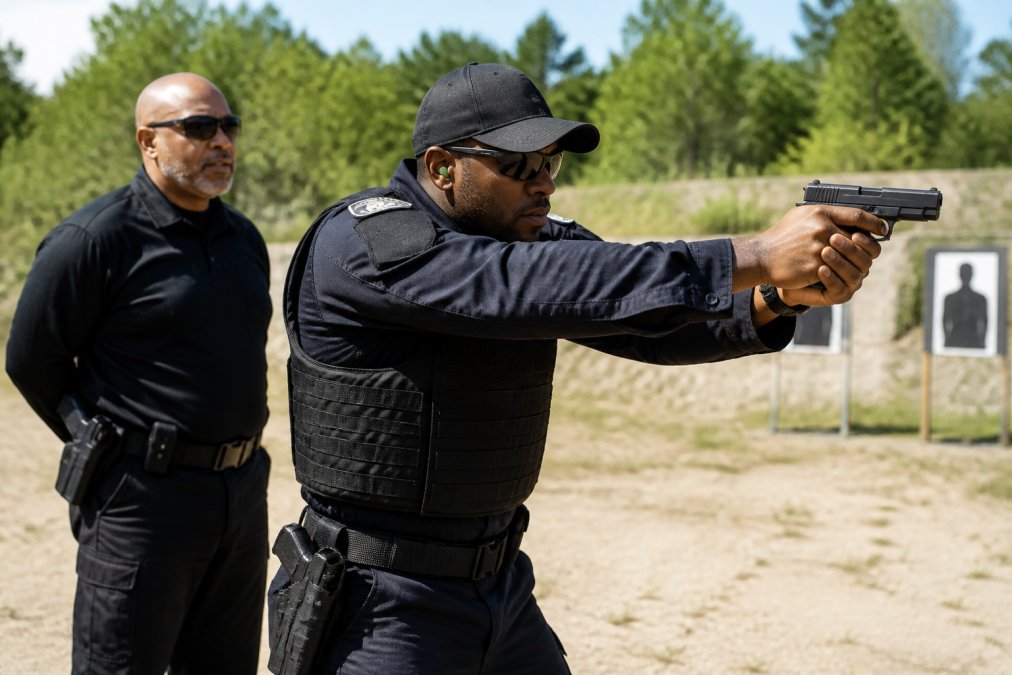
Classroom instruction covers use-of-force laws, liability, constitutional limitations, incident documentation, communication, and de-escalation. Improper force application creates liability for you and your employer.
Firearms training includes range qualification with minimum accuracy scores at specified distances, weapon maintenance, safe handling, storage, and emergency procedures under certified instructor supervision.
Level IV body armor training covers proper use, care, limitations, and threat-level-specific equipment configurations.
De-escalation and scenario-based training simulate real-world situations requiring threat assessment, communication, and appropriate response.
Background Checks, Fingerprinting, and Application Process
State licensing authorities conduct comprehensive criminal history reviews of state and federal databases, including felonies, misdemeanors, arrests, and pending charges. Investigation typically takes 30-60 days and examines employment history, finances, and references.
Fingerprinting is mandatory, submitted at law enforcement agencies, authorized services, or mobile vendors for criminal database comparison and cross-jurisdictional record matching.
Step-by-Step Application Walkthrough
Create an account on the state licensing authority's online portal using your Social Security number and email to track status, upload documents, and receive correspondence.
Complete the application form with personal information, ten-year employment history, three references, and detailed criminal history disclosure. Accuracy is critical; inconsistencies trigger automatic denial.
Upload government-issued photo ID, proof of residency (within 60 days), proof of citizenship, and professional certifications in specified formats (PDF or JPG, 5 MB max). Wrong formats cause rejection and delays.
After submission, you receive a confirmation email with an application number to track status (Received, Under Review, Fingerprinting Required, Background Investigation, or Ready for Approval).
When "Fingerprinting Required" appears, complete it within 30 days at an approved vendor (10-15 minutes, $15-$50). Bring your application number and ID; the vendor electronically submits biometric data.
During background investigation (30-45 days), investigators contact references and verify employment. Respond promptly to requests for clarification or documentation.
After background investigation, the system updates to "Ready for Approval" or "Approved." Approved applicants receive official license documents via mail (5-10 days) or digital copies through the portal.
Application Fees and Payment Methods
Initial Class G applications cost $75-$300 depending on license duration. Some states charge separate fingerprinting fees ($15-$50). Payment is non-refundable.
Payment methods include credit card, debit card, check, or money order.
Processing Timelines and Status Tracking
Processing timelines range from 30-90 days from complete submission to issuance, assuming correct documents and prompt responses. Incomplete applications reset the timeline.
Security Guard License Renewal Process and Compliance
Most armed guard licenses require renewal every two to three years. Licensing authorities notify you 60-90 days before expiration.
Career Path and Salary Expectations for Armed Security Professionals
Entry-level positions involve site-based security, facility guarding, patrols, and access monitoring, providing foundational experience.
Common Disqualifying Factors and Legal Limitations
Felony convictions result in permanent disqualification, regardless of age. Rare exceptions exist for very old convictions.
Frequently Asked Questions
What are the requirements to be an armed security guard in Florida?
To become an armed security guard, you must be at least 18 years old, hold a valid Class D security officer license, and obtain a Class G firearm license. You'll need to complete mandatory training hours, pass a background check with fingerprinting, qualify at a range with your duty caliber weapon, and pass a criminal history review. The Class D license is a prerequisite before applying for the Class G armed license.
Is a Class D license mandatory before applying for a Class G license?
Yes. The Class D security officer license is a statutory requirement and must be obtained first. Once you hold an active Class D license and meet all other eligibility criteria, you can then apply for your Class G firearm license. This two-tier system ensures all armed security professionals have foundational compliance and professional training before carrying a firearm.
What is included in the armed security guard training curriculum?
The mandatory training curriculum covers firearm safety, legal use-of-force statutes, conflict de-escalation, incident reporting, customer service, and professional conduct. Classroom instruction includes statutory requirements and regulatory agency compliance. You must also complete range qualification with your duty caliber weapon to demonstrate firearm proficiency. Total training hours are set by the licensing authority and must be completed through an approved provider.
How often must I renew my armed security license?
Both your Class D and Class G licenses require periodic renewal. The security guard license renewal process involves submitting recertification documentation, proof of continued compliance, and any updated background information to the licensing authority. Renewal timelines and requirements are established by state statute, so check with your licensing authority for specific renewal deadlines and fees to maintain your certification.
What disqualifies someone from obtaining an armed guard license?
Common disqualifying factors include a felony conviction, domestic violence charges, certain misdemeanors, active restraining orders, substance abuse issues, and false statements on your application. A thorough background check and fingerprinting review will examine your criminal history. Any unresolved legal issues, dishonesty during the application process, or failure to meet age, residency, or training requirements will result in denial.
What can an armed security guard legally do in Florida?
Armed security guards can carry a duty caliber firearm while on duty, detain suspects pending law enforcement arrival, conduct access control and property protection, and respond to security threats. However, you operate under strict legal limitations: you cannot arrest anyone (only detain), must follow statutory requirements for firearm use, cannot exceed the authority of a private citizen, and must comply with all professional training and compliance standards established by the regulatory agency.