
Retail Loss Prevention Reduces Insurance Premiums
Discover how retail loss prevention measures directly reduce insurance premiums. Learn what insurers assess and how to document your security efforts.
Table of Contents
- How Retail Loss Prevention Directly Affects Insurance Premiums
- What Insurers Look For: The Underwriting Criteria for Retail Risk Assessment
- Retail Loss Prevention Strategies That Insurers Reward
- Retail Security Cameras and Insurance: Documentation That Matters
- Inventory Loss Prevention Best Practices for Premium Reduction
- Building Your Insurance-Ready Loss Prevention Program
- Measuring ROI: What Premium Reductions Actually Mean for Your Bottom Line
- Frequently Asked Questions
Last Updated: October 17, 2026
How Retail Loss Prevention Directly Affects Insurance Premiums
Retail loss prevention insurance directly impacts what you pay for coverage. Insurers reward stores with strong security measures with lower premiums: less theft and shrinkage means fewer claims and lower risk. Understanding the broader factors behind why insurance premiums increase helps store owners better align their security investments with the evolving expectations of underwriters.
Retailers with documented loss prevention programs typically qualify for better rates.
The math is simple: a store losing 3% of inventory annually files more claims than one losing 1%. Insurers set premiums from your loss history, security measures, and risk profile, better prevention means fewer losses and lower premiums.
What Insurers Look For: The Underwriting Criteria for Retail Risk Assessment
Underwriting doesn't stop at "insurers like security." A commercial lines underwriter builds a risk profile from the documents you provide, and your loss prevention program is only as persuasive as the evidence behind it.
Loss runs and claims history. Underwriters request three to five years of loss runs and look at frequency, severity, and trend.
Protective safeguards and alarm systems. Underwriters assess central-station burglar alarms, monitoring, UL certification, and hold-up alarms at cash handling areas.
Camera coverage and retention. Insurers want coverage of entry and exit points, checkout lanes, high-theft merchandise, and stockrooms, plus footage retention. Underwriters may ask for the retention period and whether footage can be exported for claims.
Cash handling and POS controls. Underwriters check daily register reconciliation, supervisor approval for voids and refunds, daily deposits, and segregation of duties between receiving, counting, and depositing. One employee handling all three is a classic internal fraud exposure.
Inventory visibility. Insurers want evidence you can distinguish theft from error.
Employee screening and training. Underwriters may ask about background checks for cash handlers and key holders and whether loss prevention training is documented with attendance records. Signed policies carry more weight than an unacknowledged handbook.
Premises and location factors. Store size, merchandise type, foot traffic, nearby crime, and building type all feed the underwriting model. High-value, small-footprint merchandise (electronics, jewelry, pharmaceuticals, branded apparel) draws more scrutiny than bulk goods, so prepare more documentation.
Coverage type changes the criteria. Commercial property with theft coverage, general liability, and a business owners policy (BOP) each weigh loss prevention differently, and crime coverage, for employee dishonesty and forgery, often has its own application and controls questions.
What this means in practice. Underwriters reward documented, verifiable controls, not intentions. A retailer with a written program, matching records, and a clean loss run negotiates from strength over one with better hardware but no documentation.
Retail Loss Prevention Strategies That Insurers Reward
Some retail loss prevention insurance strategies carry more weight with insurers. Focus on approaches that create measurable, documentable results.
Point-of-sale (POS) reconciliation is among the most valued practices. Daily or shift-by-shift audits catch discrepancies quickly and prove you're monitoring for cash handling errors and register fraud, building credibility with underwriters.
Merchandise placement and visibility matters more than many retailers realize. High-theft items near exits or in blind spots raise loss risk; insurers expect expensive goods in visible, controlled areas, a low-cost way to reduce shoplifting opportunity.
Customer service at checkout is a loss prevention tool. Engaged cashiers who greet customers and make eye contact deter casual shoplifters, and underwriters recognize that good service correlates with lower shrinkage.
Receiving procedures and supplier verification prevent fraud at the source. Documented receiving, checking shipments against invoices, and inspecting merchandise catch errors before they hit inventory, addressing external fraud risk.
Return and refund policies need clear documentation. Loose policies invite fraud and theft disguised as returns; strict, documented procedures show insurers you control this vulnerability.
Retail Security Cameras and Insurance: Documentation That Matters
Security cameras are valuable only if they work and you can prove it. Insurers want evidence the system functions and covers critical areas, not just that cameras exist.
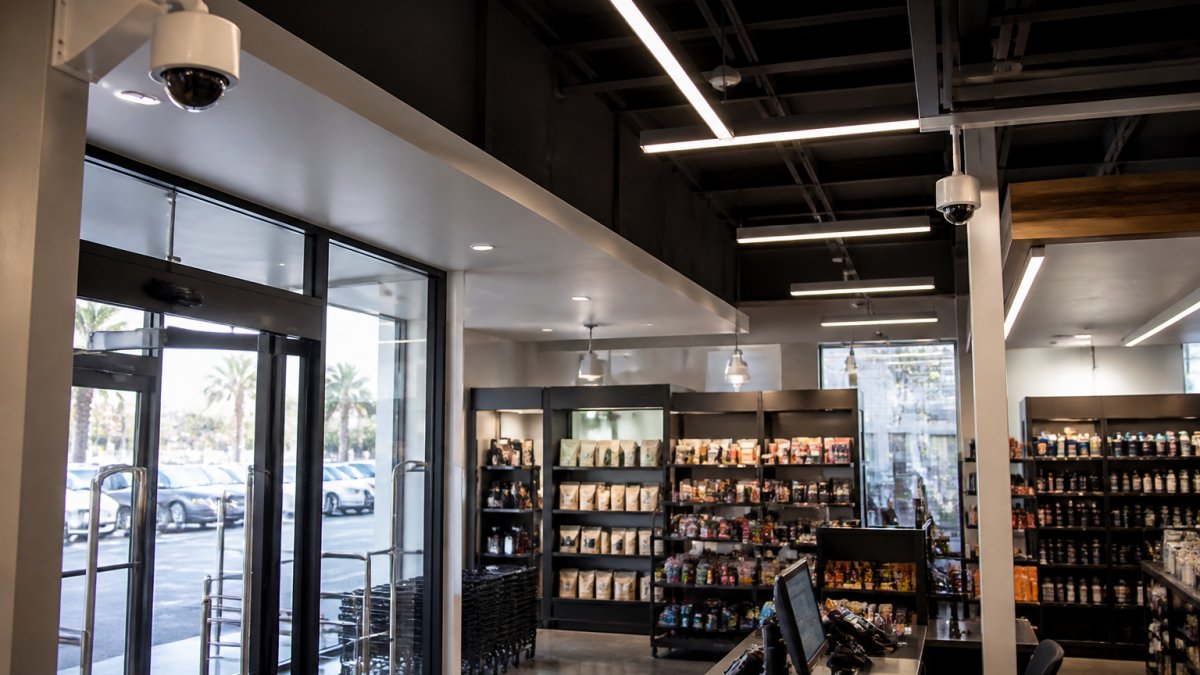
Camera placement and coverage must be strategic. Blind spots are unmonitored loss opportunities; insurers expect coverage of entry and exit points, checkout areas, high-theft zones, and stockrooms. Poor coverage suggests you're not serious about prevention.
Video quality and retention matter for claims. Low-resolution footage has limited value; insurers want HD recording and at least 30 days of retention to support claims investigation.
Maintenance and testing prove your system works. An out-of-focus, offline, or broken camera defeats the purpose; documented maintenance schedules and regular testing show insurers the system stays functional. Cameras that haven't worked for months are a red flag.
Integration with incident response strengthens documentation. Video evidence supporting a suspected theft report matters; retailers who review footage and include it in incident reports show cameras are an active prevention tool, not passive recording.
Inventory Loss Prevention Best Practices for Premium Reduction
Strong inventory management reduces shrinkage and supports lower premiums. Focus on practices that create clear, auditable records.
Cycle counting is more valuable than annual physical inventory. Counting small sections of inventory regularly catches discrepancies early. Insurers see regular cycle counting as proof you're monitoring inventory continuously, not just once a year. This approach also identifies problem areas before they become major losses.
Shrinkage baseline measurement shows insurers you understand your starting point. Calculate your current shrinkage rate before implementing changes. Tracking improvement over time proves your prevention efforts work. Insurers reward retailers who can show shrinkage declining year over year.
Merchandise categorization by risk focuses prevention where it matters most. High-value items, small expensive goods, and frequently stolen products need tighter controls than bulk merchandise. Insurers expect to see different security levels for different product categories.
Supplier accountability reduces external loss. Verify supplier credentials and track shipments carefully. Insurers want to see that you're not just accepting merchandise, you're verifying it arrives in good condition and matches what you ordered. This catches supplier fraud and damage before it becomes your loss.
Damage and waste tracking separates legitimate loss from theft. Broken merchandise, expired products, and waste happen in retail. Documenting these separately from shrinkage shows insurers you understand your loss sources. Stores that lump everything together appear to have higher actual theft than they do.
Building Your Insurance-Ready Loss Prevention Program
Creating a formal loss prevention program that insurers recognize requires structure and documentation. Start with assessment, then build systems that create auditable records.
Step 1: Conduct a loss prevention audit. Identify your current shrinkage rate, primary loss sources, and security gaps. Insurers expect you to understand your problem before you solve it. Document this baseline.
Step 2: Develop written policies and procedures. Formal documentation of how you handle inventory, cash, returns, and incident reporting shows insurers you're serious. These policies become the foundation of your program.
Step 3: Train all staff on loss prevention. Every employee needs to understand their role in preventing loss. Document training dates, topics covered, and attendance. Insurers want proof that training happened, not just hope that it did.
Step 4: Implement technology that creates records. Security cameras, POS systems with audit trails, and access control systems all generate documentation. These records support your claims if loss occurs.
Step 5: Establish incident reporting procedures. Every suspected theft, suspicious activity, or unexplained discrepancy should be documented. Create a simple form and process that captures details. Insurers review incident history during underwriting.
Step 6: Review and improve regularly. Quarterly or semi-annual reviews of your loss prevention program show insurers you're actively managing risk. Document what you find and what changes you make.
For retailers managing multiple locations or high-value inventory, professional security support strengthens your program. Having a trained security team conduct regular audits and staff training demonstrates to underwriters that you're taking prevention seriously.
Measuring ROI: What Premium Reductions Actually Mean for Your Bottom Line
A word of caution before the math: loss prevention does not guarantee a lower premium.
Start with your actual insurance cost. Pull the declarations page for each policy, commercial property, general liability, business owners policy, and crime coverage if you carry it. Record premium, deductible, and any theft sublimits. This is your baseline. Do not estimate from memory; the declarations page is the number your agent and underwriter will use.
Separate the four ways insurance can respond. Improved loss prevention can affect:
- Premium. A rate credit or improved pricing tier, where the carrier's filed rating plan allows it.
- Deductibles. A lower theft or property deductible, which changes your out-of-pocket cost per claim even if premium is unchanged.
- Eligibility and carrier appetite. Access to admitted carriers or preferred programs that were previously unavailable, which often matters more than a small rate difference.
- Coverage terms. Broader theft coverage, fewer exclusions, or higher sublimits for high-theft merchandise.
A renewal that keeps premium flat but cuts the theft deductible from $5,000 to $2,500 and removes a merchandise exclusion is a real financial gain, one that a premium-only ROI calculation would miss entirely.
Measure shrinkage reduction separately. Shrinkage savings and premium savings are different buckets and should be tracked separately. Calculate shrinkage as a percentage of sales using a consistent method, typically (beginning inventory + purchases − ending inventory − recorded sales) adjusted for known markdowns and damage. Compare year over year by category.
Quantify the cost side honestly. Add up camera maintenance, alarm monitoring, POS audit software, training hours, and staff time spent on cycle counts and incident reports. Many retailers underestimate staff time.
Use a simple multi-year frame. A practical approach is to build a three-year table with four rows: prevention cost, shrinkage change, insurance cost change (premium plus deductible exposure), and operational time saved. Do not assume every avoided loss produces a premium discount, it does not.
Account for insurability risk. For retailers with a poor loss history, the return on investment may not appear as a lower premium at all, it may appear as the difference between having coverage and not having it, or between an admitted carrier and a surplus lines policy with higher cost and narrower terms. In that scenario, the ROI case rests on access to coverage, not on a rate reduction.
Differences by business and coverage type. A single-location specialty retailer, a multi-site chain, and a big-box format are underwritten differently, and a program that earns credit on a BOP may not move the rate on a large deductible program. High-theft merchandise categories, prior claims, and location crime data all shift the calculation.
Frequently Asked Questions
How much can retail loss prevention reduce insurance premiums?
Premium reductions vary by insurer, property profile, and loss history. The actual amount depends on your baseline risk assessment, claims history, and the specific loss prevention measures in place. Contact your insurer for a quote after implementing your program.
What documents do insurers require to verify retail loss prevention measures?
Insurers typically request incident reports, security camera footage logs, access control records, staff training certificates, inventory audit reports, and written loss prevention policies. They also review your shrinkage baseline and trend data to confirm that measures are actually reducing loss frequency and severity. Having organized, timestamped documentation of your retail security cameras, incident prevention protocols, and employee compliance training strengthens your underwriting profile.
Does installing security cameras actually lower business insurance costs?
Security cameras alone do not automatically lower premiums. Insurers reward the complete package: documented surveillance coverage of high-risk areas, regular footage retention, integration with incident reporting, and staff training on how to use footage for loss prevention. A camera system without documented procedures, staff accountability, or evidence of preventing actual losses has minimal impact on underwriting decisions.
How do I know if my retail loss prevention program is reducing shrink enough to matter to my insurer?
Track your shrinkage rate (inventory loss as a percentage of sales) monthly and compare it to your baseline. Document the specific measures that drove the reduction: security technology, staff training, access control improvements, or inventory management changes. Present this data to your insurer during renewal to support a premium reduction request.