
How to Secure Commercial Parking Lots at Night
Learn how to secure commercial parking lots at night with layered parking lot security: lighting, cameras, patrols, access control, and a nightly
Last Updated: October 23, 2026
Quick Summary
To learn how to secure commercial parking lots at night, combine even lighting, well-placed cameras with adequate footage retention, random overnight patrols, and controlled access points. Start with a nighttime risk assessment, then layer these controls so poor visibility, no witnesses, and an easy exit are all removed.
- Walk the lot at 2 a.m. with a flashlight to find dark zones and blind spots.
- Aim for even lighting that lets a person read a license plate from a distance.
- Mix scheduled patrol rounds with random checks so patterns can't be learned.
- Set camera retention long enough to cover your incident response window.
- Review metrics monthly and make one or two concrete changes each time.
Table of Contents
- Why Overnight Parking Lot Security Fails
- Start With a Risk Assessment by Lot Type and Hours
- Parking Lot Lighting Best Practices for Nighttime Visibility
- Parking Lot Security Cameras: Placement, Monitoring, and Evidence Retention
- Overnight Security Patrols: Staffing, Schedules, and Handoffs
- Access Control and Parking Layout: Barriers, Gates, and Safe Exits
- Your Nightly Parking Lot Security Checklist
- Incident Response and Measuring Parking Lot Security Performance
- Frequently Asked Questions
Why Overnight Parking Lot Security Fails
Most commercial parking lot security fails at night because the plan was built for daytime traffic, which is why knowing how to secure commercial parking lots at night starts with rethinking the plan.
Thieves, vandals, and trespassers need three things: poor visibility, no witnesses, and an easy exit. An unsecured lot at night offers all three, which is why how to secure commercial parking lots at night comes down to breaking that combination, layer by layer.
Start With a Risk Assessment by Lot Type and Hours
A risk assessment maps your lot's weak points against its actual operating hours. Do it before you buy a camera or hire a guard.
Walk the lot at night. Not during the day, when everything looks fine. Note:
- Dark zones: corners, stairwells, and areas behind dumpsters
- Blind spots: places no camera currently covers
- Access points: every vehicle and pedestrian entry
Different lot types carry different risks: retail lots face vandalism and vehicle theft, construction sites face material theft, medical facilities face trespassing and compliance concerns.
For a broader framework, see our guide on how to improve commercial property security.
Parking Lot Lighting Best Practices for Nighttime Visibility
Lighting is the cheapest, highest-impact security upgrade you can make. It removes the cover criminals depend on and makes your cameras work, a camera in the dark records nothing useful.
Follow these parking lot lighting best practices:
- Light the whole lot evenly. Bright pools with dark gaps between them are worse than useless. Aim for consistent coverage.
- Target key zones first: entrances, exits, walkways, ATMs, and stairwells.
- Use motion-activated lighting in low-traffic areas to save power while keeping coverage.
Lighting and cameras work as a pair. Bright, even light gives your surveillance system something to record. Dim, patchy light gives you hours of unusable footage.
Test your lighting with a simple check. Stand where a camera is mounted and look out at the lot.
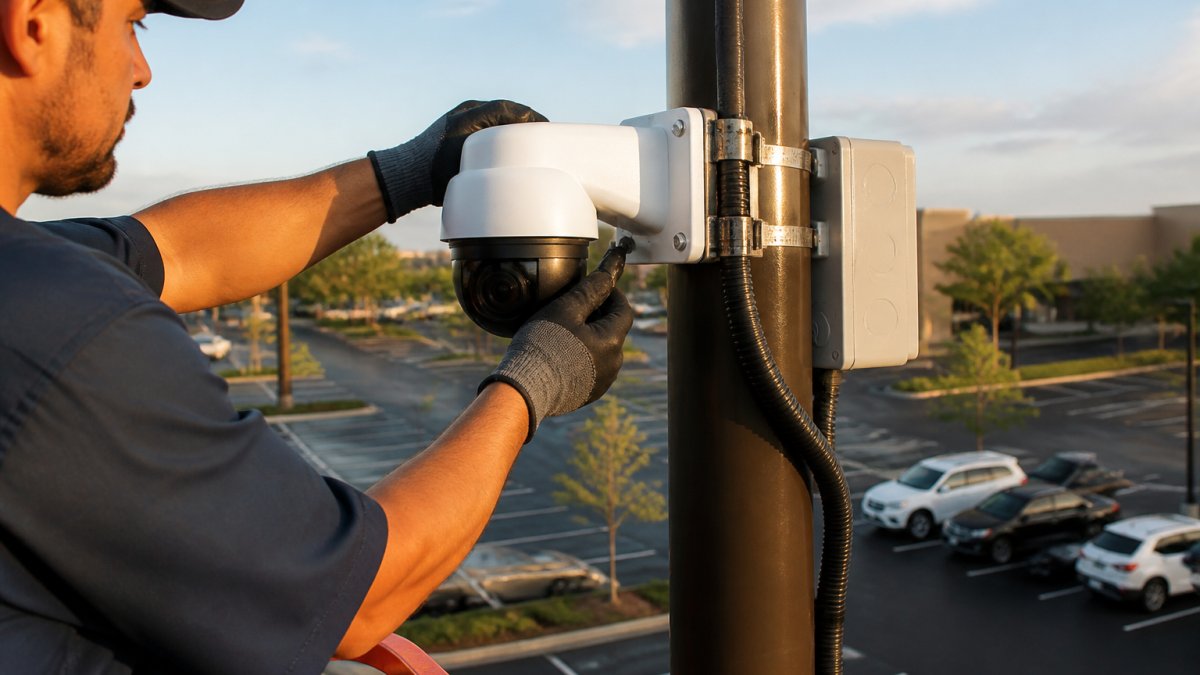
Parking Lot Security Cameras: Placement, Monitoring, and Evidence Retention
Cameras deter crime and preserve evidence, but only when placed and managed correctly.
Place cameras to cover:
- Every vehicle entrance and exit, aimed to catch plates
- Pedestrian walkways and building doors
- High-value storage areas and equipment yards
Then handle the back end: set a retention period long enough to cover your incident response window and store footage securely, so an incident yields clear video, not a blurry clip that got overwritten.
AI-assisted surveillance is changing this. To understand how this improves nighttime monitoring and evidence capture, read our article on integrating AI with commercial video surveillance.
Overnight Security Patrols: Staffing, Schedules, and Handoffs
Technology catches a lot, but a visible human presence changes behavior.
A solid patrol plan covers three things:
- Staffing: licensed, trained officers, not untrained warm bodies
- Schedules: a mix of scheduled and random checks so patterns can't be learned
- Handoffs: clear shift-change notes so nothing falls through the cracks
Random timing matters. If a patrol passes the same spot at the same minute every night, a thief simply waits, so mix scheduled rounds with unpredictable checks.
Our mobile patrol service uses marked, GPS-tracked vehicles running scheduled and random checks across properties.
Wondering whether patrols or a fixed guard is the better fit? Our breakdown of whether mobile patrol is cheaper than a stationary guard explains the cost comparison and which model suits which property.
Access Control and Parking Layout: Barriers, Gates, and Safe Exits
Access control decides who gets in, when, and how they leave. Combined with a deliberate layout, it removes the easy entry and exit criminals rely on after dark. The goal is not to lock the lot down completely, most lots still serve late-shift employees, deliveries, and tenants, but to make every entry and exit a recorded, intentional event.
Start with an access audit, not a shopping list
Before buying gates or readers, map every way a person or vehicle can enter the lot. Walk the perimeter at night and list:
- Vehicle entries and exits, including any secondary curb cuts or alley access
- Pedestrian entries, including building doors that open onto the lot, stairwells, and fire exits
- Service and delivery points, including loading docks and trash enclosures
Operators often secure the main entrance while a side gate or propped fire door becomes the real front door for anyone who knows the property. The audit finds those gaps before an intruder does.
Match the access control to the lot type and hours
Different lots need different access models. A retail lot open to the public overnight needs different controls than an office lot that empties at 7 p.m. or an industrial yard holding equipment.
- Retail and mixed-use lots open overnight: keep public access but add gate arms at secondary entrances, close off unused sections with barriers, and use signage and lighting to funnel traffic past a camera-covered chokepoint.
- Office and medical lots that empty after hours: use keycard or code access at vehicle gates and pedestrian doors, and program the system to log every after-hours entry. Consider closing the lot entirely after the last scheduled shift and requiring badge-in at a single controlled entrance.
- Industrial and construction yards: use full-perimeter fencing with a single controlled vehicle gate, lockable equipment cages inside the fence, and a gate log that ties each entry to a named person or company.
Design the layout for safe exits, not just parking capacity
Layout is a security control. A lot that maximizes spaces at the expense of sightlines and exit routes creates the isolation and boxed-in conditions criminals look for.
- Keep traffic flowing in one direction where possible so drivers are not reversing into blind lanes.
- Separate pedestrian walkways from vehicle lanes with curbing, bollards, or striping, and route walkways past lit, camera-covered areas rather than behind dumpsters or equipment.
- Avoid dead-end rows where a vehicle can be blocked in. If a row must dead-end, keep the end lit and visible from the building or a patrol route.
Plan for gate and reader failure
Every access control system fails eventually. A gate arm that sticks open, a reader that loses power, or a controller that drops offline can leave the lot wide open until morning.
- Set the fail mode deliberately. Decide whether a power loss should fail the gate open (for life safety and fire access) or closed (for security), and document that decision with the local fire authority where required.
- Add a manual override that only authorized staff can use, and log every use.
- Monitor gate status remotely so a stuck-open gate generates an alert rather than waiting for a patrol to find it.
Watch for tailgating and propping
The most common access control failure is not a broken reader, it is tailgating or a door propped open for a smoke break. Mitigate with:
- Door position sensors that alert when a controlled door is held open beyond a set time.
- Signage at each controlled entry reminding users not to tailgate.
- Patrol checks that include testing controlled doors and gates, not just driving past them.
Access control and layout work best designed together with lighting and cameras. A gate in a dark corner with no camera is a suggestion, not a control.
Your Nightly Parking Lot Security Checklist
A parking lot security checklist turns your plan into a repeatable routine. Use this one at the start and end of every overnight shift.
- Confirm all exterior lights are working
- Verify cameras are recording and retention is active
- Check that gates and barriers close and latch properly
Keep the completed checklist on file. It becomes your record of due diligence and a tool for spotting patterns over time.
Incident Response and Measuring Parking Lot Security Performance
Most parking lot security advice stops at prevention. For alarm activations, alarm response dispatches trained officers to the lot after hours. But the measure of an overnight program is what happens after a trespass, theft, vandalism, or alarm activation, and whether the property learns from it. Here is the incident response sequence and the metrics that turn a plan into an improving loop.
Build the incident response plan before you need it
An incident response plan is a short, written sequence telling every person on the property what to do in the first minutes of an event. Keep it to one page per incident type and post it where staff can find it at 2 a.m.
At minimum, the plan should cover these incident types:
- Trespassing or loitering
- Vehicle theft or break-in
- Vandalism or property damage
For each type, spell out the sequence:
- Observe and do not confront. Staff should report, not intervene, unless a person is in immediate danger. Confrontation is how minor incidents become injuries.
- Call the right number first. List the dispatch number, the property manager's after-hours number, and 911, in the order they should be called for each incident type.
- Secure the scene. Move people away, lock down adjacent areas if needed, and prevent contamination of evidence.
- Preserve evidence. Note the time, location, description, and any camera coverage. Do not delete or overwrite footage.
- Document. Use a standard incident report form that captures time, location, people involved, actions taken, and witnesses.
- Notify. Property manager, tenant contact, insurer, and police as appropriate.
- Review. Debrief within 48 hours while details are fresh.
Handle evidence correctly
Evidence handling is where many overnight programs fall apart. A clear clip that gets overwritten, or a scene cleaned up before photos are taken, can turn a prosecutable incident into an unsupported insurance claim.
- Export and preserve footage immediately when an incident is reported. Do not rely on the retention window to hold it.
- Log the chain of custody for any exported video, photo, or physical item.
- Photograph the scene before anything is moved, including wide shots and close-ups.
Measure the program with a small set of metrics
A security program that is not measured drifts. Pick a small set of metrics, review them monthly, and act on what they show. Useful metrics include:
- Incidents by type, location, and time of night, this shows where and when the risk actually concentrates.
- Patrol completion rate, the percentage of scheduled and random checks actually completed, not just assigned.
- Camera uptime, the percentage of time each camera is recording and reachable.
A lot with falling incident counts, steady patrol completion, and high camera uptime is working. A lot with rising trespassing reports, falling patrol completion, or repeated lighting outages needs a closer look at the schedule, staffing, or physical condition of the property.
Close the loop
Measurement only matters if it changes something. Hold a monthly review where the property manager, security provider, and a tenant representative look at the metrics and make one or two concrete changes, adjust a patrol route, add a camera, fix a lighting pattern, change a gate schedule.
That loop, plan, respond, measure, adjust, separates a security program from a stack of equipment, and it is the part most overnight lot guides skip.
Frequently Asked Questions
How often should security patrol a parking lot overnight?
There is no single number that fits every lot. Patrol frequency should match your risk assessment: a retail lot with overnight inventory might need patrols every 30 to 60 minutes, while a low-risk office lot may only need two or three visits per night. What matters most is that patrols are irregular enough that trespassers cannot time them, and that each patrol is logged with timestamps so you can prove coverage and spot gaps. Handoffs between shifts should be documented too, so nothing gets dropped between officers.
What lighting is best for a commercial parking lot?
LED fixtures with full cutoff optics are the standard choice for parking lot security. They cut glare, direct light down where it is needed, and use far less power than older high-pressure sodium lamps. Aim for even coverage across the lot rather than bright pools around a few poles, and keep fixtures on photocells or timers so they run from dusk to dawn. Dark corners near dumpsters, stairwells, and perimeter fencing are where incidents happen, so check those spots on foot after dark before you sign off on the lighting design.
What should a nighttime parking lot security checklist include?
A solid parking lot security checklist covers lighting checks, camera feed verification, gate and barrier function, lock and door checks, patrol sign-ins, and a review of any incidents from the previous shift. Add a walk-through of secluded areas, a check that emergency call boxes work, and confirmation that the lot is cleared of loiterers before close. The checklist should be signed and timestamped each night so you have a record if a theft or trespass claim comes up later.
How can access to a commercial parking lot be controlled after hours?
Gate arms, keycard or app-based entry, and protective bollards are the core tools. For lots that stay open to the public, restrict entry to one controlled point and close off secondary drives with barriers. For lots that close overnight, use a gate that logs every entry and exit so you can match vehicles to authorized users. Pair physical access control with cameras at the entrance and a posted after-hours contact number, so anyone who does get in knows they are being watched and recorded.
