
How Do You Conduct a Security Risk Assessment?
A security risk assessment starts with asset inventory and threat identification. Learn the 7 steps and scoring methods to protect your business.
Last Updated: October 24, 2026
Quick Summary
To conduct a security risk assessment, define your scope and stakeholders, build an asset inventory, then identify threats and vulnerabilities across people, property, data, and systems. Score each risk on a 1-to-5 likelihood and impact scale, prioritize the results, and assign every fix an owner and deadline.
- A security risk assessment delivers a ranked risk register, named controls, a budget case, and evidence for insurers or auditors.
- Risk equals the likelihood of an event combined with its impact, per CISA guidance.
- Scoping too wide is the most common failure, producing generic findings nobody acts on.
- Score likelihood and impact on a 1-to-5 scale and multiply for a score from 1 to 25.
- Assign one person to own the risk register and review it quarterly.
Table of Contents
- What a Security Risk Assessment Actually Delivers
- Step 1: Define Scope, Objectives, and Stakeholders
- Step 2: Build Your Asset Inventory and Identify Critical Assets
- Step 3: Identify Threats and Vulnerabilities Across People, Property, Data, and Systems
- Step 4: Score Likelihood and Impact to Prioritize Risk
- Your Business Security Risk Assessment Checklist
- How a Physical Security Risk Assessment Fits the Full Picture
- Using a Security Risk Assessment Template and Real Examples
- Frequently Asked Questions
What a Security Risk Assessment Actually Delivers
A security risk assessment is a structured review of what you need to protect, what could harm it, and where you are exposed.
This guide from Ranger Operation Services walks through the full process, from scoping to scoring to remediation, so you can run one without hiring a consultant on day one.
A security risk assessment delivers four things: a ranked risk register, a set of named controls, a budget case for fixing gaps, and evidence you can hand to an insurer or auditor. Skip any of the four and the exercise becomes paperwork.
The core logic is simple. According to CISA's guidance on risk assessment, risk equals the likelihood of an event combined with its impact.
Here is the sequence we use:
- Define scope, objectives, and stakeholders
- Build an asset inventory
- Identify threats and vulnerabilities
- Score likelihood and impact
- Prioritize and treat the risks
- Document, monitor, and repeat
Step 1: Define Scope, Objectives, and Stakeholders
Write down what the assessment covers and what it does not.
Objectives should be measurable: "reduce after-hours trespass incidents at the north lot" beats "improve safety." Name stakeholders too: the property manager, operations lead, IT owner, and budget signer.
Industry shapes scope more than most guides admit: a construction site cares about material theft and after-hours access, a retail chain about shrink and organized retail crime, a medical facility about chain-of-custody documentation. See how purpose-built security for your industry changes assessment priorities by sector.
Watch out: scoping too wide is the most common failure. An assessment that tries to cover every site at once produces generic findings nobody acts on.
Step 2: Build Your Asset Inventory and Identify Critical Assets
You cannot protect what you have not listed. An asset inventory records everything that would hurt to lose, damage, or have stolen.
Group assets into four buckets:
- People: staff, contractors, visitors, executives
- Property: buildings, equipment, vehicles, inventory
- Data: customer records, financials, employee files, access logs
- Systems: networks, cameras, alarms, payment platforms
Mark each asset critical or standard. Critical means the business stops or takes serious harm if the asset is lost: a server holding order history is critical; a breakroom microwave is not.
Vacant and high-value properties deserve their own line. See vacant property protection for details on protecting these assets.
Step 3: Identify Threats and Vulnerabilities Across People, Property, Data, and Systems
Threats are what could go wrong; vulnerabilities are the weaknesses that let a threat succeed.
Common threats include:
- Theft and organized retail crime
- Trespass, loitering, and squatting
- Workplace violence and disgruntled insiders
- Cyber intrusion and ransomware
- Fire, flood, and utility failure
- Vendor or contractor misuse of access
Vulnerabilities show up in inspections and interviews. Walk the site.
People-related threats need their own plan. See workplace violence response for immediate on-site coverage during these events.
Fire-system gaps count as vulnerabilities too. See fire watch for NFPA-compliant coverage when continuous fire watch is needed.
Step 4: Score Likelihood and Impact to Prioritize Risk
Likelihood definitions (use these exact anchors):
| Rating | Label | Definition |
|---|---|---|
| 5 | Almost certain | Expected to occur within 12 months based on incident history or current exposure |
| 4 | Likely | Could occur within 12 months; similar events have happened nearby or to peers |
| 3 | Possible | Might occur within 2-3 years; conditions exist but no recent incidents |
| 2 | Unlikely | Could occur but no known precedent and controls are in place |
| 1 | Rare | Would require multiple failures; no realistic path today |
Impact definitions (use these exact anchors):
| Rating | Label | Definition |
|---|---|---|
| 5 | Severe | Business stops, serious injury, regulatory action, or loss that threatens solvency |
| 4 | Major | Multi-day disruption, significant financial loss, or reportable data exposure |
| 3 | Moderate | Short disruption, manageable cost, or reputational hit contained to one site |
| 2 | Minor | Minor cost or inconvenience; absorbed by normal operations |
| 1 | Negligible | No measurable effect on operations, safety, or compliance |
With those anchors in place, the matrix reads cleanly:
| Likelihood | Impact | Score | Risk Level | Action |
|---|---|---|---|---|
| 5 | 5 | 25 | Critical | Fix now; escalate to leadership today |
| 4 | 4 | 16 | High | Fix this quarter; assign owner and budget |
| 3 | 3 | 9 | Medium | Schedule and budget within 6-12 months |
| 2 | 2 | 4 | Low | Monitor; revisit at next review |
| 1 | 1 | 1 | Minimal | Accept; document the decision |
Worked example 1: unlocked loading dock. No camera coverage and the door is propped open during shifts.
Worked example 2: faded parking-lot sign. Legible but worn, with no incidents traced to it.
Worked example 4: impaired fire sprinkler system. A hot-work contractor disabled a zone during renovation.
Score in pairs. One person who knows the asset and one who knows the threat will catch inflated likelihoods and missed impacts. Re-score the top ten risks every quarter so the register reflects current conditions, not last year's snapshot.
Risk treatment follows the score: avoid, reduce with controls, transfer through insurance, or accept.
The scoring definitions matter more than the math. Publish the anchors, apply them to every row, and the register becomes defensible to an insurer, an auditor, or a budget committee.
Your Business Security Risk Assessment Checklist
Use this checklist to keep the work consistent across sites and reviewers. Each item names the evidence you should produce and the owner who signs off.
Phase 1: Scope and setup
- Scope statement written and approved, naming the sites, shifts, and systems covered and explicitly excluded
- Stakeholders named with clear owners: property manager, operations lead, IT owner, budget signer
- Assessment schedule set with a start date, site-walk dates, and a review date
- Scoring definitions published so every reviewer uses the same 1-5 anchors
Phase 2: Asset inventory
- Asset register built with four columns: asset, category (people, property, data, systems), criticality, owner
- Critical assets flagged; each one has a named business owner
- Vacant, high-value, or long-term-empty properties listed separately with their own protection plan
Phase 3: Evidence collection
- Site walk completed with dated photos of access points, lighting, camera coverage, and storage areas
- Staff interviews done using the prompts below; notes filed with the asset register
- Access controls and access logs reviewed for shared codes, orphaned accounts, and after-hours entries
- Camera and alarm coverage mapped against the asset register to find blind spots
- Cyber and information security reviewed with IT: backups, patching, multi-factor authentication, incident history
- Policies and procedures reviewed for gaps between what is written and what staff actually do
Phase 4: Analysis and scoring
- Threats and vulnerabilities listed separately for each critical asset
- Likelihood and impact scored using the published anchors
- Risk register built with these columns: asset, threat, vulnerability, likelihood, impact, score, control, owner, due date, residual score
- Top ten risks reviewed by at least two people to catch inflated or deflated scores
Phase 5: Treatment and tracking
- Treatment plan written for every High and Critical risk: avoid, reduce, transfer, or accept
- Budget estimate attached to each treatment, with a named approver
- Review date set and calendar invite sent to the register owner
- Evidence packet assembled for insurer or auditor: scope, register, site-walk photos, interview notes, treatment plan
Staff interview prompts. Ask these questions verbatim and write down the answers:
- When in the last year did you feel unsafe at work, and where were you?
- Who has keys, codes, or badge access to your area, and has anyone left the company in the last 90 days?
- What would you steal if you wanted to hurt the business, and how would you get it out?
- What system would you take down if you wanted to stop operations, and who would notice first?
- What security rule do people routinely break because it slows down the job?
Risk register template. Build the register as a spreadsheet with one row per asset-threat-vulnerability pair. Add a residual score column to show what the risk drops to after treatment, and a status column (open, in progress, closed, accepted) so the register doubles as a project tracker.
A checklist that lives in a drawer is worse than no checklist, because it creates the appearance of a program. Assign one person to own the register, set a quarterly review, and require a written reason every time a High or Critical risk is accepted rather than treated.
The checklist is the evidence packet. If you cannot produce the scope statement, the register, the site-walk photos, and the interview notes, you have not completed the assessment, regardless of how many boxes are checked.
How a Physical Security Risk Assessment Fits the Full Picture
A physical security risk assessment covers the built environment: doors, gates, lighting, cameras, guards, and access points. It sits inside the wider assessment, not apart from it.
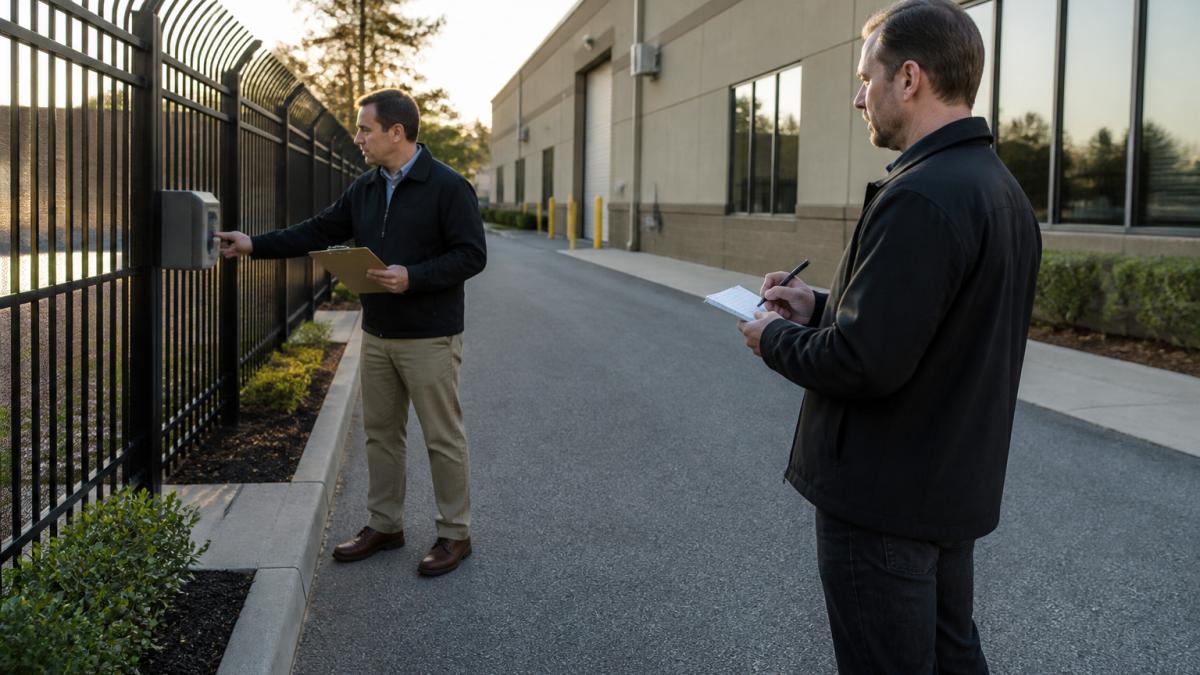
This is where findings become visible deterrence. See retail loss prevention for the service that puts this coverage in place.
What most guides miss is the link between physical and cyber risk. An unmonitored server room is both a physical vulnerability and a data breach waiting to happen.
Using a Security Risk Assessment Template and Real Examples
A security risk assessment template saves time and keeps scoring consistent. Build one with these columns: asset, threat, vulnerability, likelihood, impact, score, control, owner, and due date.
Real security risk assessment examples show how it works in practice:
- Construction site: high-value copper and tools stolen overnight. Likelihood 5, impact 4. Control: overnight patrols plus locked storage.
- Retail chain: repeated loitering at the entrance. Likelihood 4, impact 3. Control: visible guard presence and trespass documentation.
- Corporate office: shared badge codes across floors. Likelihood 3, impact 5. Control: individual access controls and log reviews.
The template only works if someone owns it. Assign one person to maintain the risk register and review it quarterly.
Most businesses finish the assessment and then stall on staffing the fixes. That gap between a ranked risk register and real coverage is where incidents happen.
Frequently Asked Questions
How often should a business conduct a security risk assessment?
Most businesses should run a full security risk assessment once a year and refresh it after any major change: a new facility, a layoff, a break-in, or a shift in the threat landscape. High-risk operations such as construction sites with valuable materials or facilities handling sensitive data may need quarterly reviews. Between full assessments, keep a risk register updated as incidents occur so the next review starts with current information rather than a blank page.
What should a business security risk assessment checklist include?
A solid business security risk assessment checklist covers asset inventory, threat identification, vulnerability review, and control verification. In practice that means listing critical assets and their locations, documenting threats to people, property, data, and systems, inspecting physical security features like locks, lighting, cameras, and access controls, reviewing access logs and background check procedures, and confirming incident response and business continuity plans are current. Each item should record a pass or fail with supporting evidence.
How do you prioritize security risks after an assessment?
Prioritize by risk score, which multiplies likelihood by impact. A threat that is likely and would cause severe harm, such as an unlocked loading dock at a construction site with high-value materials, outranks a low-probability event with minor consequences. Sort findings into tiers, address the highest scores first, and note residual risk after each control is applied. Document the rationale so stakeholders and insurers can see why certain fixes came first.
What are the main types of business risk a security assessment should cover?
A complete security risk assessment should examine physical, cyber, personnel, and operational risk together rather than in silos. Physical risk covers facilities, access control, and property crime. Cyber risk covers information systems, sensitive data, and access logs. Personnel risk covers insider threats, background checks, and workplace safety. Operational risk covers business continuity, incident response, and compliance. Assessing them as one picture prevents gaps where a fix in one area leaves another exposed.
