
Hiring Security for Small Properties: 2026 Guide
Hiring security for small properties means verifying licenses, comparing armed vs unarmed guards, and checking hourly rates. Learn how to vet and hire.
Table of Contents
- Why Small Properties Face Bigger Security Gaps
- How Much Do Private Security Guard Hourly Rates Cost in 2026?
- Security Guard Licensing Requirements You Must Verify Before Hiring
- Armed vs Unarmed Security for Small Business: Which Fits Your Property?
- Contract Staffing vs. Direct Hire: What Small Properties Should Weigh
- Insurance, Liability, and What Homeowners and Small Property Owners Need to Know
- Technology Integration and Cultural Fit: The Overlooked Hiring Factors
- Conclusion
- Frequently Asked Questions
Last Updated: September 17, 2026
Why Small Properties Face Bigger Security Gaps
Hiring security for small properties is harder than it looks. Large commercial campuses spread the cost of a full security program across thousands of square feet and dozens of tenants. A small property carries the same risks without that scale.
How Much Do Private Security Guard Hourly Rates Cost in 2026?
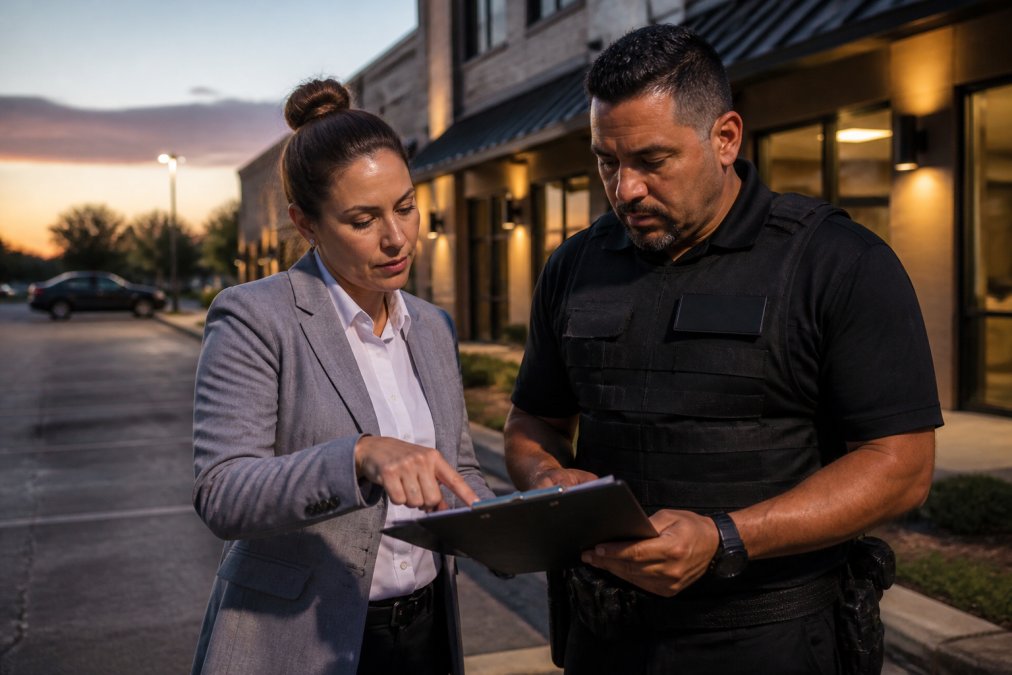
Private security guard hourly rates vary by region, service type, and contract length, with premiums for armed officers, overnight shifts, and short-term agreements. Because pricing depends on coverage hours, officer classification, and site requirements, request a quote for your property rather than relying on a generic rate card.
A few structural factors push rates up or down:
- Shift timing. Overnight and holiday coverage typically costs more than standard daytime hours.
- Officer classification. Armed officers command higher rates than unarmed officers because of additional training and licensing.
- Contract length. Short-term or one-off coverage usually carries a higher hourly rate than a 12-month agreement.
- Site complexity. Access control, multiple entry points, and camera monitoring add labor hours.
What Drives the Rate: Armed vs. Unarmed, Hours, and Location
Armed officers cost more than unarmed officers because of additional licensing, training hours, and insurance requirements. Location matters too: dense metro areas and high-crime zones push rates above rural markets. The biggest driver most owners underestimate is hours, not headcount, two unarmed officers on a 12-hour overnight rotation often cost more than one armed officer on an 8-hour shift.
Security Guard Licensing Requirements You Must Verify Before Hiring
Security guard licensing requirements exist at the state level, and every state sets its own training hours, background check standards, and license classifications. Before signing anything, verify that the company and every officer assigned to your property hold current, valid licenses for your state.
How to Check a Company's License and Insurance
Run this checklist before you sign a service agreement:
- Request the company's license number and the individual license numbers of every officer assigned to your site
- Verify each license against your state's official licensing database
- Ask for a current certificate of insurance showing general liability coverage limits
- Confirm workers' compensation coverage is active
- Request proof of completed background checks for assigned personnel
- Get the named supervisor for your account in writing
If a provider hesitates on any of these, that hesitation is your answer.
Armed vs Unarmed Security for Small Business: Which Fits Your Property?
Armed versus unarmed security for small business is a risk-classification decision, not a budget decision. The answer depends on what you protect, what threat you have documented, and what liability you can absorb. Most small properties land on unarmed coverage, but the reasoning matters more than the label.
What Unarmed Officers Actually Do
Unarmed officers handle the majority of small-property security work:
- Access control. Checking IDs, logging visitors, managing gate entry, and controlling key or fob distribution.
- Visible patrol. Walking or driving a route to create deterrence through presence.
- Incident reporting. Documenting trespass, loitering, property damage, or suspicious activity in a written report.
- Escort and lockup. Walking tenants to vehicles after hours, securing doors and gates at close.
- Rule enforcement. Enforcing parking rules, noise ordinances, or property-specific policies.
Unarmed officers cannot detain, search, or use force beyond what any private citizen may use in self-defense. Their authority comes from the property owner's delegation of control over private property, not police powers.
What Armed Officers Actually Do
Armed officers carry a firearm and hold a higher license classification. They are appropriate when the credible threat of armed response changes behavior:
- Cash-handling operations. Banks, check-cashing stores, dispensaries, and retail with high daily cash volume.
- High-value inventory. Jewelry, electronics, pharmaceuticals, or any property with a documented theft history.
- Documented violent incidents. Properties with prior armed robbery, assault, or credible threats against staff.
- Executive protection. Close protection for a specific individual rather than a fixed property.
The Decision Framework
Run your property through these questions before choosing:
- Is there a documented threat of violence? If police reports show armed incidents on or adjacent to your property, armed coverage is defensible. If not, unarmed is almost always right.
- Is there high-value cash or property on site? Cash-handling businesses and high-theft inventory justify armed coverage.
- What does your liability insurance say? Some commercial policies exclude or surcharge armed security. Call your broker first.
- What does your state require? Armed licensing varies widely, some states require psychological evaluation, extra training hours, and a separate permit. Confirm your provider holds the correct classification.
- Can you absorb the liability? An armed officer who uses force creates a liability chain that can reach the property owner. Unarmed coverage carries lower exposure.
The Cost Reality
Armed officers typically cost more per hour than unarmed officers because of licensing, training, insurance, and equipment. For most small commercial and residential properties, that premium is not justified by the actual threat profile.
The Middle Ground: Unarmed with Deterrent Presence
Many small properties get the deterrence benefit of armed coverage without the liability by using unarmed officers in marked uniforms and vehicles. That visible professional presence deters most opportunistic crime, the cost-effective answer for loitering, trespass, and package theft.
Contract Staffing vs. Direct Hire: What Small Properties Should Weigh
Contract staffing is the right default for most small properties. A security agency carries the licensing, insurance, training, and scheduling burden. Direct hire makes you the employer: payroll taxes, workers' compensation, scheduling gaps, and sick-call coverage.
| Factor | Contract Staffing | Direct Hire |
|---|---|---|
| Licensing burden | Agency holds it | You must verify it |
| Insurance | Agency carries it | You carry it |
| Shift coverage gaps | Agency backfills | You solve it |
| Cost per hour | Higher rate, lower overhead | Lower rate, higher overhead |
| Best for | Most small properties | Large, single-site operations |
Insurance, Liability, and What Homeowners and Small Property Owners Need to Know
Liability insurance is the piece small property owners most often overlook. Hiring a security provider isn't just buying patrol hours, it's transferring risk, and that transfer only works if the paperwork is real.
Technology Integration and Cultural Fit: The Overlooked Hiring Factors
Most guides on hiring security for small properties stop at licensing and cost. Two factors separate a contract that works from one that quietly fails: how the provider integrates with your existing technology, and whether the assigned officer fits your property's culture. Neither shows up on a rate card, and both determine whether you get value from the hours you pay for.
Technology Integration: What to Ask Before You Sign
If your property already has cameras, smart locks, or an alarm system, your security provider should integrate with them, not duplicate them. Ask these questions during vetting:
- Does the provider offer a client portal or mobile app? Real-time assignment tracking shows when an officer clocks in, what route they walked, and what incidents they logged. Without it, you rely on a monthly report that may be weeks old.
- How does the provider handle incident reporting? Digital reports with timestamps and photo attachments are standard; paper reports get lost and are hard to share with your insurer after a claim.
- Can the provider monitor your existing camera system? Some agencies offer remote video monitoring as an add-on, reducing on-site patrol hours. Others only provide physical officers. Know which you are buying.
- Does the provider use GPS-tracked patrol? GPS tracking creates a verifiable record of coverage; without it, you have no proof the officer walked the route you paid for.
- How does dispatch communicate with your on-site contact? A 24/7 dispatch line with a named account supervisor is the baseline. A shared email inbox is not.
Integrating Guards with Smart Home and CCTV Systems
For residential and small commercial properties, the highest-value integration is between human guards and existing technology:
- Camera-to-guard handoff. Your cameras detect motion; the guard responds, but only if the guard has a live feed or monitoring alert. Ask how the provider receives alerts from your system.
- Smart lock and access control integration. With keyless entry, the guard needs a way to grant or deny access without sharing master codes. Ask whether the provider works with your access control platform.
- Alarm response protocols. When your alarm triggers, does the guard respond directly, or does the monitoring company call the guard? Clarify the chain of response before an incident.
- Incident documentation tied to camera timestamps. A guard's report should reference the camera timestamp so you can pull matching footage, this matters for insurance claims and police reports.
Cultural Fit: Why Personality Matters More Than You Think
The right officer for a warehouse is not the right officer for a residential building. Cultural fit determines whether tenants, residents, or staff view the guard as an asset or a problem.
For residential properties and HOAs:
- Discretion is the top soft skill. Residents do not want their comings and goings discussed.
- Hospitality matters. A guard who greets residents by name and helps with small tasks creates goodwill. A guard who treats every resident as a suspect creates complaints.
- De-escalation skills are essential. Residential disputes over parking, noise, or pets are common. A guard who escalates minor conflicts creates liability.
For small commercial and retail properties:
- Deterrence presence matters more than hospitality. A guard who is visible and alert deters theft and loitering.
- Clear communication with staff is essential. The guard needs to coordinate with employees without creating friction.
- Report-writing quality is critical. Commercial incidents often lead to insurance claims or police reports, and a poorly written report undermines both.
For industrial and warehouse properties:
- Access control discipline is the priority. The guard must enforce entry rules consistently, even with familiar vendors or contractors.
- Physical stamina matters for large properties requiring foot patrol.
- Threat assessment skills matter more than customer service.
How to Evaluate Cultural Fit Before You Hire
Ask the provider these questions during the vetting process:
- How do you match officers to property types? A provider that ignores property type is not thinking about fit.
- What is your replacement process if an officer is not working out? The answer should include a specific timeline and a named supervisor who owns the decision.
- How do you screen for communication skills? Written incident reports are a core deliverable, ask to see a sample.
- Can I meet the assigned officer before the contract starts? Some providers allow this; others do not. It is worth asking.
- What is your escalation path when a resident or tenant complains? A documented process with a named contact is the baseline.
Conclusion
Small properties carry outsized risk: they attract the same threats as large ones without the resources to absorb them. Getting the hiring decision right means verifying licenses, matching officer classification to actual risk, understanding your liability exposure, and choosing a provider who can backfill a shift at 2 AM without a fight.
Frequently Asked Questions
How much does it cost to hire a security guard for a small property?
Cost depends on hours, armed or unarmed status, and location. Unarmed guards typically bill at a lower hourly rate than armed officers, and short shifts or overnight coverage often carry premiums. Rather than quoting a flat number, request a written proposal that breaks out the hourly rate, minimum shift length, and any scheduling fees. Ranger Operation Services publishes current pricing on its website, so you can compare before committing.
What is the difference between armed and unarmed security for small businesses?
Unarmed officers handle access control, patrols, incident reporting, and visible deterrence. Armed officers add a firearm and typically require a higher license class, more training, and higher liability coverage. Most small retail, office, and residential properties do well with unarmed guards. Armed protection makes more sense for high-value transport, cash handling, or sites with elevated threat levels. Match the officer type to the actual risk, not the image you want to project.
How do I verify the licensing of a private security company?
Ask for the company's license number and each officer's individual license class. In most states, the regulating agency, often the Department of Agriculture and Consumer Services or a state licensing board, maintains a public lookup. Confirm the license is active, matches the officer's name, and covers the services you're buying. Also request a certificate of insurance showing general liability coverage. A company that hesitates to share these documents is a red flag.
Is it better to hire in-house security or use a professional agency?
In-house means you handle recruiting, licensing, payroll, insurance, and scheduling yourself. An agency supplies vetted, licensed officers, covers liability insurance, and can staff gaps when someone calls out. For a small property with one or two buildings, an agency can offer benefits like reduced administrative overhead and legal exposure. Direct hire can work if you need full-time coverage and have the infrastructure to manage employment obligations.