
Customized Security Plans for Construction Sites
Customized security plans for construction sites: Build a customized security plan for your construction site. Learn perimeter protection, surveillance.
Table of Contents
- Why Construction Sites Need Customized Security Plans
- Assessing Your Site's Vulnerabilities and Risk Profile
- Essential Components of a Construction Site Security Checklist
- Construction Site Theft Prevention Strategies That Work
- Security Guard Deployment for Construction Projects
- Integrating Technology and Real-Time Monitoring
- Building Your Post-Incident Response Plan
- How Customized Plans Reduce Insurance Costs
- Frequently Asked Questions
Last Updated: September 26, 2026
Why Construction Sites Need Customized Security Plans
Construction sites face unique vulnerabilities that generic security approaches simply cannot address. Equipment theft, material loss, unauthorized access, and project delays cost contractors billions annually. A one-size-fits-all security strategy treats a high-rise development the same as a small residential renovation, which is why so many sites experience preventable losses.
Customized security plans for construction sites account for your specific layout, asset value, workforce composition, and operational timeline. They're built around what you're actually protecting, not what a standard checklist suggests. This precision matters because construction environments change constantly. The perimeter shifts as structures rise. Access points evolve. Staffing patterns fluctuate. A static security approach breaks down within weeks.
At Ranger Operation Services, we've worked with general contractors to develop security strategies that adapt to each project's reality. The difference between a site that experiences theft and one that doesn't often comes down to whether security was designed for that specific location or borrowed from somewhere else entirely.
Assessing Your Site's Vulnerabilities and Risk Profile
Before deploying any security measure, you need to understand what you're actually protecting against. A risk assessment identifies your specific vulnerabilities rather than assuming all construction sites face the same threats.
Start by mapping your site physically. Document entry and exit points, high-value equipment storage areas, material staging zones, and blind spots where visibility is limited. Note which areas are exposed to public roads or adjacent properties. Identify temporary structures versus permanent installations. This map becomes your security foundation.
Next, evaluate your asset profile. What's the total value of equipment on-site at any given time? Which items are most theft-prone (copper wiring, power tools, catalytic converters)? What materials have the longest lead times if stolen? This tells you where to concentrate security resources.
Consider your workforce dynamics. How many employees, subcontractors, and vendors access the site daily? Do shift changes create gaps in supervision? Are there areas where unauthorized personnel could blend in? Insider theft accounts for a significant portion of construction site losses, so understanding who has access and when matters.
Weather and seasonal factors also shape vulnerability. Winter darkness extends unmonitored hours. Rain or snow can disable certain monitoring systems. Holiday periods often see reduced staffing and increased risk. Your customized security plans for construction sites must account for these seasonal patterns.
Finally, review your project timeline. High-risk periods typically occur during early phases when perimeter security is incomplete, and during final phases when valuable fixtures are installed but permanent security systems aren't yet active.
Essential Components of a Construction Site Security Checklist
A comprehensive construction site security checklist ensures nothing falls through the cracks. This isn't a generic list, it's structured around the major security layers that protect construction operations.
Perimeter Security and Fencing
Your perimeter is your first line of defense against unauthorized access and theft. Temporary fencing should completely surround the work area, with no gaps or shortcuts around the boundary. Standard chain-link fencing is visible and cost-effective, but consider the height required for your site, taller fencing prevents climbing and signals serious security intent.
Secure all gates with heavy-duty locks and ensure they're monitored during operating hours. Gate access should be limited to authorized personnel only. If your site has multiple entry points, consolidate them to one or two monitored locations during non-working hours. This reduces the number of vulnerable access points you need to secure.
Fencing alone isn't enough. Pair it with signage that clearly marks the property as a restricted construction area. Signs should include emergency contact numbers and warning language about trespassing. Visible security measures deter casual theft and signal that the site is actively monitored. Integrating these physical deterrents into a broader strategy for securing commercial property ensures that every vulnerability is addressed before unauthorized access occurs.
Video Surveillance and Camera Systems
Surveillance cameras serve dual purposes: they deter theft and they provide evidence if incidents occur. For construction sites, cameras should cover all perimeter entry points, high-value equipment storage areas, and material staging zones.
Choose cameras rated for outdoor construction environments, they need to withstand dust, weather, and temperature fluctuations. High-resolution cameras capture detail necessary for identifying individuals or reading license plates. Night vision capability is essential since many thefts occur after hours.
Real-time monitoring is more effective than footage review after the fact. If budget allows, connect cameras to a live monitoring service so someone is actively watching during off-hours. If not, ensure footage is stored securely and reviewed regularly. Cloud storage protects footage from on-site theft or destruction.
Access Control and Sign-In Procedures
Controlled access is fundamental to preventing unauthorized entry. Implement a sign-in system that documents who enters the site, when, and for how long. This creates accountability and helps identify when unauthorized individuals were present.
For larger sites, consider biometric access systems or keycard readers that log every entry electronically. These systems eliminate the possibility of forged credentials and provide an audit trail. Rotate access codes frequently and revoke credentials for workers who leave the project.
Require visible identification badges for all personnel. This simple measure prevents strangers from walking onto the site unquestioned. Enforce badge requirements consistently, if supervision is lax, the system becomes useless.
Lighting and Motion Sensors
Darkness enables theft. Adequate lighting around the entire perimeter, particularly at entry points and equipment storage areas, dramatically reduces nighttime theft risk. Motion-activated lighting is cost-effective and signals activity if someone approaches the site after hours.
Place lighting strategically to eliminate shadows where someone could hide. Lights should illuminate both the perimeter and key interior zones. Solar-powered lighting options reduce electrical setup costs on temporary sites.
Motion sensors paired with alarms or notifications alert security personnel to after-hours activity. They're particularly valuable for detecting intruders attempting to bypass other security measures.
Construction Site Theft Prevention Strategies That Work
Theft prevention requires more than passive monitoring, it demands active deterrence and smart operational practices.
Secure high-value items in locked containers or cages within the site. Don't leave expensive tools, equipment, or materials visible and accessible. Copper wiring, catalytic converters, and power tools disappear quickly if left exposed. Create a secure storage area with controlled access and inventory tracking.
Implement strict tool checkout procedures. Require workers to sign out equipment and return it at end of shift. This prevents theft by employees and creates accountability if tools go missing. Regularly audit your tool inventory to catch discrepancies early.
Remove valuable materials from the site daily when possible. If overnight storage is necessary, secure it in locked containers or buildings. Schedule high-value deliveries to arrive during working hours when supervision is present.
Vary your security routines. Thieves watch for patterns. If your site is always unmonitored from midnight to 6 AM, that's when theft happens. Randomize patrol schedules and monitoring times. This unpredictability raises the risk profile for potential thieves and makes your site a less attractive target.
Document equipment serial numbers and take photographs. If theft occurs, this documentation helps with recovery and insurance claims. It also discourages organized theft rings that target specific equipment.
Security Guard Deployment for Construction Projects
Professional security personnel provide visible deterrence and active monitoring that technology alone cannot match. A uniformed guard presence signals that theft will be detected and responded to immediately.
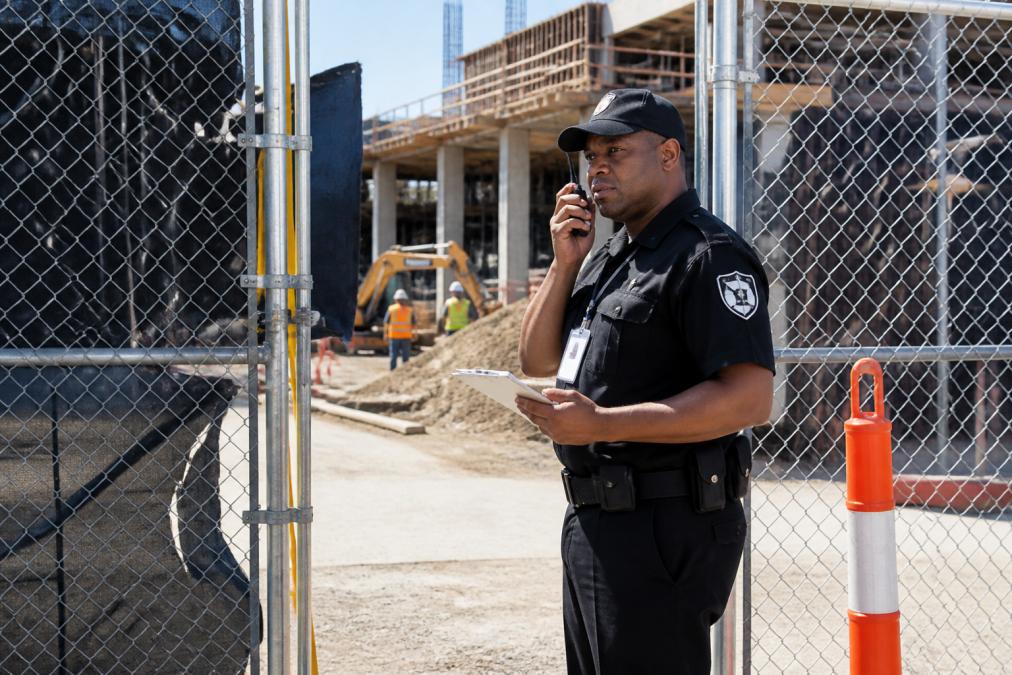
Determine guard coverage based on your site's risk profile and operational schedule. High-value sites or those in high-crime areas benefit from 24/7 coverage. Smaller projects might need guards during evening hours and weekends when theft risk peaks.
Position guards at primary entry points where they can control access and verify credentials.
Integrating Technology and Real-Time Monitoring
Modern security integrates multiple systems into a unified monitoring platform. Cameras, access controls, sensors, and alarms should communicate with a central system that alerts security personnel to issues in real time.
Building Your Post-Incident Response Plan
Even with strong preventive measures, incidents occasionally happen. A post-incident response plan ensures you react quickly and effectively when theft or unauthorized access occurs.
How Customized Plans Reduce Insurance Costs
Insurance companies recognize that well-designed security reduces loss frequency and severity. Many insurers offer premium discounts for documented security measures, depending on your coverage type and site risk profile.
Frequently Asked Questions
What are the essential components of a construction site security plan?
A comprehensive customized security plan for construction sites must address perimeter protection, video surveillance, access control, lighting, asset tracking, and incident response procedures. The plan should also include risk assessment findings specific to your site, security personnel deployment schedules, real-time monitoring protocols, and documented procedures for unauthorized access or theft. Each element should be tailored to your site's layout, materials stored, project timeline, and local theft patterns. A security checklist ensures nothing is overlooked during implementation and ongoing operations.
Why is a customized security plan more effective than a generic one?
Generic security plans fail to address your site's unique vulnerabilities. A customized plan accounts for your specific location, equipment value, site layout, access points, and theft patterns in your area. It prioritizes the threats that matter most to your project, whether that's organized equipment theft, copper wire theft, or unauthorized access. Customized plans also align security protocols with your project timeline, budget, and operational workflow, making guards and systems work efficiently rather than creating friction with your crews. This targeted approach reduces both theft losses and unnecessary security spending.
How can technology improve construction site security?
Modern security technology enables real-time monitoring, automated alerts, and detailed incident documentation. Connected camera systems with cloud storage allow remote site viewing 24/7, reducing reliance on constant on-site personnel. Motion-activated lighting deters nighttime theft, while access control systems log every entry and exit with timestamps. Mobile apps provide instant notifications of unauthorized access or sensor triggers, allowing rapid response. Asset tracking tags help recover stolen equipment and prove ownership. Integrating these technologies with professional security personnel creates layered protection that's harder for thieves to defeat and provides evidence for insurance claims and law enforcement.
What role do armed and unarmed guards play in a construction site security plan?
Unarmed guards provide visible deterrence, manage access control, conduct site patrols, and document incidents through daily reports. Armed guards add escalation capability for high-risk sites or valuable material storage, providing authority to intervene in active theft or trespassing. Both roles include real-time communication with dispatch, immediate incident reporting, and evidence preservation. Guard presence alone reduces theft on most construction sites because thieves avoid confrontation. Professional guards also monitor for safety hazards, coordinate with law enforcement when needed, and provide testimony if incidents escalate to legal action. Your customized plan determines which type and deployment schedule fits your risk profile.